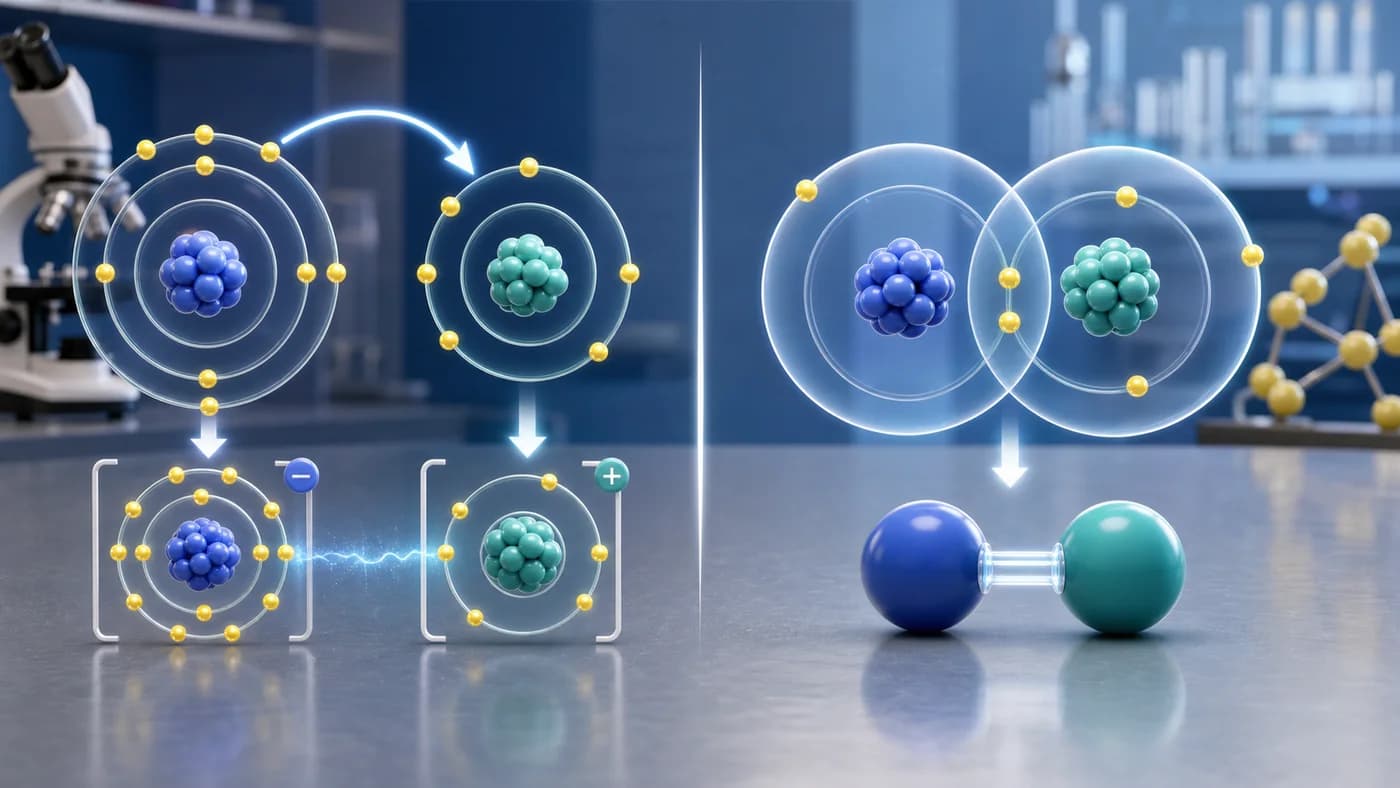
Bonding comparison model
Use these labels to connect structure, observation, and reasoning in bonding comparison.- 1Metal + non-metal -> Ionic: usually gives
- 2Non-metal + non-metal -> Covalent: usually gives
Checking progress account…
Opening your study space…
Lesson
Chemical bonding explains how atoms combine by transferring or sharing electrons to achieve stable arrangements. The main bonding types here are ionic and covalent.
Learning objectives
Explain Chemical Bonding using correct Grade 9 Chemistry terms.
Use observation, formula, symbol, or equation as evidence.
Connect the evidence to the exact chemical conclusion or classification.
Lesson
Ready to check what you remember?
Continue to revisionStudy path
Notes
Review the compact notes before moving into recall.
Open notesShowing 4 of 5 notes.
Diagrams

Practice
Choose one small set. The full bank opens only inside the practice session.
In this chapter
Now on Chemical Bonding. Next up: Periodic Classification.
Lesson progress
Save this lesson when done. Next: Periodic Classification.
Keep moving