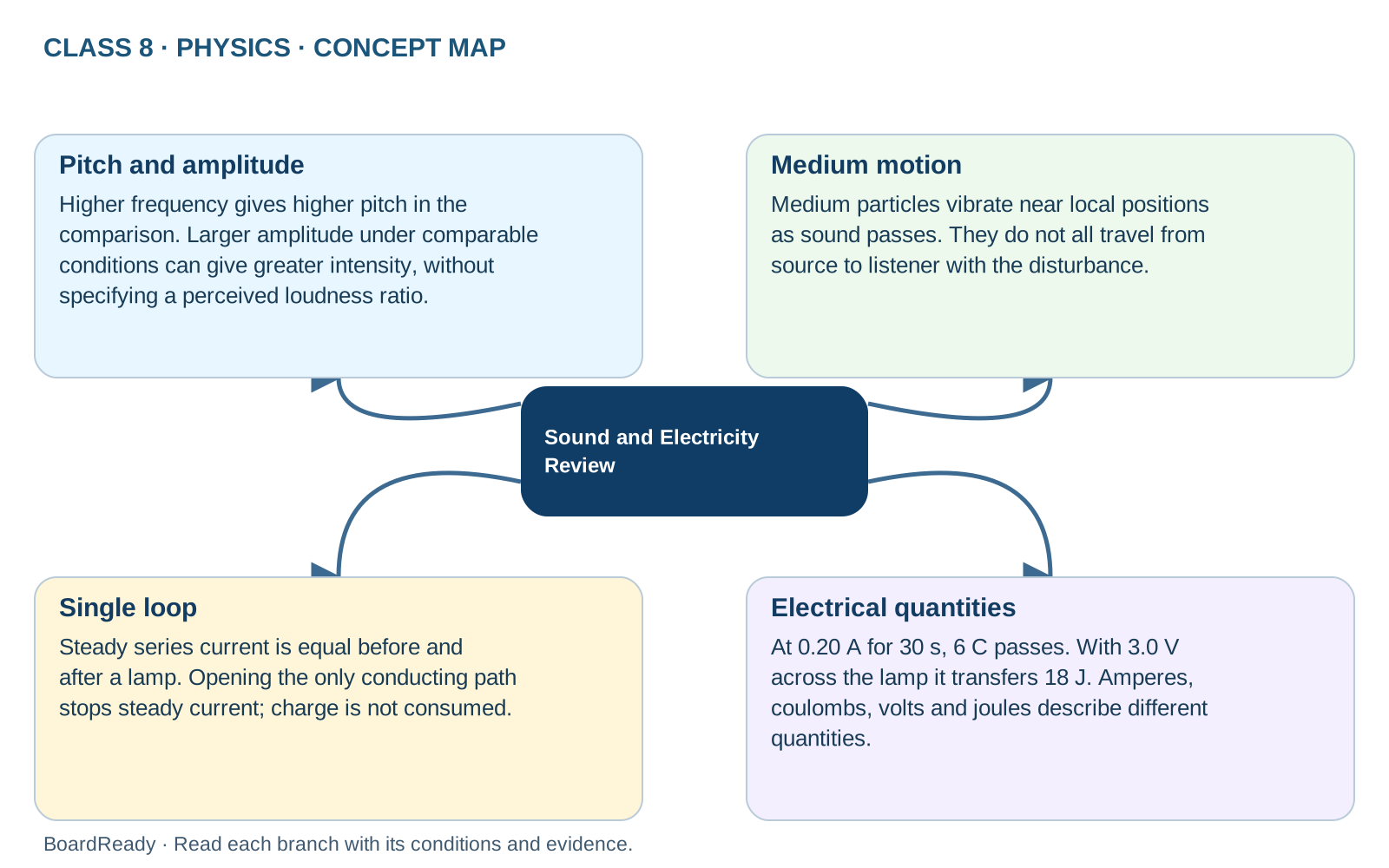
Comparison map
Sound and Electricity Review: relationships and examples
Keep vibration comparisons separate from charge and electrical energy accounting.Exam cue: Choose frequency, amplitude, current or potential difference to match the evidence.
- 1Sound and Electricity Review -> Pitch and amplitude: Higher frequency gives higher pitch in the comparison. Larger amplitude under comparable conditions can give greater intensity, without specifying a perceived loudness ratio.
- 2Sound and Electricity Review -> Medium motion: Medium particles vibrate near local positions as sound passes. They do not all travel from source to listener with the disturbance.
- 3Sound and Electricity Review -> Single loop: Steady series current is equal before and after a lamp. Opening the only conducting path stops steady current; charge is not consumed.
- 4Sound and Electricity Review -> Electrical quantities: At 0.20 A for 30 s, 6 C passes. With 3.0 V across the lamp it transfers 18 J. Amperes, coulombs, volts and joules describe different quantities.