Comparison map
Refraction and Dispersion: relationships and examples
Use medium, normal and wavelength to explain distinct optical effects.Exam cue: Separate speed change, direction change and wavelength separation.
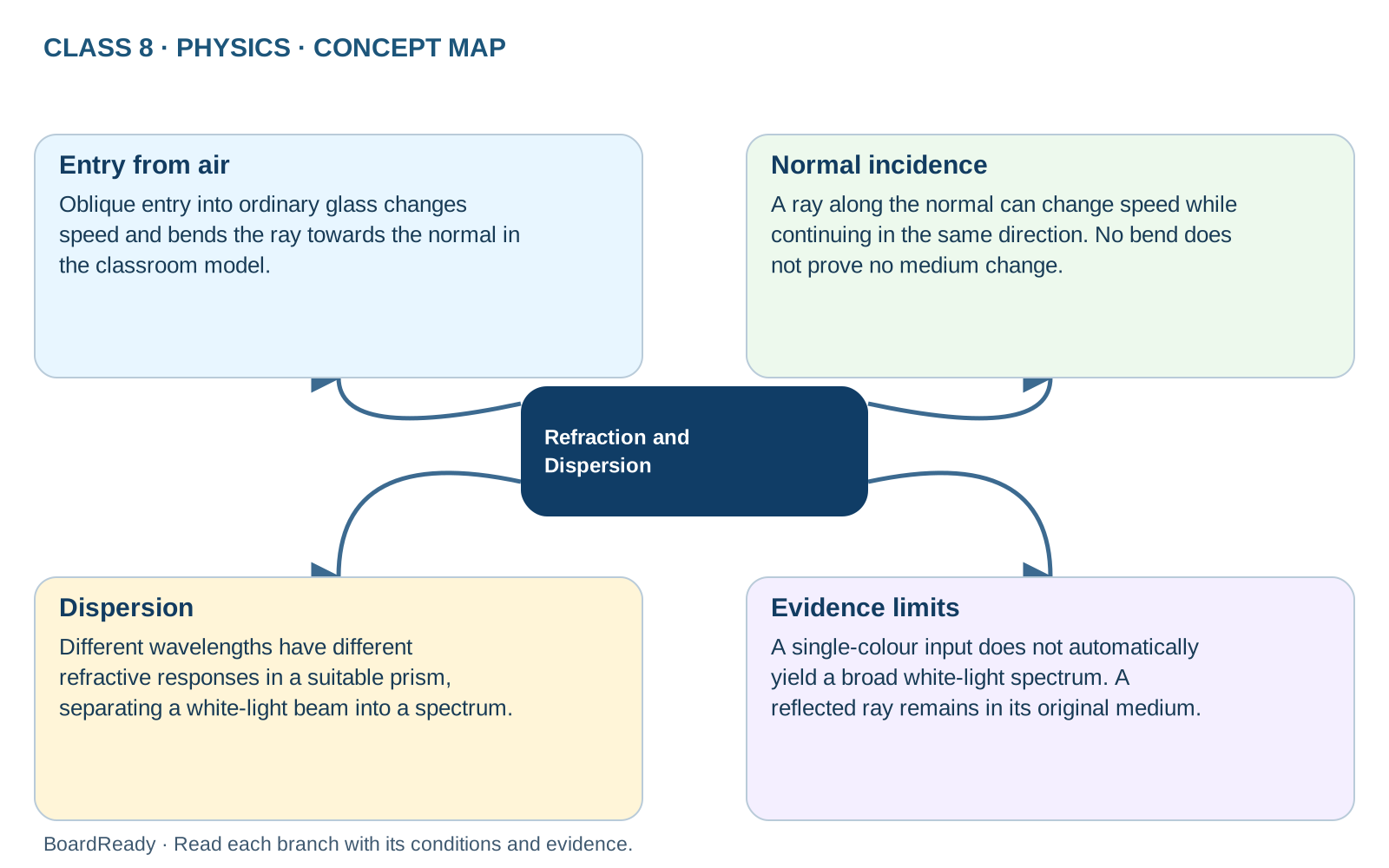
- 1Refraction and Dispersion -> Entry from air: Oblique entry into ordinary glass changes speed and bends the ray towards the normal in the classroom model.
- 2Refraction and Dispersion -> Normal incidence: A ray along the normal can change speed while continuing in the same direction. No bend does not prove no medium change.
- 3Refraction and Dispersion -> Dispersion: Different wavelengths have different refractive responses in a suitable prism, separating a white-light beam into a spectrum.
- 4Refraction and Dispersion -> Evidence limits: A single-colour input does not automatically yield a broad white-light spectrum. A reflected ray remains in its original medium.