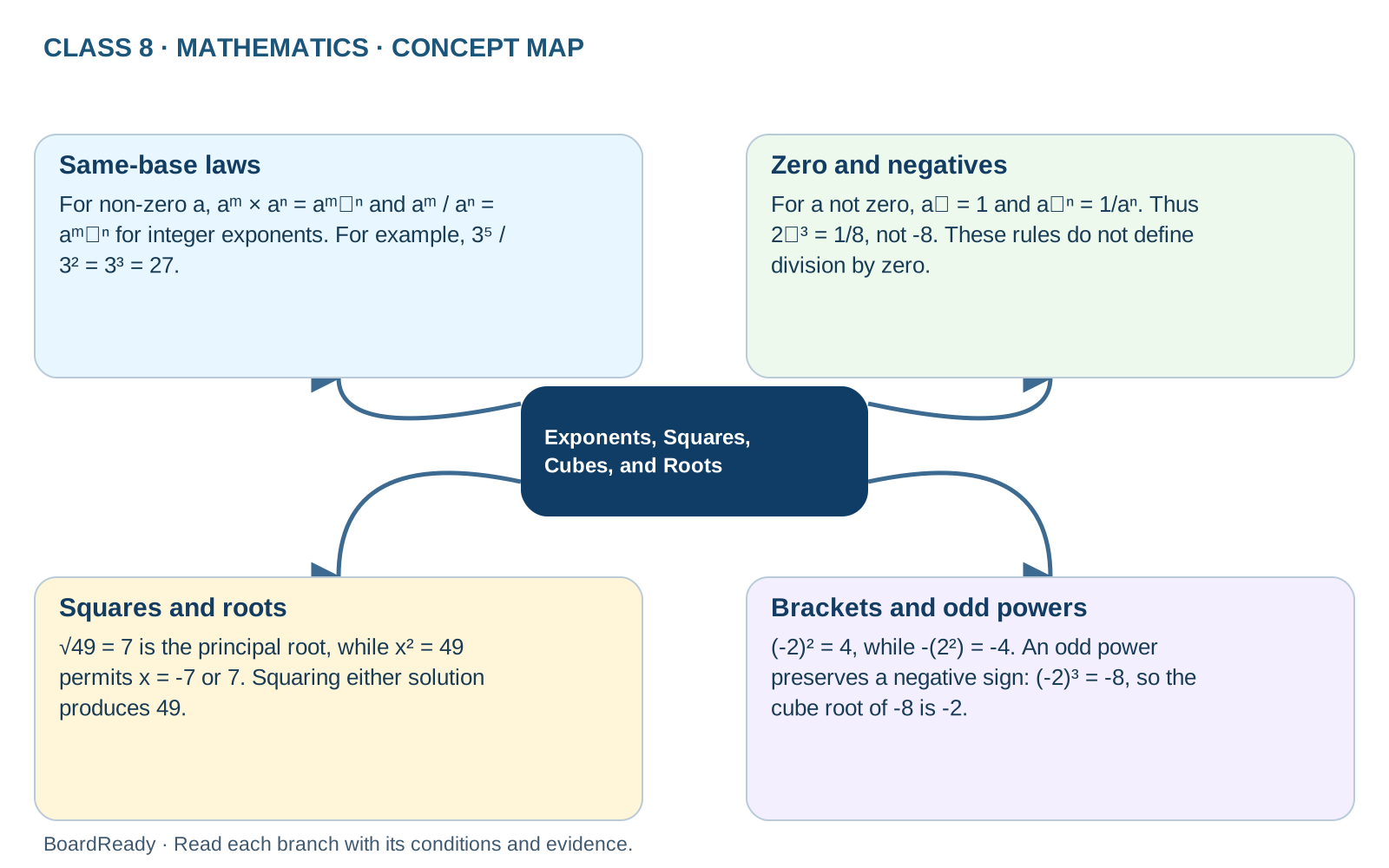
Comparison map
Exponents, Squares, Cubes, and Roots: relationships and examples
Connect repeated multiplication to exponent laws and distinguish inverse operations from solving equations.Exam cue: A negative exponent changes reciprocal position, not the sign of the base.
- 1Exponents, Squares, Cubes, and Roots -> Same-base laws: For non-zero a, aᵐ × aⁿ = aᵐ⁺ⁿ and aᵐ / aⁿ = aᵐ⁻ⁿ for integer exponents. For example, 3⁵ / 3² = 3³ = 27.
- 2Exponents, Squares, Cubes, and Roots -> Zero and negatives: For a not zero, a⁰ = 1 and a⁻ⁿ = 1/aⁿ. Thus 2⁻³ = 1/8, not -8. These rules do not define division by zero.
- 3Exponents, Squares, Cubes, and Roots -> Squares and roots: √49 = 7 is the principal root, while x² = 49 permits x = -7 or 7. Squaring either solution produces 49.
- 4Exponents, Squares, Cubes, and Roots -> Brackets and odd powers: (-2)² = 4, while -(2²) = -4. An odd power preserves a negative sign: (-2)³ = -8, so the cube root of -8 is -2.