Comparison map
States of Matter: relationships and examples
Use arrangement and movement to explain shape and volume in three common states.Exam cue: Compare equal particle counts, not the apparent size of the coloured dots.
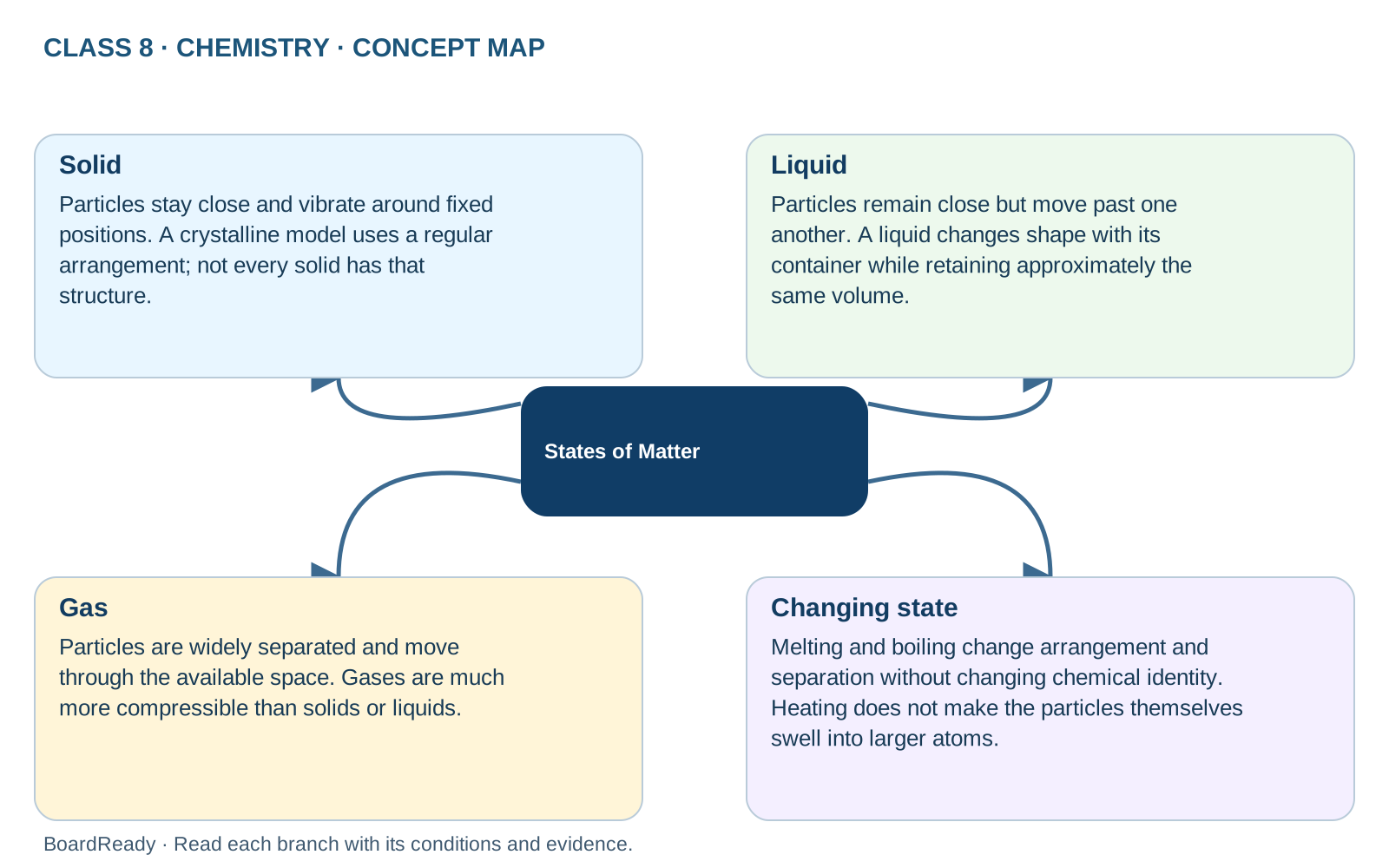
- 1States of Matter -> Solid: Particles stay close and vibrate around fixed positions. A crystalline model uses a regular arrangement; not every solid has that structure.
- 2States of Matter -> Liquid: Particles remain close but move past one another. A liquid changes shape with its container while retaining approximately the same volume.
- 3States of Matter -> Gas: Particles are widely separated and move through the available space. Gases are much more compressible than solids or liquids.
- 4States of Matter -> Changing state: Melting and boiling change arrangement and separation without changing chemical identity. Heating does not make the particles themselves swell into larger atoms.