Comparison map
Water, Solutions, and Pollution: relationships and examples
Connect dissolving, mass concentration and the limits of visual water inspection.Exam cue: Use the mass of the complete solution in a mass-percentage calculation.
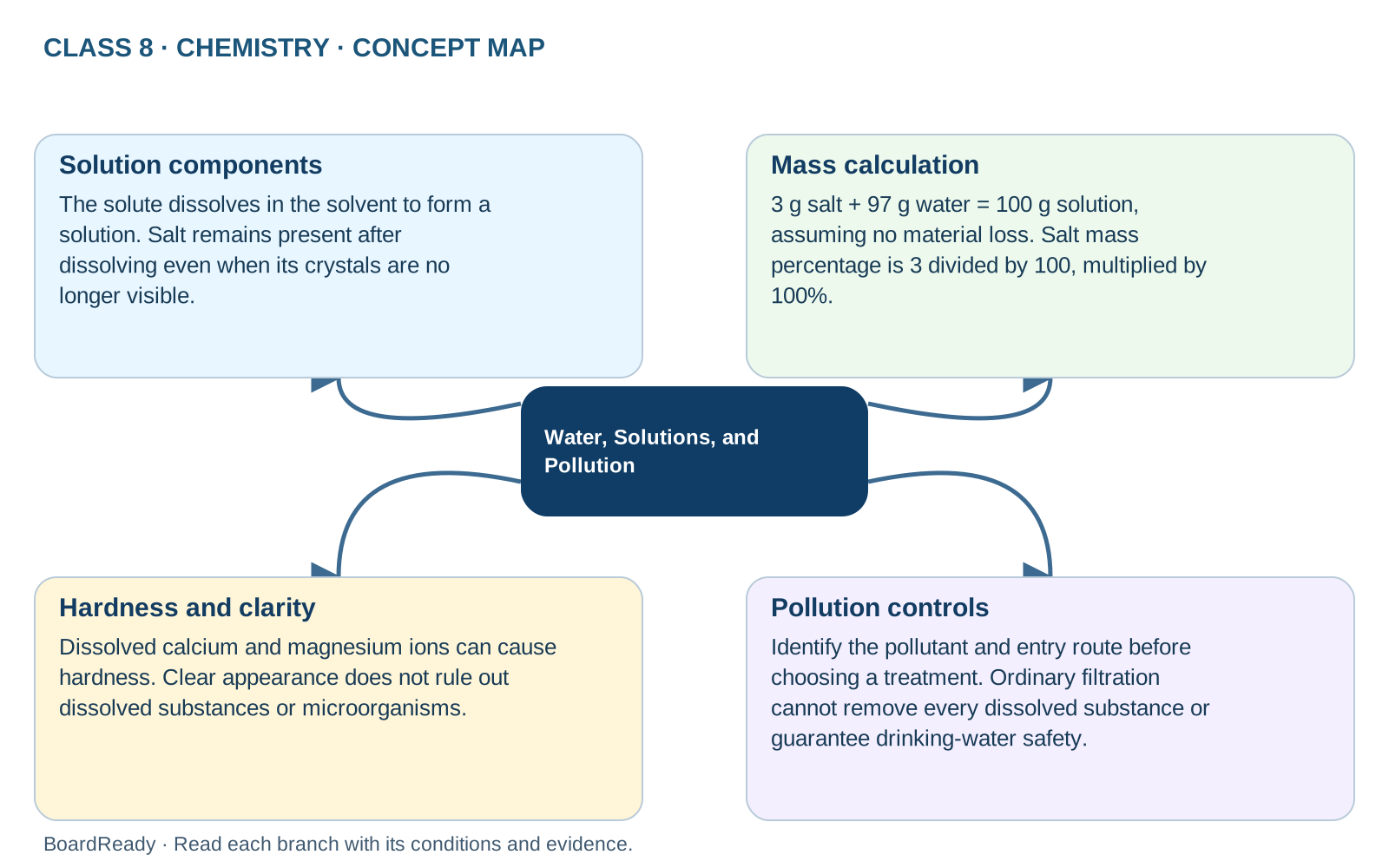
- 1Water, Solutions, and Pollution -> Solution components: The solute dissolves in the solvent to form a solution. Salt remains present after dissolving even when its crystals are no longer visible.
- 2Water, Solutions, and Pollution -> Mass calculation: 3 g salt + 97 g water = 100 g solution, assuming no material loss. Salt mass percentage is 3 divided by 100, multiplied by 100%.
- 3Water, Solutions, and Pollution -> Hardness and clarity: Dissolved calcium and magnesium ions can cause hardness. Clear appearance does not rule out dissolved substances or microorganisms.
- 4Water, Solutions, and Pollution -> Pollution controls: Identify the pollutant and entry route before choosing a treatment. Ordinary filtration cannot remove every dissolved substance or guarantee drinking-water safety.