Comparison map
Physical vs Chemical Change: relationships and examples
Classify changes by substance identity and account for material crossing the boundary.Exam cue: New substances distinguish a chemical change; reversibility alone does not.
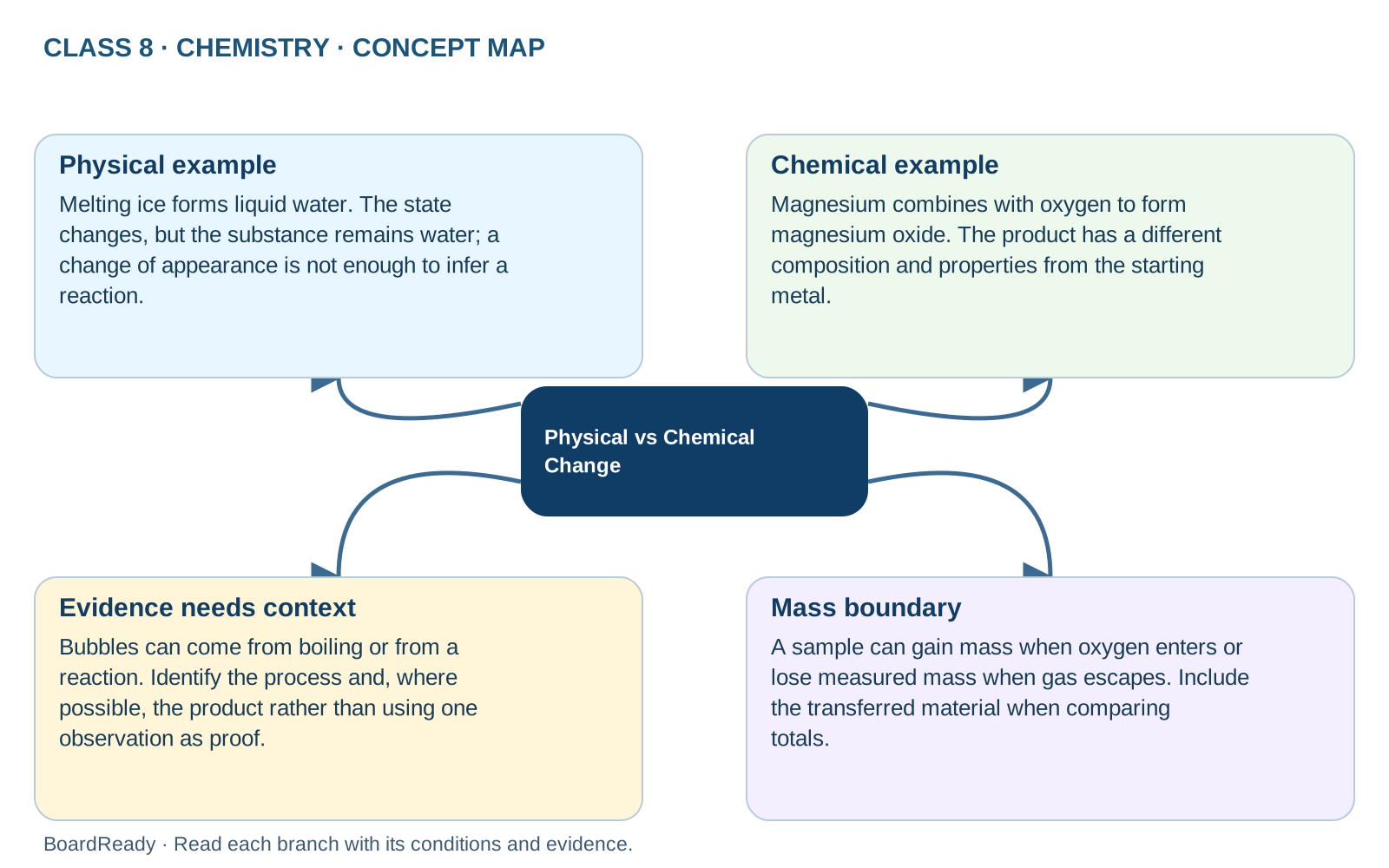
- 1Physical vs Chemical Change -> Physical example: Melting ice forms liquid water. The state changes, but the substance remains water; a change of appearance is not enough to infer a reaction.
- 2Physical vs Chemical Change -> Chemical example: Magnesium combines with oxygen to form magnesium oxide. The product has a different composition and properties from the starting metal.
- 3Physical vs Chemical Change -> Evidence needs context: Bubbles can come from boiling or from a reaction. Identify the process and, where possible, the product rather than using one observation as proof.
- 4Physical vs Chemical Change -> Mass boundary: A sample can gain mass when oxygen enters or lose measured mass when gas escapes. Include the transferred material when comparing totals.