Comparison map
Valency and Formulae: relationships and examples
Use neutral charge totals and intact groups to check an ionic formula.Exam cue: A criss-cross shortcut must be followed by charge and atom-count checks.
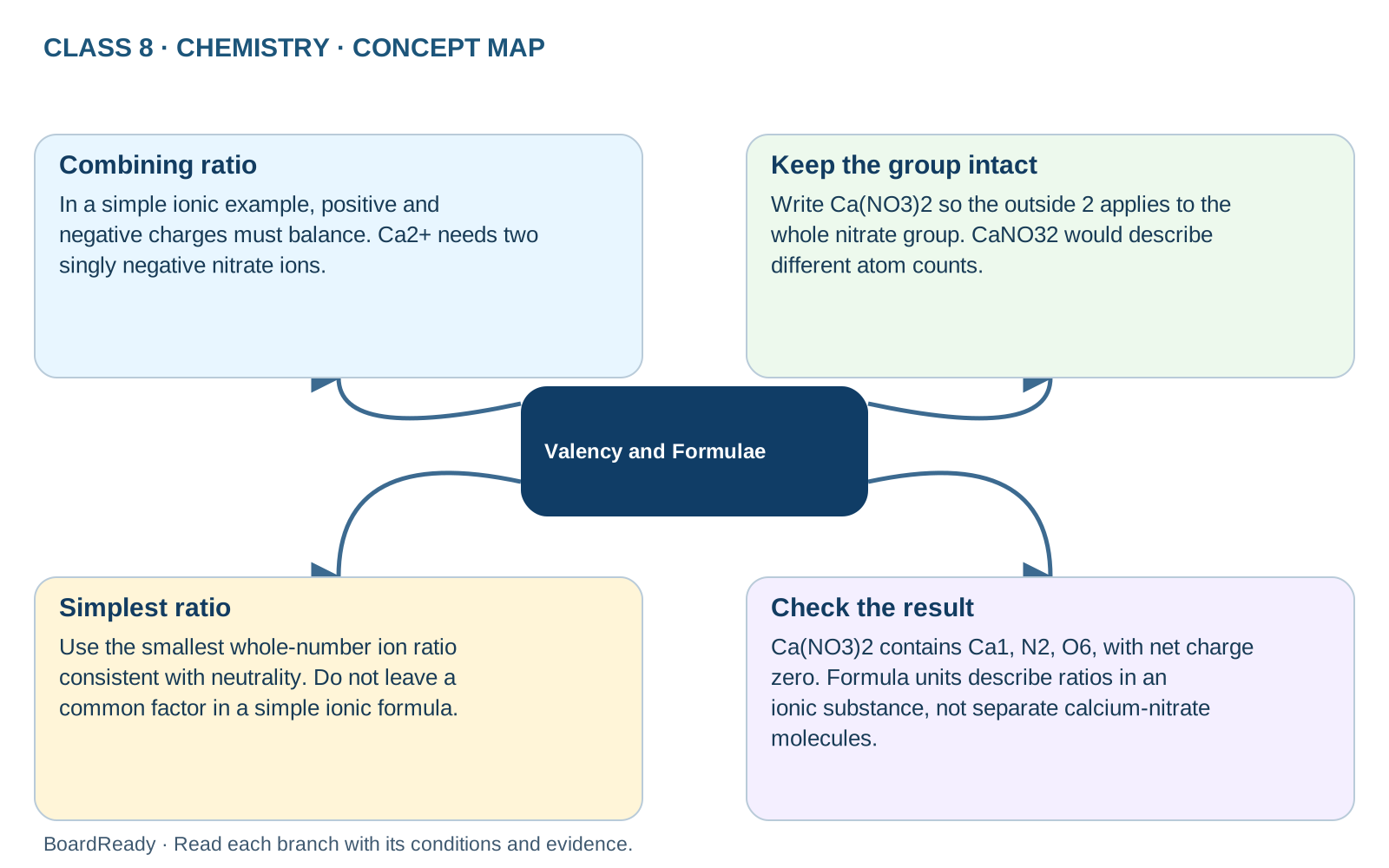
- 1Valency and Formulae -> Combining ratio: In a simple ionic example, positive and negative charges must balance. Ca2+ needs two singly negative nitrate ions.
- 2Valency and Formulae -> Keep the group intact: Write Ca(NO₃)₂ so the outside 2 applies to the whole nitrate group. CaNO₃₂ would describe different atom counts.
- 3Valency and Formulae -> Simplest ratio: Use the smallest whole-number ion ratio consistent with neutrality. Do not leave a common factor in a simple ionic formula.
- 4Valency and Formulae -> Check the result: Ca(NO₃)₂ contains Ca₁, N₂, O₆, with net charge zero. Formula units describe ratios in an ionic substance, not separate calcium-nitrate molecules.