Comparison map
Absorption by Roots: relationships and examples
Use membrane conditions to explain net water movement rather than treating roots as straws.Exam cue: State the membrane and gradient; do not infer direction from surface area alone.
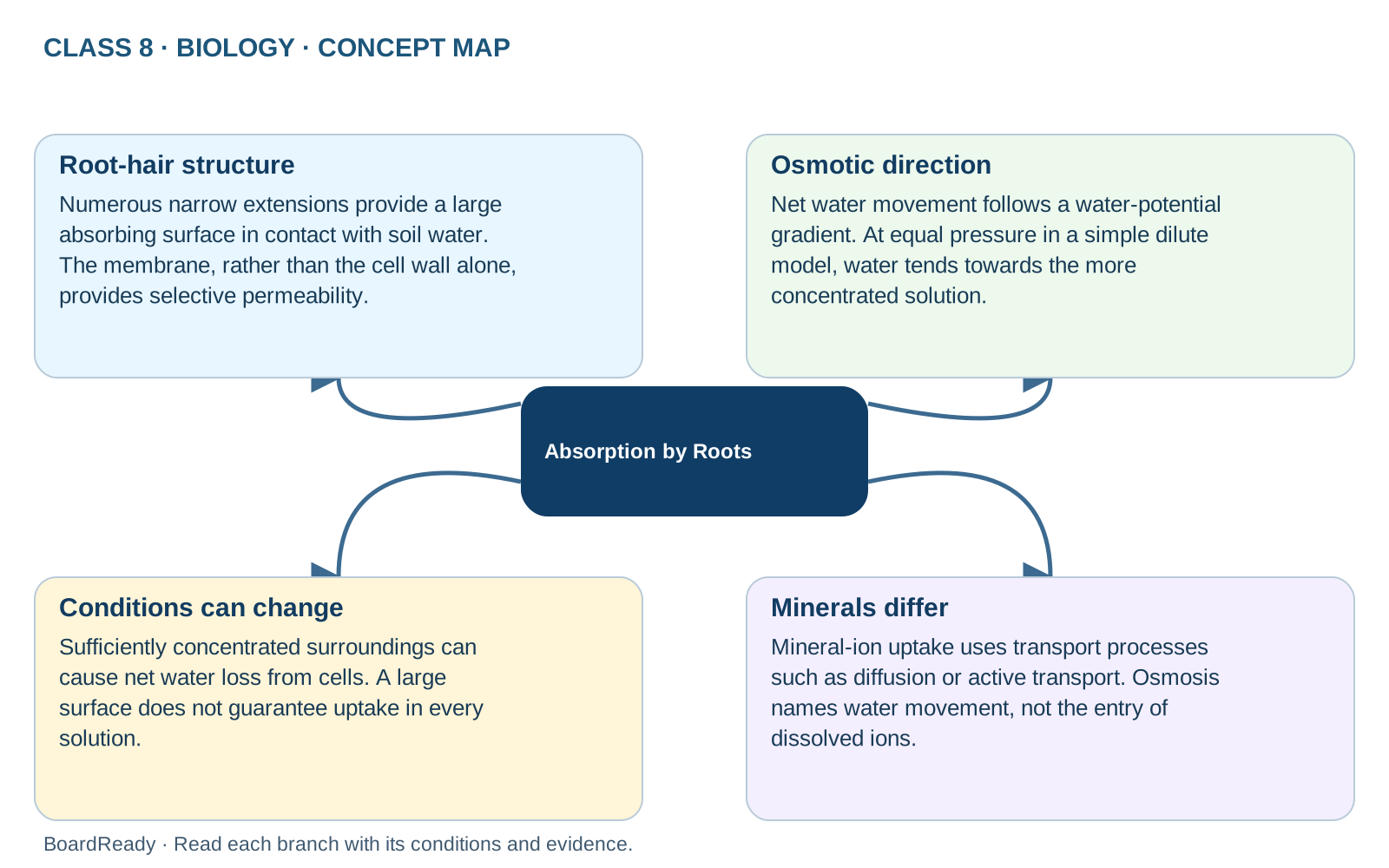
- 1Absorption by Roots -> Root-hair structure: Numerous narrow extensions provide a large absorbing surface in contact with soil water. The membrane, rather than the cell wall alone, provides selective permeability.
- 2Absorption by Roots -> Osmotic direction: Net water movement follows a water-potential gradient. At equal pressure in a simple dilute model, water tends towards the more concentrated solution.
- 3Absorption by Roots -> Conditions can change: Sufficiently concentrated surroundings can cause net water loss from cells. A large surface does not guarantee uptake in every solution.
- 4Absorption by Roots -> Minerals differ: Mineral-ion uptake uses transport processes such as diffusion or active transport. Osmosis names water movement, not the entry of dissolved ions.