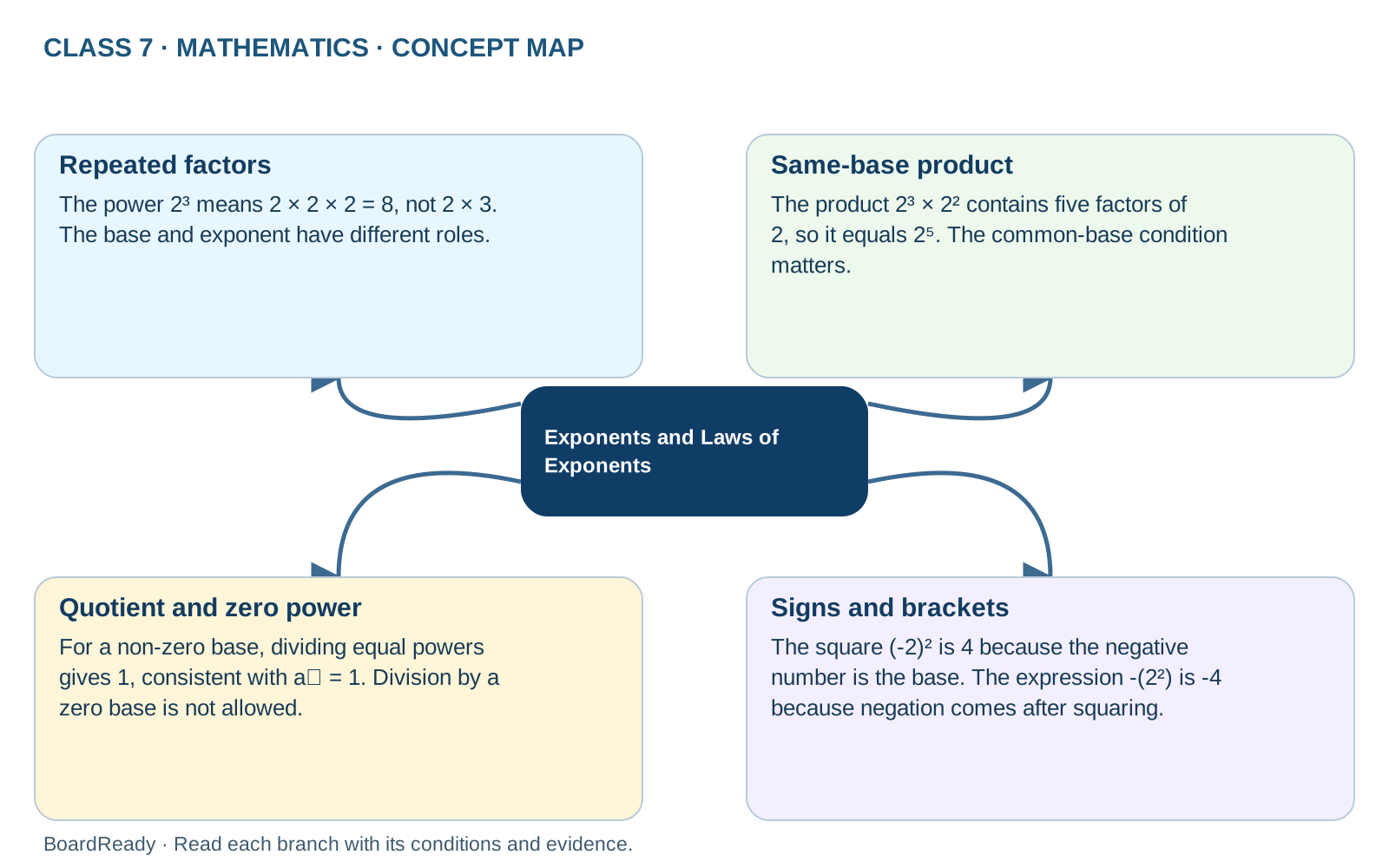
Comparison map
Exponents and Laws of Exponents: relationships and examples
Connect repeated multiplication with exponent laws and their conditions.Exam cue: Do not apply multiplication laws to addition: 2³ + 2² = 12, not 32.
- 1Exponents and Laws of Exponents -> Repeated factors: The power 2³ means 2 × 2 × 2 = 8, not 2 × 3. The base and exponent have different roles.
- 2Exponents and Laws of Exponents -> Same-base product: The product 2³ × 2² contains five factors of 2, so it equals 2⁵. The common-base condition matters.
- 3Exponents and Laws of Exponents -> Quotient and zero power: For a non-zero base, dividing equal powers gives 1, consistent with a⁰ = 1. Division by a zero base is not allowed.
- 4Exponents and Laws of Exponents -> Signs and brackets: The square (-2)² is 4 because the negative number is the base. The expression -(2²) is -4 because negation comes after squaring.