Comparison map
Representing 3-D in 2-D: relationships and examples
Use nets, views and hidden-edge conventions to reason about three-dimensional solids.Exam cue: Distinguish the solid from the conventions used to draw it.
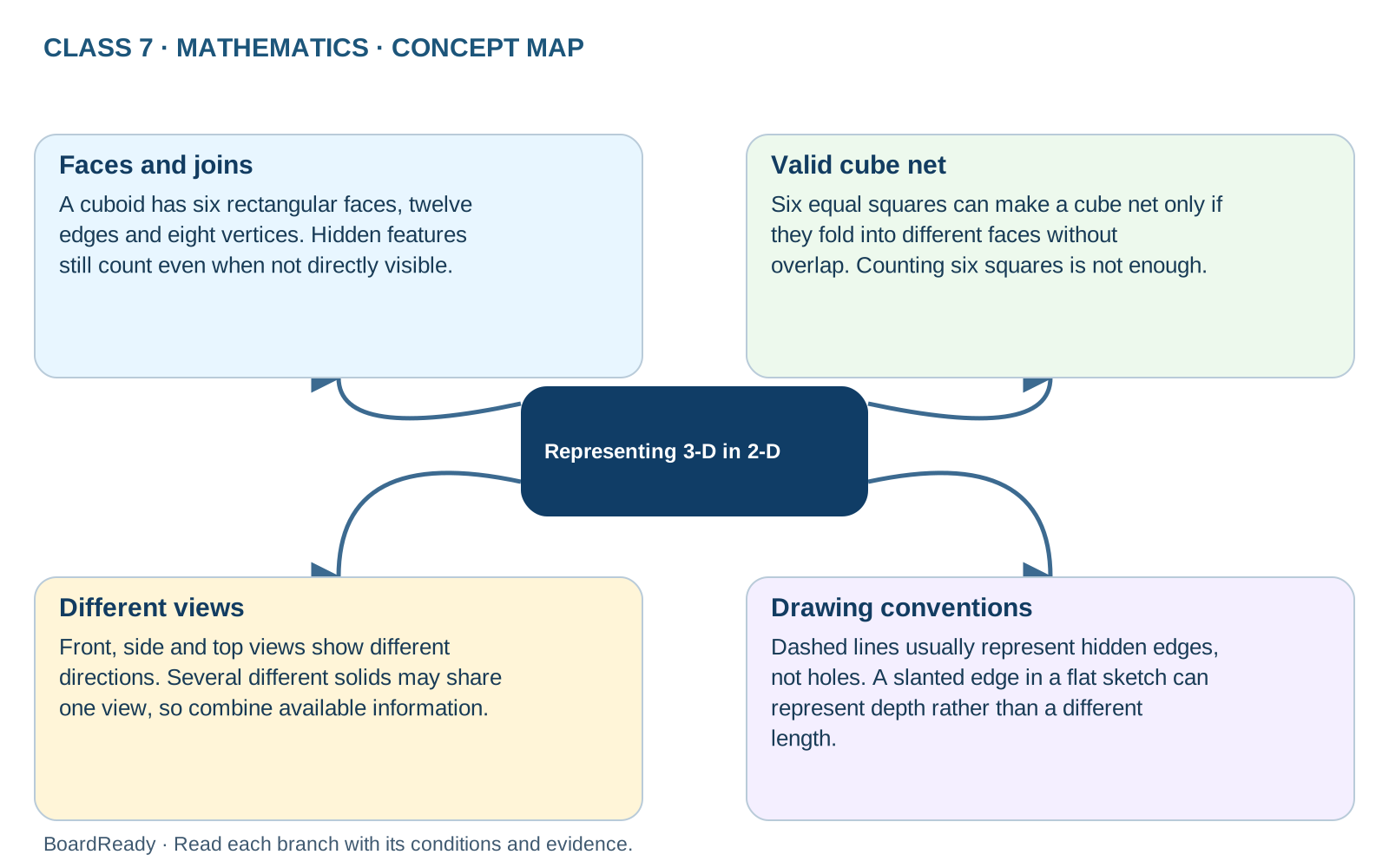
- 1Representing 3-D in 2-D -> Faces and joins: A cuboid has six rectangular faces, twelve edges and eight vertices. Hidden features still count even when not directly visible.
- 2Representing 3-D in 2-D -> Valid cube net: Six equal squares can make a cube net only if they fold into different faces without overlap. Counting six squares is not enough.
- 3Representing 3-D in 2-D -> Different views: Front, side and top views show different directions. Several different solids may share one view, so combine available information.
- 4Representing 3-D in 2-D -> Drawing conventions: Dashed lines usually represent hidden edges, not holes. A slanted edge in a flat sketch can represent depth rather than a different length.