Comparison map
Probability and Randomness: relationships and examples
Use an explicit sample space and equal-likelihood assumption to calculate theoretical probability.Exam cue: Counting favourable over total outcomes needs the equal-likelihood condition.
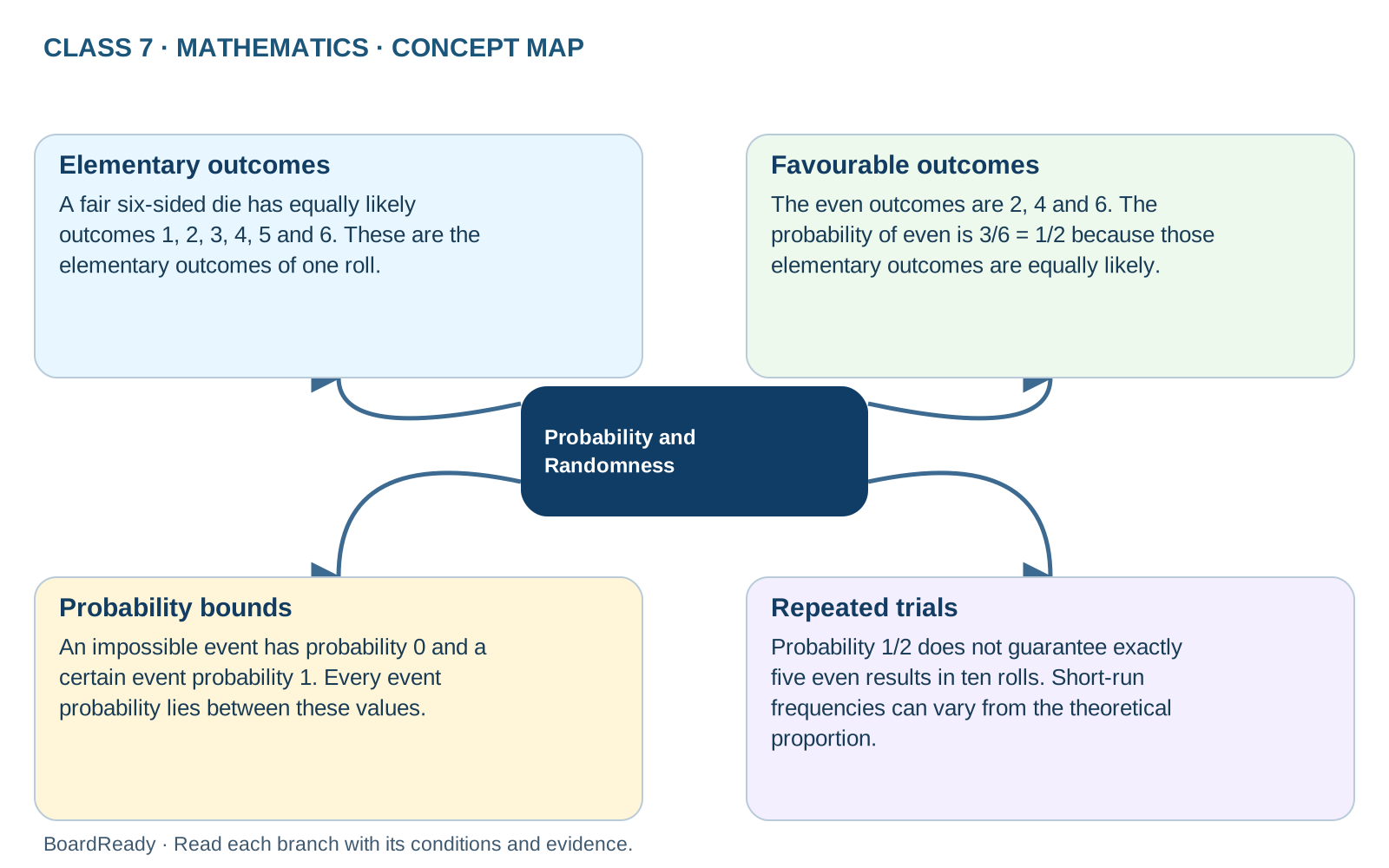
- 1Probability and Randomness -> Elementary outcomes: A fair six-sided die has equally likely outcomes 1, 2, 3, 4, 5 and 6. These are the elementary outcomes of one roll.
- 2Probability and Randomness -> Favourable outcomes: The even outcomes are 2, 4 and 6. The probability of even is 3/6 = 1/2 because those elementary outcomes are equally likely.
- 3Probability and Randomness -> Probability bounds: An impossible event has probability 0 and a certain event probability 1. Every event probability lies between these values.
- 4Probability and Randomness -> Repeated trials: Probability 1/2 does not guarantee exactly five even results in ten rolls. Short-run frequencies can vary from the theoretical proportion.