Comparison map
Valency: concepts and evidence
Build simple formulae using combining capacity, charge balance and the lowest whole-number ratio.Exam cue: Use the valencies or charges supplied; some elements can have more than one valency.
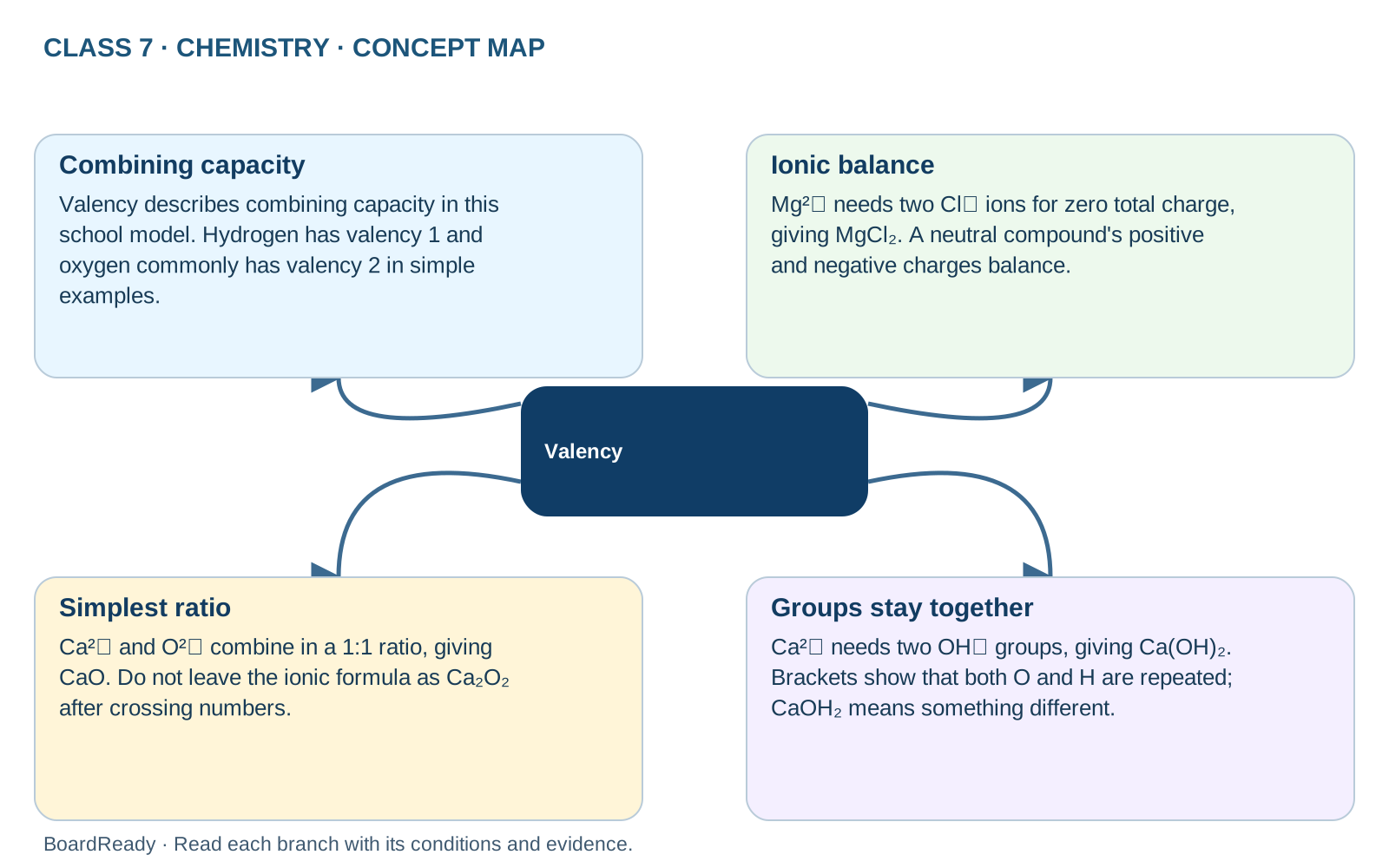
- 1Valency -> Combining capacity: Valency describes combining capacity in this school model. Hydrogen has valency 1 and oxygen commonly has valency 2 in simple examples.
- 2Valency -> Ionic balance: Mg²⁺ needs two Cl⁻ ions for zero total charge, giving MgCl₂. A neutral compound's positive and negative charges balance.
- 3Valency -> Simplest ratio: Ca²⁺ and O²⁻ combine in a 1:1 ratio, giving CaO. Do not leave the ionic formula as Ca₂O₂ after crossing numbers.
- 4Valency -> Groups stay together: Ca²⁺ needs two OH⁻ groups, giving Ca(OH)₂. Brackets show that both O and H are repeated; CaOH₂ means something different.