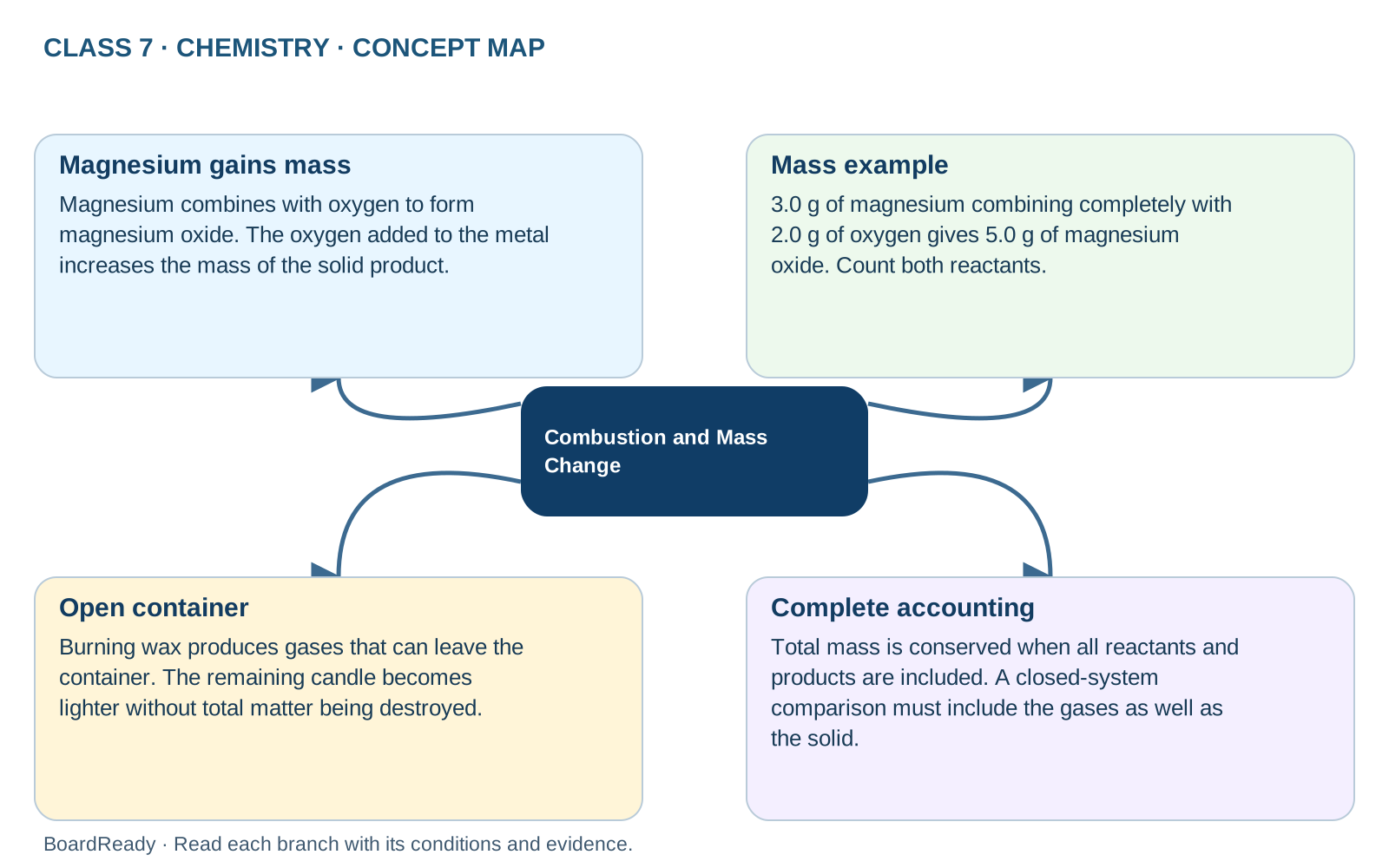
Comparison map
Combustion and Mass Change: concepts and evidence
Track gases across the system boundary to explain apparent mass gains and losses during burning.Exam cue: State whether the measurement covers the remaining sample or the whole system.
- 1Combustion and Mass Change -> Magnesium gains mass: Magnesium combines with oxygen to form magnesium oxide. The oxygen added to the metal increases the mass of the solid product.
- 2Combustion and Mass Change -> Mass example: 3.0 g of magnesium combining completely with 2.0 g of oxygen gives 5.0 g of magnesium oxide. Count both reactants.
- 3Combustion and Mass Change -> Open container: Burning wax produces gases that can leave the container. The remaining candle becomes lighter without total matter being destroyed.
- 4Combustion and Mass Change -> Complete accounting: Total mass is conserved when all reactants and products are included. A closed-system comparison must include the gases as well as the solid.