Comparison map
Matter and Particle Model: concepts and evidence
Matter has mass and occupies space. A simple particle model helps explain why gases spread out and why materials can change state.Exam cue: Visibility is not the test. Air and many other gases have mass and occupy space despite being invisible under ordinary conditions.
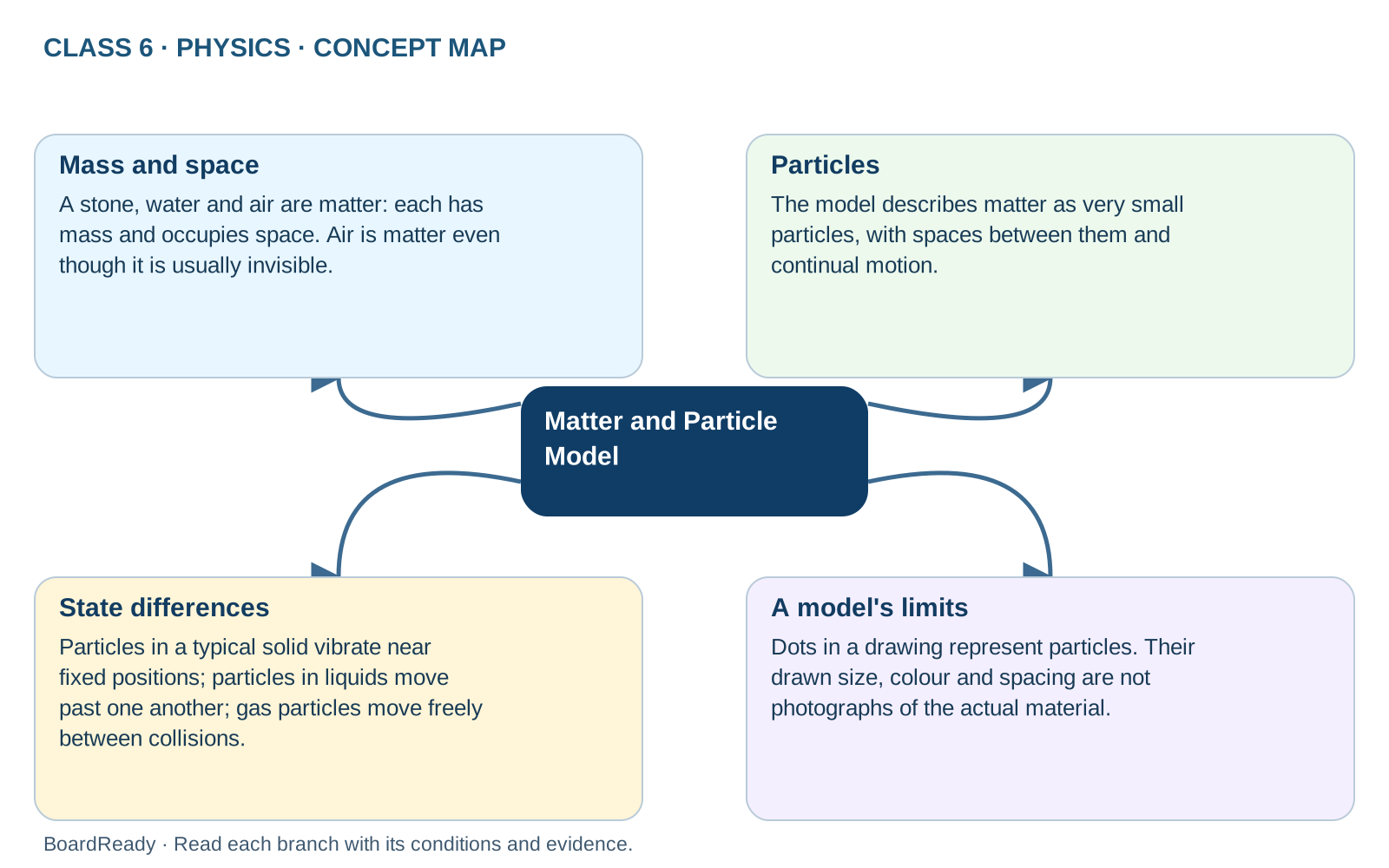
- 1Matter and Particle Model -> Mass and space: A stone, water and air are matter: each has mass and occupies space. Air is matter even though it is usually invisible.
- 2Matter and Particle Model -> Particles: The model describes matter as very small particles, with spaces between them and continual motion.
- 3Matter and Particle Model -> State differences: Particles in a typical solid vibrate near fixed positions; particles in liquids move past one another; gas particles move freely between collisions.
- 4Matter and Particle Model -> A model's limits: Dots in a drawing represent particles. Their drawn size, colour and spacing are not photographs of the actual material.