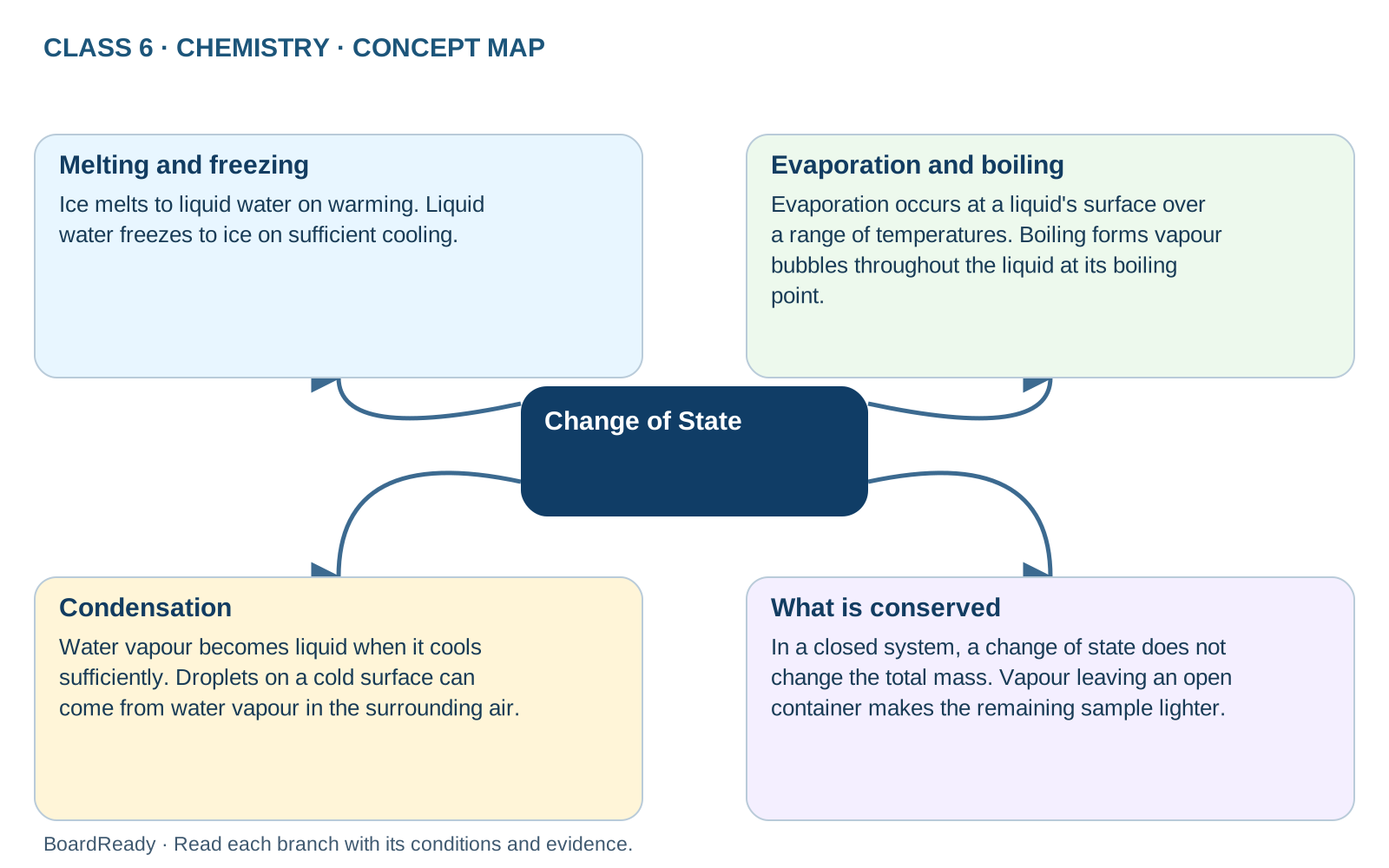
Comparison map
Change of State: concepts and evidence
Heating and cooling can change water's state while its chemical identity stays the same.Exam cue: Invisible water vapour is gas; a visible white mist contains tiny liquid droplets.
- 1Change of State -> Melting and freezing: Ice melts to liquid water on warming. Liquid water freezes to ice on sufficient cooling.
- 2Change of State -> Evaporation and boiling: Evaporation occurs at a liquid's surface over a range of temperatures. Boiling forms vapour bubbles throughout the liquid at its boiling point.
- 3Change of State -> Condensation: Water vapour becomes liquid when it cools sufficiently. Droplets on a cold surface can come from water vapour in the surrounding air.
- 4Change of State -> What is conserved: In a closed system, a change of state does not change the total mass. Vapour leaving an open container makes the remaining sample lighter.