Comparison map
Unicellular and Multicellular Organisms: concepts and evidence
The number and organisation of cells distinguish unicellular from multicellular organisms. Being small does not by itself tell you which kind an organism is.Exam cue: One cell can perform several necessary life processes. Unicellular organisms demonstrate this.
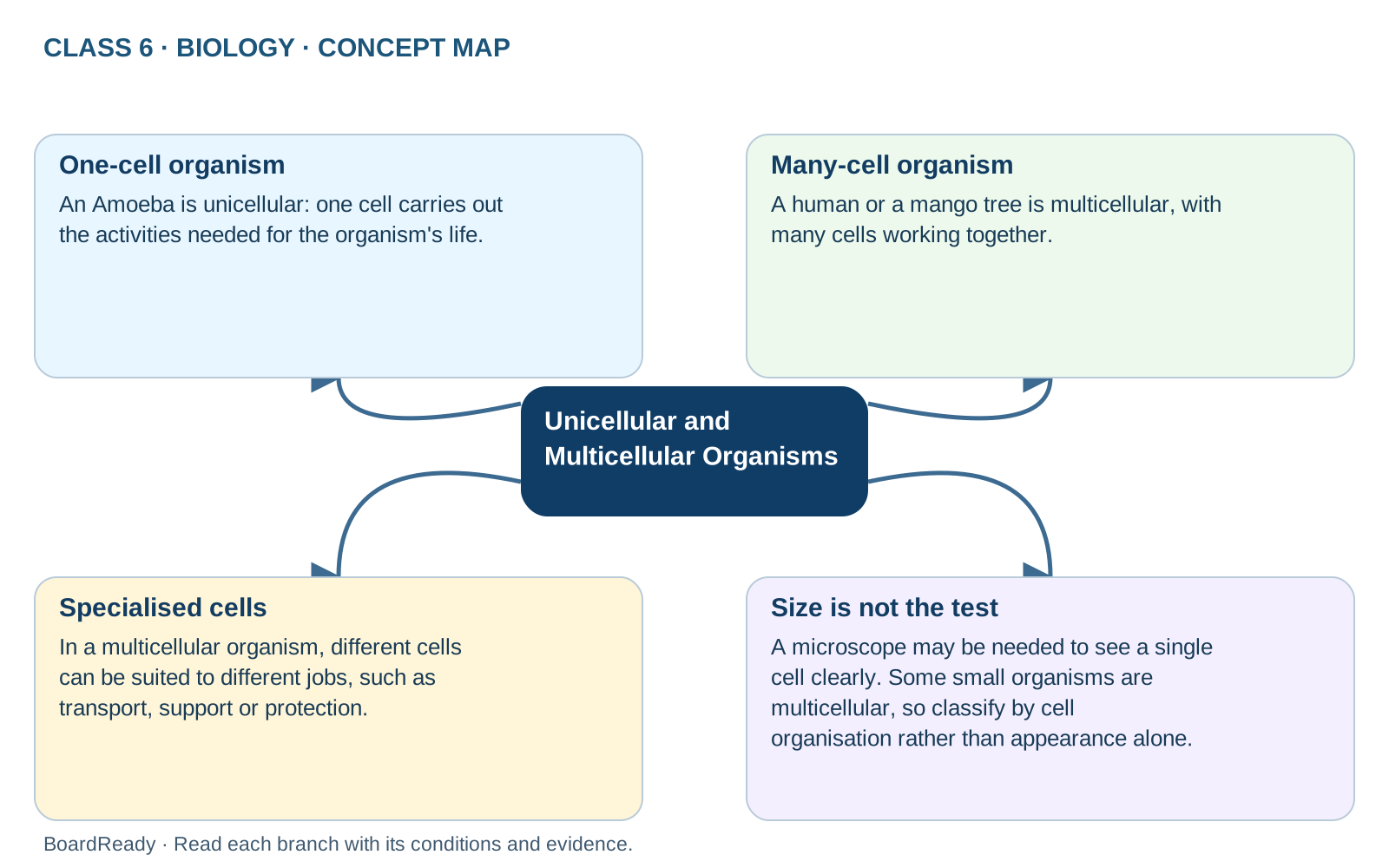
- 1Unicellular and Multicellular Organisms -> One-cell organism: An Amoeba is unicellular: one cell carries out the activities needed for the organism's life.
- 2Unicellular and Multicellular Organisms -> Many-cell organism: A human or a mango tree is multicellular, with many cells working together.
- 3Unicellular and Multicellular Organisms -> Specialised cells: In a multicellular organism, different cells can be suited to different jobs, such as transport, support or protection.
- 4Unicellular and Multicellular Organisms -> Size is not the test: A microscope may be needed to see a single cell clearly. Some small organisms are multicellular, so classify by cell organisation rather than appearance alone.