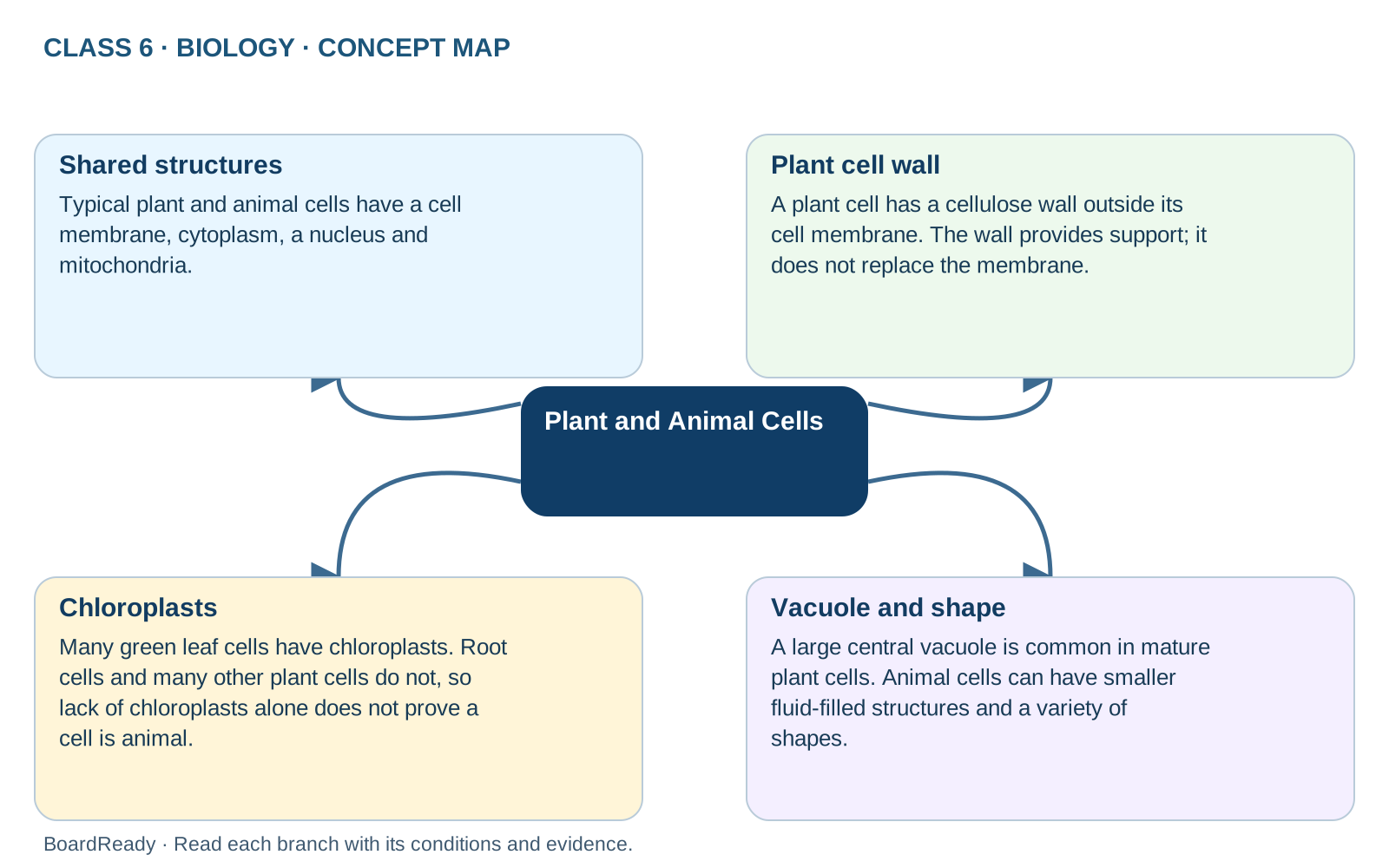
Comparison map
Plant and Animal Cells: concepts and evidence
Compare typical plant and animal cells through shared structures and useful differences, while allowing for specialised cells.Exam cue: A plant cell has both: a supporting wall outside and a membrane that controls movement of substances at the cell boundary.
- 1Plant and Animal Cells -> Shared structures: Typical plant and animal cells have a cell membrane, cytoplasm, a nucleus and mitochondria.
- 2Plant and Animal Cells -> Plant cell wall: A plant cell has a cellulose wall outside its cell membrane. The wall provides support; it does not replace the membrane.
- 3Plant and Animal Cells -> Chloroplasts: Many green leaf cells have chloroplasts. Root cells and many other plant cells do not, so lack of chloroplasts alone does not prove a cell is animal.
- 4Plant and Animal Cells -> Vacuole and shape: A large central vacuole is common in mature plant cells. Animal cells can have smaller fluid-filled structures and a variety of shapes.