Comparison map
Roman Numerals: relationships and examples
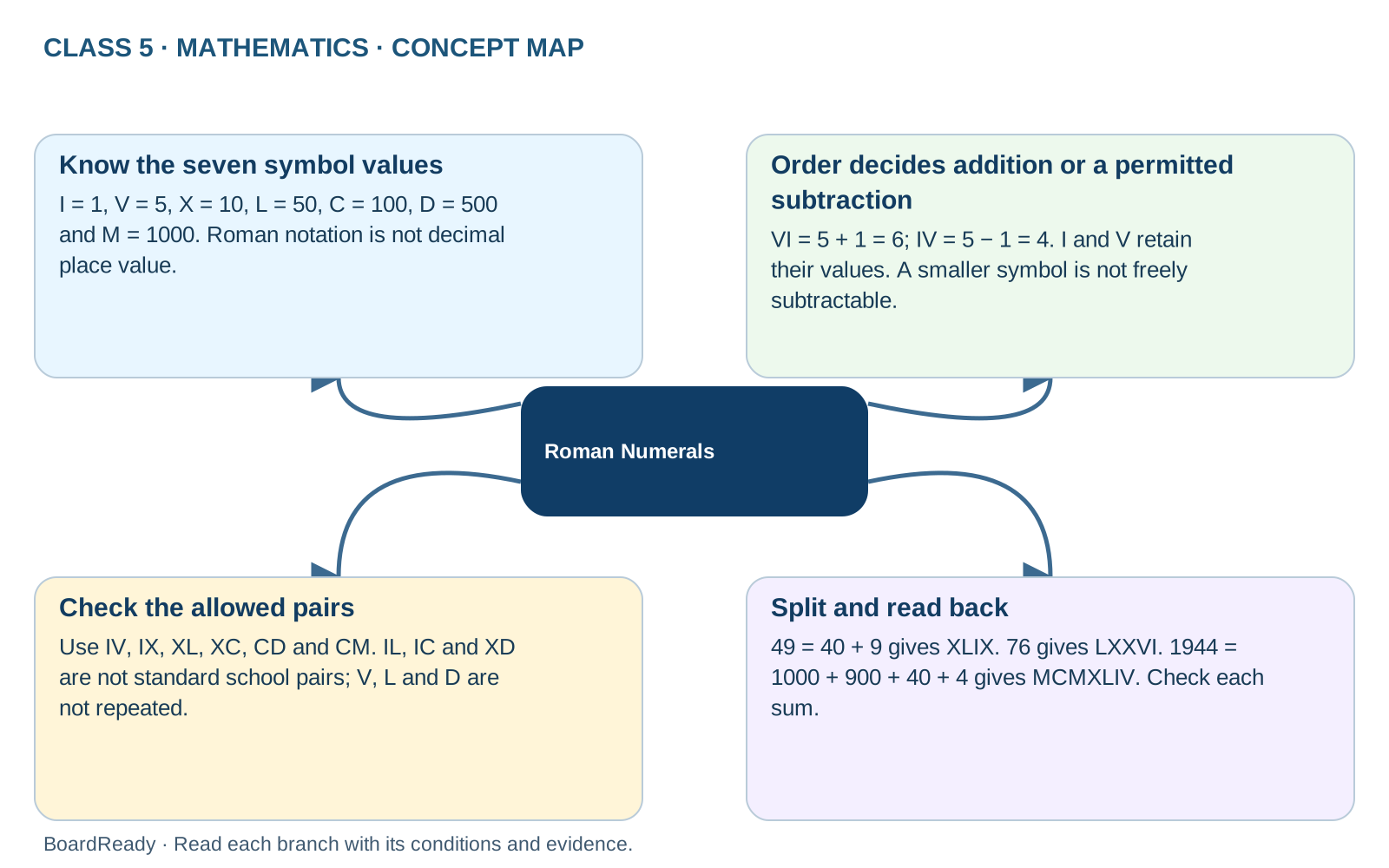
Read fixed symbol values in order, use permitted pairs, and check a conversion by reading it back. Know the seven symbol values: I = 1, V = 5, X = 10, L = 50, C = 100, D = 500 and M = 1000. Roman notation is not decimal place value. Order decides addition or a permitted subtraction: VI = 5 + 1 = 6; IV = 5 − 1 = 4. I and V retain their values. A smaller symbol is not freely subtractable. Check the allowed pairs: Use IV, IX, XL, XC, CD and CM. IL, IC and XD are not standard school pairs; V, L and D are not repeated. Split and read back: 49 = 40 + 9 gives XLIX. 76 gives LXXVI. 1944 = 1000 + 900 + 40 + 4 gives MCMXLIV. Check each sum.Exam cue: Use standard school notation for 1–3999. Split by decimal parts, convert each part, join in order and verify the result.
- 1Roman Numerals -> Know the seven symbol values: I = 1, V = 5, X = 10, L = 50, C = 100, D = 500 and M = 1000. Roman notation is not decimal place value.
- 2Roman Numerals -> Order decides addition or a permitted subtraction: VI = 5 + 1 = 6; IV = 5 − 1 = 4. I and V retain their values. A smaller symbol is not freely subtractable.
- 3Roman Numerals -> Check the allowed pairs: Use IV, IX, XL, XC, CD and CM. IL, IC and XD are not standard school pairs; V, L and D are not repeated.
- 4Roman Numerals -> Split and read back: 49 = 40 + 9 gives XLIX. 76 gives LXXVI. 1944 = 1000 + 900 + 40 + 4 gives MCMXLIV. Check each sum.