Comparison map
Fractions and Decimals: relationships and examples
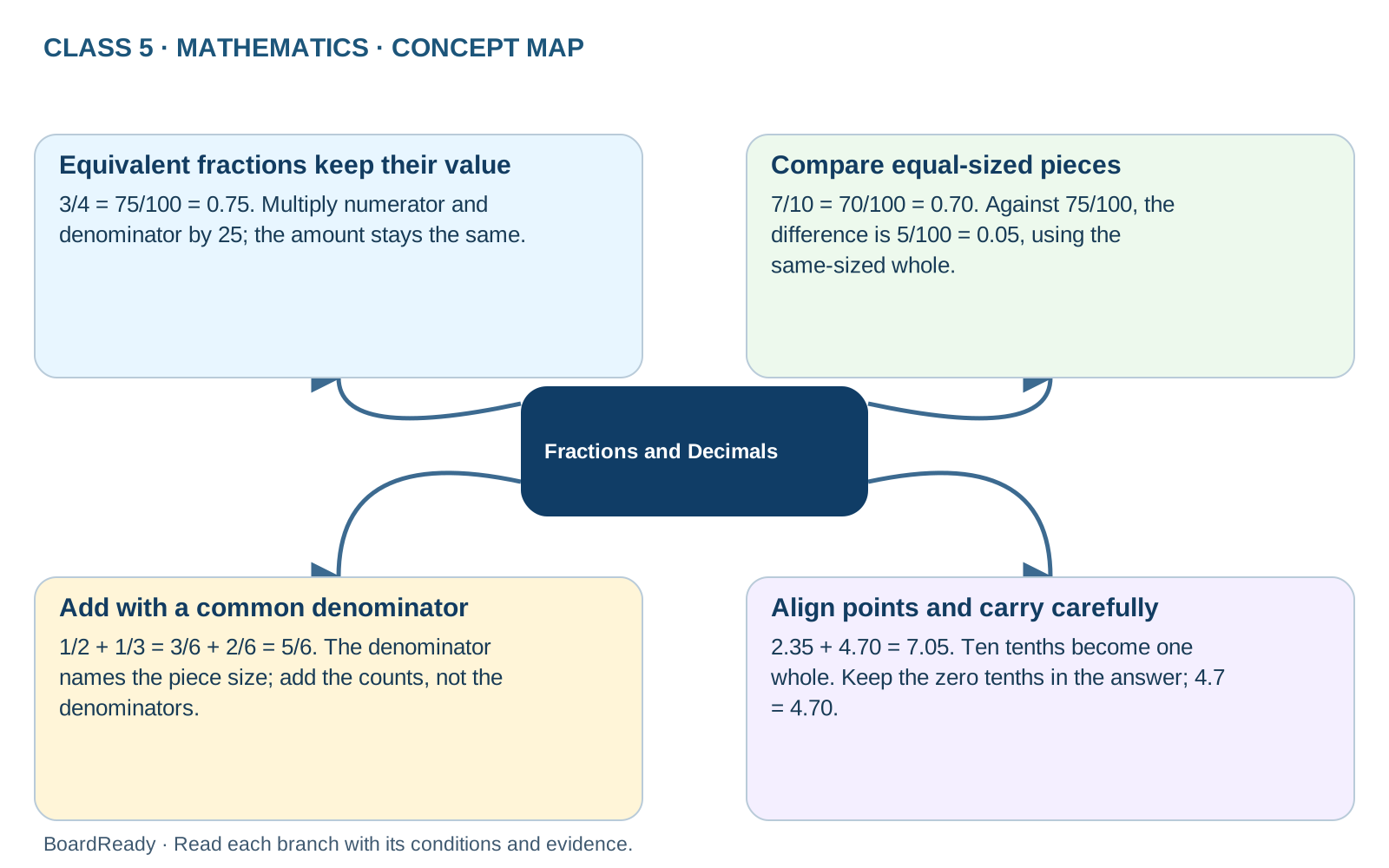
Use the same whole and equal-sized parts, rename values without changing them, and protect decimal place value. Equivalent fractions keep their value: 3/4 = 75/100 = 0.75. Multiply numerator and denominator by 25; the amount stays the same. Compare equal-sized pieces: 7/10 = 70/100 = 0.70. Against 75/100, the difference is 5/100 = 0.05, using the same-sized whole. Add with a common denominator: 1/2 + 1/3 = 3/6 + 2/6 = 5/6. The denominator names the piece size; add the counts, not the denominators. Align points and carry carefully: 2.35 + 4.70 = 7.05. Ten tenths become one whole. Keep the zero tenths in the answer; 4.7 = 4.70.Exam cue: Check equal wholes, common denominators or aligned decimal points before calculating. Use the size and place values to check the result.
- 1Fractions and Decimals -> Equivalent fractions keep their value: 3/4 = 75/100 = 0.75. Multiply numerator and denominator by 25; the amount stays the same.
- 2Fractions and Decimals -> Compare equal-sized pieces: 7/10 = 70/100 = 0.70. Against 75/100, the difference is 5/100 = 0.05, using the same-sized whole.
- 3Fractions and Decimals -> Add with a common denominator: 1/2 + 1/3 = 3/6 + 2/6 = 5/6. The denominator names the piece size; add the counts, not the denominators.
- 4Fractions and Decimals -> Align points and carry carefully: 2.35 + 4.70 = 7.05. Ten tenths become one whole. Keep the zero tenths in the answer; 4.7 = 4.70.