Comparison map
Factors and Multiples: relationships and examples
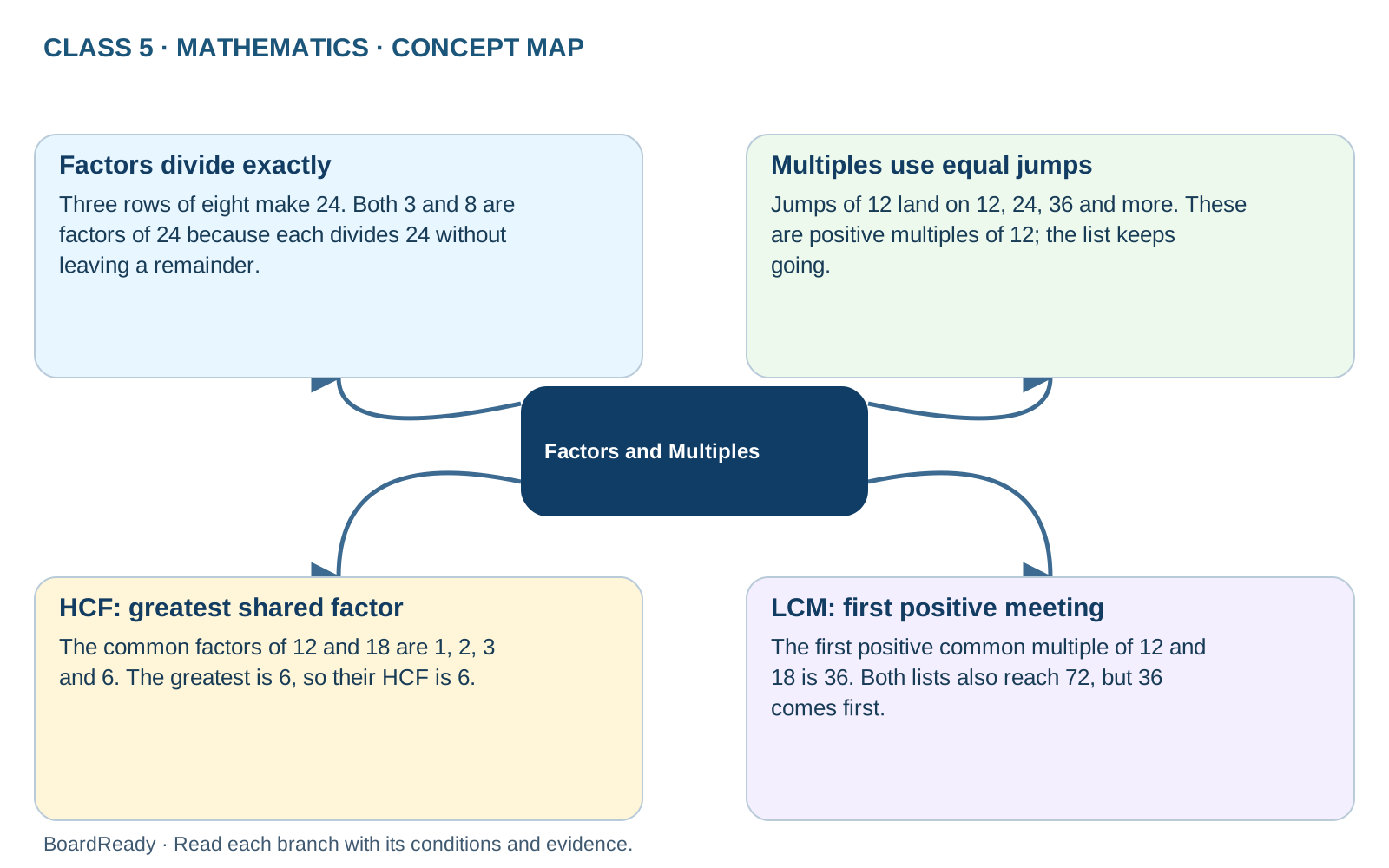
Use arrays for factors and equal jumps for multiples, then compare the shared values. Factors divide exactly: Three rows of eight make 24. Both 3 and 8 are factors of 24 because each divides 24 without leaving a remainder. Multiples use equal jumps: Jumps of 12 land on 12, 24, 36 and more. These are positive multiples of 12; the list keeps going. HCF: greatest shared factor: The common factors of 12 and 18 are 1, 2, 3 and 6. The greatest is 6, so their HCF is 6. LCM: first positive meeting: The first positive common multiple of 12 and 18 is 36. Both lists also reach 72, but 36 comes first.Exam cue: Factors divide; multiples are made by multiplying. Choose the greatest shared factor for HCF and the least positive shared multiple for LCM. Do not use zero as a divisor.
- 1Factors and Multiples -> Factors divide exactly: Three rows of eight make 24. Both 3 and 8 are factors of 24 because each divides 24 without leaving a remainder.
- 2Factors and Multiples -> Multiples use equal jumps: Jumps of 12 land on 12, 24, 36 and more. These are positive multiples of 12; the list keeps going.
- 3Factors and Multiples -> HCF: greatest shared factor: The common factors of 12 and 18 are 1, 2, 3 and 6. The greatest is 6, so their HCF is 6.
- 4Factors and Multiples -> LCM: first positive meeting: The first positive common multiple of 12 and 18 is 36. Both lists also reach 72, but 36 comes first.