Comparison map
Speed, Distance, and Work: relationships and examples
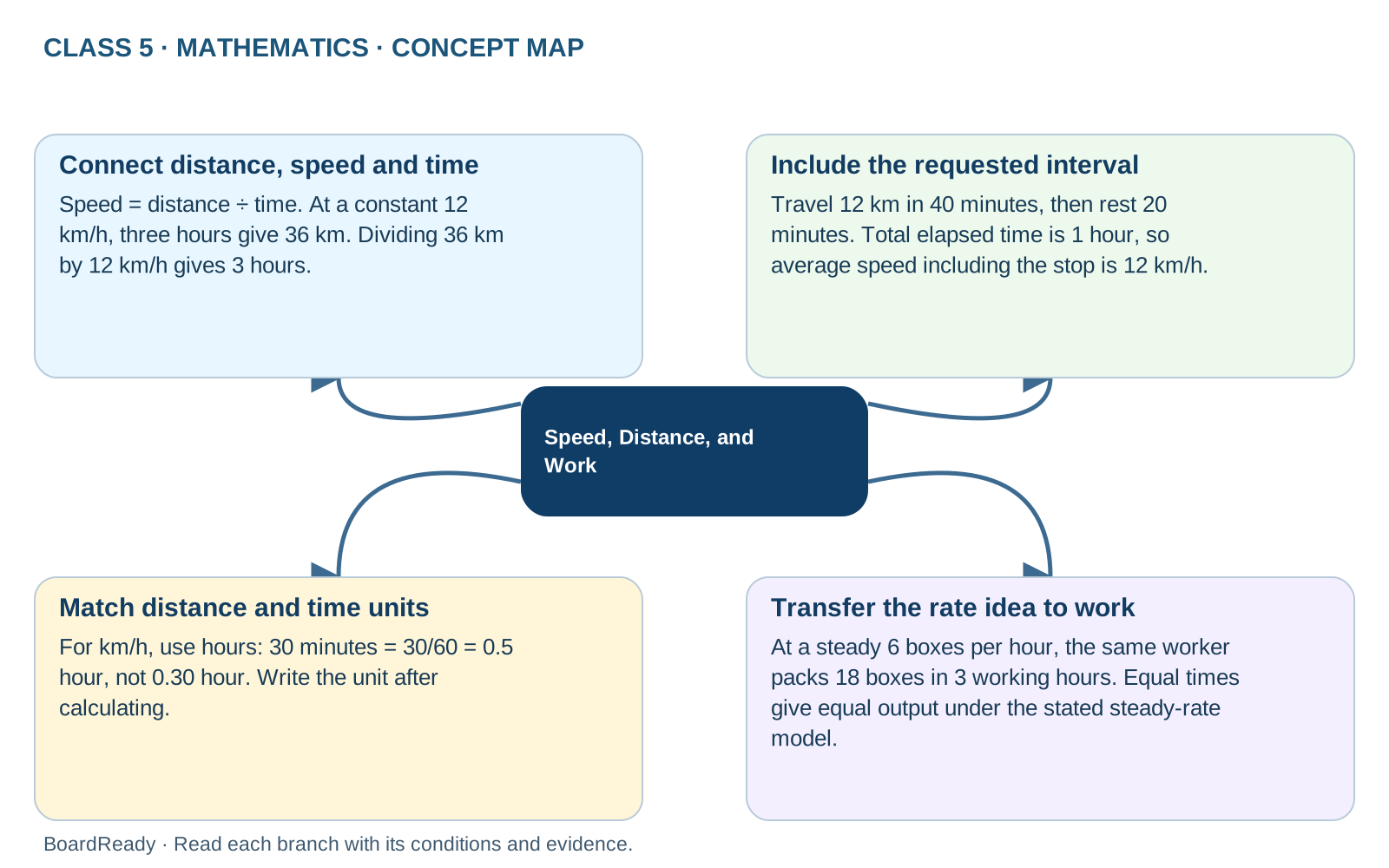
Choose the quantity and time interval, match the units, and use equal increments only when a constant rate is stated. Connect distance, speed and time: Speed = distance ÷ time. At a constant 12 km/h, three hours give 36 km. Dividing 36 km by 12 km/h gives 3 hours. Include the requested interval: Travel 12 km in 40 minutes, then rest 20 minutes. Total elapsed time is 1 hour, so average speed including the stop is 12 km/h. Match distance and time units: For km/h, use hours: 30 minutes = 30/60 = 0.5 hour, not 0.30 hour. Write the unit after calculating. Transfer the rate idea to work: At a steady 6 boxes per hour, the same worker packs 18 boxes in 3 working hours. Equal times give equal output under the stated steady-rate model.Exam cue: Average speed uses total distance and the entire chosen time interval. Work output = steady rate × working time.
- 1Speed, Distance, and Work -> Connect distance, speed and time: Speed = distance ÷ time. At a constant 12 km/h, three hours give 36 km. Dividing 36 km by 12 km/h gives 3 hours.
- 2Speed, Distance, and Work -> Include the requested interval: Travel 12 km in 40 minutes, then rest 20 minutes. Total elapsed time is 1 hour, so average speed including the stop is 12 km/h.
- 3Speed, Distance, and Work -> Match distance and time units: For km/h, use hours: 30 minutes = 30/60 = 0.5 hour, not 0.30 hour. Write the unit after calculating.
- 4Speed, Distance, and Work -> Transfer the rate idea to work: At a steady 6 boxes per hour, the same worker packs 18 boxes in 3 working hours. Equal times give equal output under the stated steady-rate model.