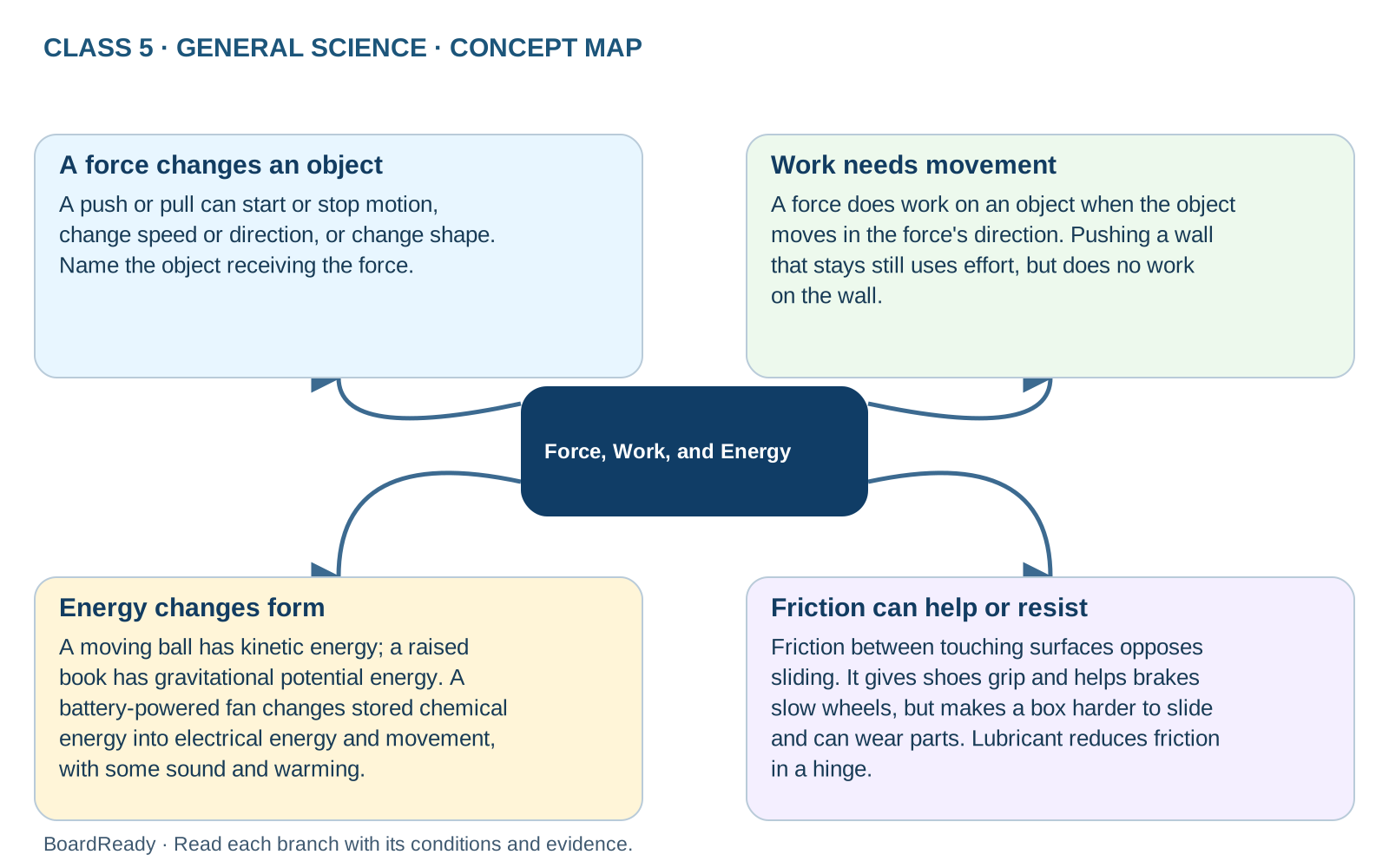
Comparison map
Force, Work, and Energy: relationships and examples
Connect pushes and pulls to motion, check when a force does work, and follow energy changes and friction in familiar examples. A force changes an object: A push or pull can start or stop motion, change speed or direction, or change shape. Name the object receiving the force. Work needs movement: A force does work on an object when the object moves in the force's direction. Pushing a wall that stays still uses effort, but does no work on the wall. Energy changes form: A moving ball has kinetic energy; a raised book has gravitational potential energy. A battery-powered fan changes stored chemical energy into electrical energy and movement, with some sound and warming. Friction can help or resist: Friction between touching surfaces opposes sliding. It gives shoes grip and helps brakes slow wheels, but makes a box harder to slide and can wear parts. Lubricant reduces friction in a hinge.Exam cue: Name the object, force, and movement before describing work. For energy, trace a change; for friction, decide whether grip or resistance is useful.
- 1Force, Work, and Energy -> A force changes an object: A push or pull can start or stop motion, change speed or direction, or change shape. Name the object receiving the force.
- 2Force, Work, and Energy -> Work needs movement: A force does work on an object when the object moves in the force's direction. Pushing a wall that stays still uses effort, but does no work on the wall.
- 3Force, Work, and Energy -> Energy changes form: A moving ball has kinetic energy; a raised book has gravitational potential energy. A battery-powered fan changes stored chemical energy into electrical energy and movement, with some sound and warming.
- 4Force, Work, and Energy -> Friction can help or resist: Friction between touching surfaces opposes sliding. It gives shoes grip and helps brakes slow wheels, but makes a box harder to slide and can wear parts. Lubricant reduces friction in a hinge.