Comparison map
Earth, Environment, and Sky Review: relationships and examples
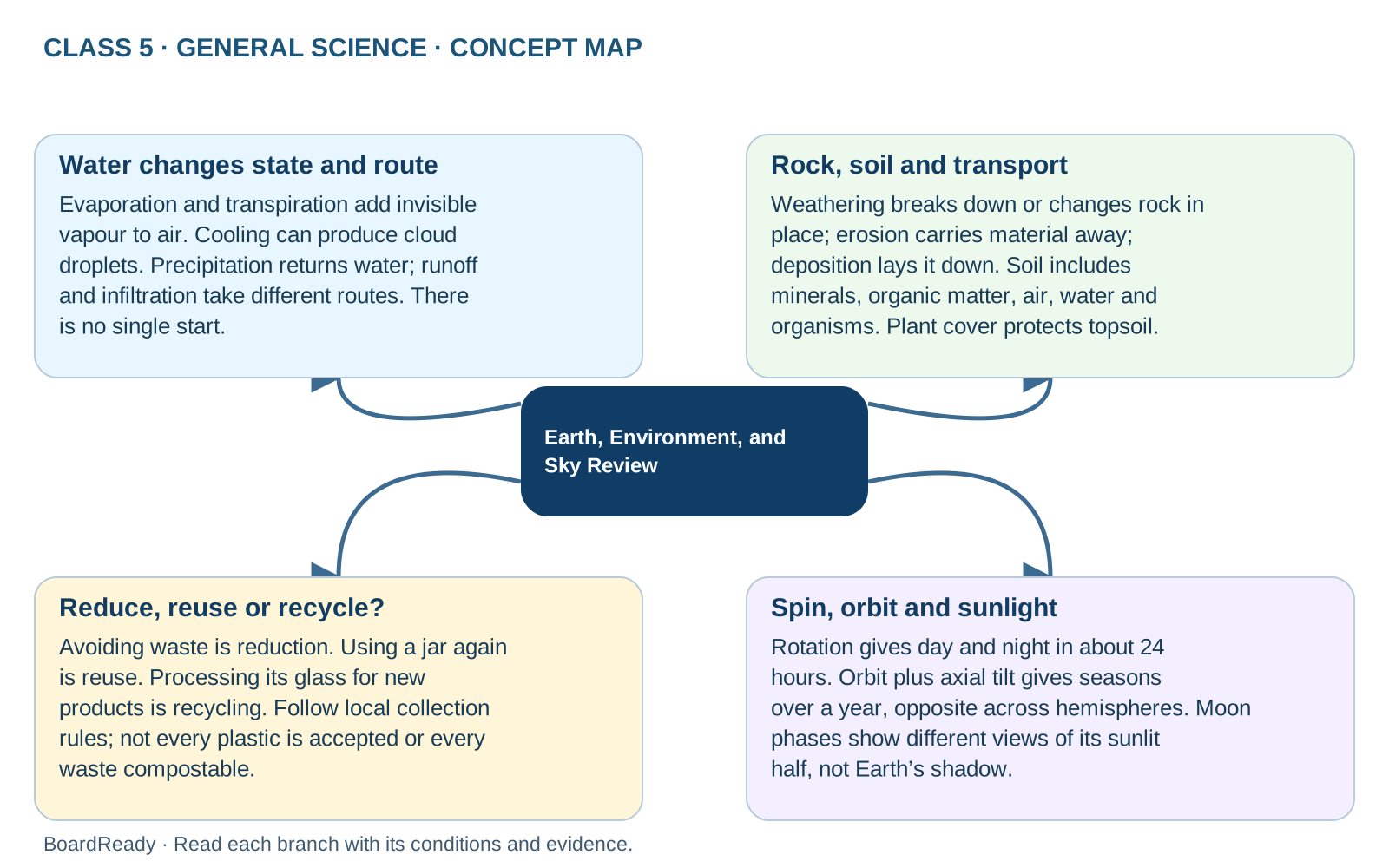
Connect changing water, landscape processes, responsible resource use and the different motions seen in the sky. Water changes state and route: Evaporation and transpiration add invisible vapour to air. Cooling can produce cloud droplets. Precipitation returns water; runoff and infiltration take different routes. There is no single start. Rock, soil and transport: Weathering breaks down or changes rock in place; erosion carries material away; deposition lays it down. Soil includes minerals, organic matter, air, water and organisms. Plant cover protects topsoil. Reduce, reuse or recycle?: Avoiding waste is reduction. Using a jar again is reuse. Processing its glass for new products is recycling. Follow local collection rules; not every plastic is accepted or every waste compostable. Spin, orbit and sunlight: Rotation gives day and night in about 24 hours. Orbit plus axial tilt gives seasons over a year, opposite across hemispheres. Moon phases show different views of its sunlit half, not Earth’s shadow.Exam cue: Name the process and follow its evidence. Vapour is not a cloud droplet; erosion is not weathering; rotation is not revolution.
- 1Earth, Environment, and Sky Review -> Water changes state and route: Evaporation and transpiration add invisible vapour to air. Cooling can produce cloud droplets. Precipitation returns water; runoff and infiltration take different routes. There is no single start.
- 2Earth, Environment, and Sky Review -> Rock, soil and transport: Weathering breaks down or changes rock in place; erosion carries material away; deposition lays it down. Soil includes minerals, organic matter, air, water and organisms. Plant cover protects topsoil.
- 3Earth, Environment, and Sky Review -> Reduce, reuse or recycle?: Avoiding waste is reduction. Using a jar again is reuse. Processing its glass for new products is recycling. Follow local collection rules; not every plastic is accepted or every waste compostable.
- 4Earth, Environment, and Sky Review -> Spin, orbit and sunlight: Rotation gives day and night in about 24 hours. Orbit plus axial tilt gives seasons over a year, opposite across hemispheres. Moon phases show different views of its sunlit half, not Earth’s shadow.