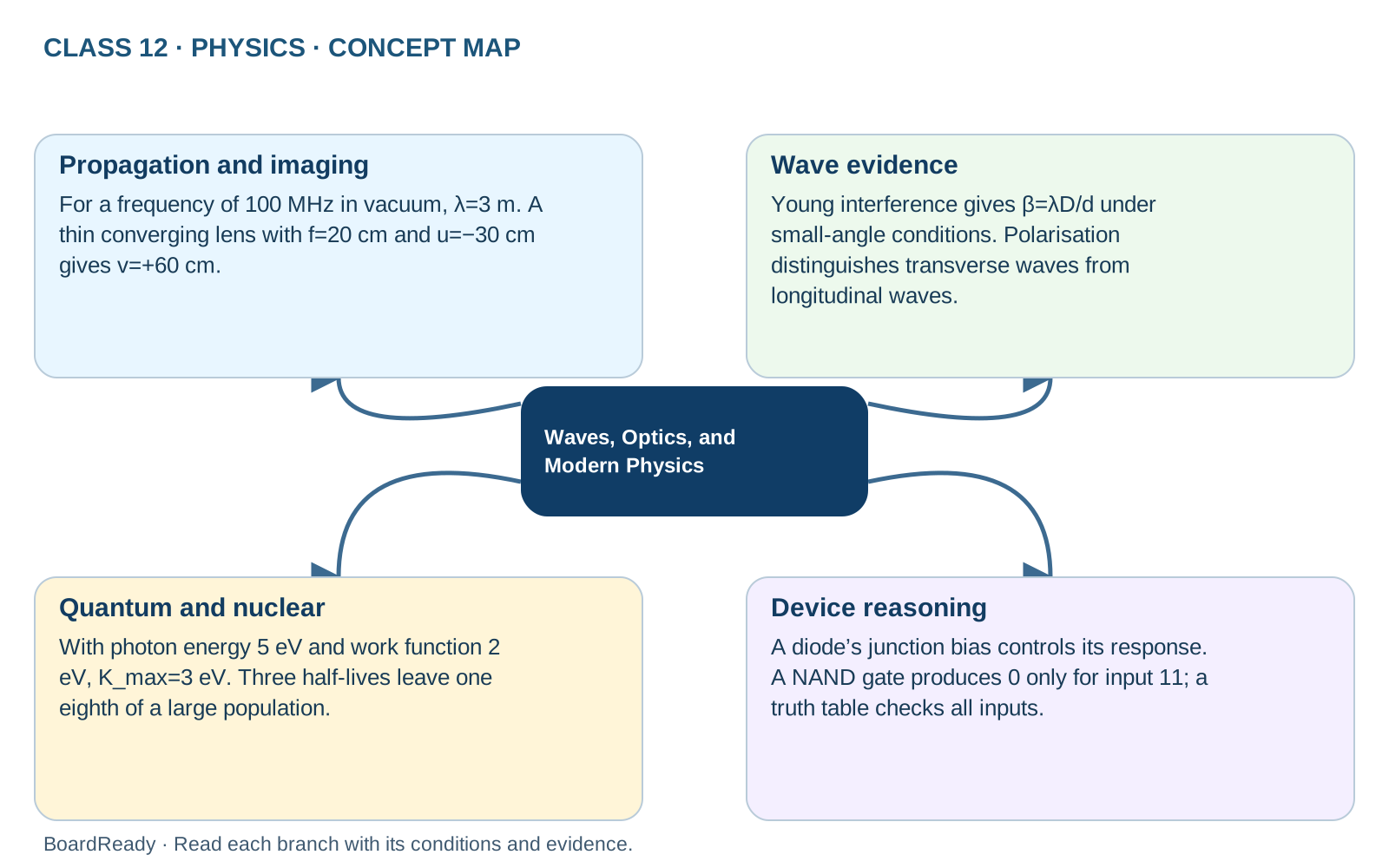
Comparison map
Waves, Optics, and Modern Physics: relationships and examples
Choose ray, wave, photon or device models to explain different observations. Propagation and imaging: For a frequency of 100 MHz in vacuum, λ=3 m. A thin converging lens with f=20 cm and u=−30 cm gives v=+60 cm. Wave evidence: Young interference gives β=λD/d under small-angle conditions. Polarisation distinguishes transverse waves from longitudinal waves. Quantum and nuclear: With photon energy 5 eV and work function 2 eV, K_max=3 eV. Three half-lives leave one eighth of a large population. Device reasoning: A diode’s junction bias controls its response. A NAND gate produces 0 only for input 11; a truth table checks all inputs.Exam cue: A useful model must explain the observation and its conditions; one formula cannot describe every phenomenon here.
- 1Waves, Optics, and Modern Physics -> Propagation and imaging: For a frequency of 100 MHz in vacuum, λ=3 m. A thin converging lens with f=20 cm and u=−30 cm gives v=+60 cm.
- 2Waves, Optics, and Modern Physics -> Wave evidence: Young interference gives β=λD/d under small-angle conditions. Polarisation distinguishes transverse waves from longitudinal waves.
- 3Waves, Optics, and Modern Physics -> Quantum and nuclear: With photon energy 5 eV and work function 2 eV, K_max=3 eV. Three half-lives leave one eighth of a large population.
- 4Waves, Optics, and Modern Physics -> Device reasoning: A diode’s junction bias controls its response. A NAND gate produces 0 only for input 11; a truth table checks all inputs.