Comparison map
Electrostatics: relationships and examples
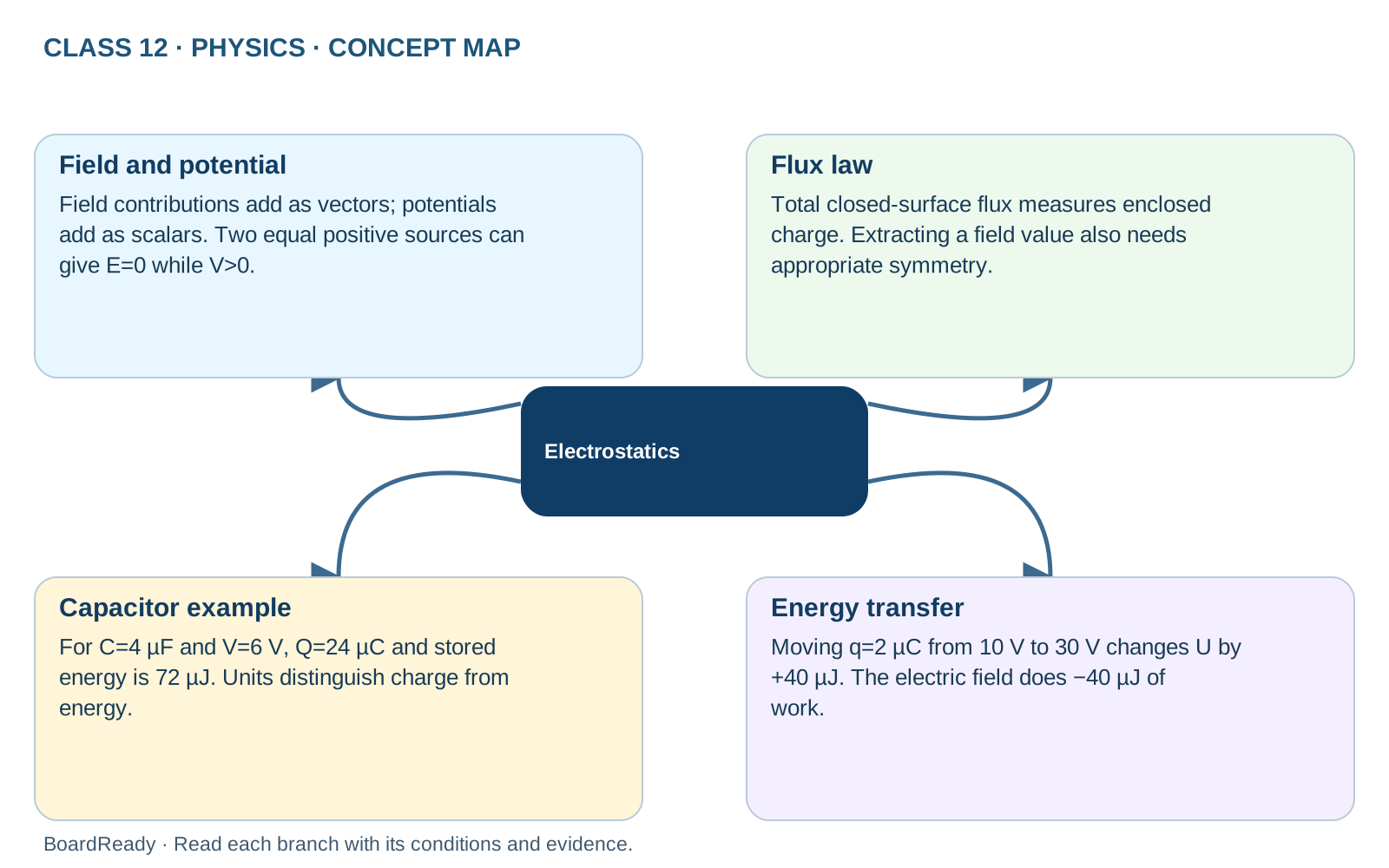
Connect force, field, potential and capacitance through superposition and energy. Field and potential: Field contributions add as vectors; potentials add as scalars. Two equal positive sources can give E=0 while V>0. Flux law: Total closed-surface flux measures enclosed charge. Extracting a field value also needs appropriate symmetry. Capacitor example: For C=4 µF and V=6 V, Q=24 µC and stored energy is 72 µJ. Units distinguish charge from energy. Energy transfer: Moving q=2 µC from 10 V to 30 V changes U by +40 µJ. The electric field does −40 µJ of work.Exam cue: State the source, reference potential and fixed quantities; keep field work and potential-energy change opposite.
- 1Electrostatics -> Field and potential: Field contributions add as vectors; potentials add as scalars. Two equal positive sources can give E=0 while V>0.
- 2Electrostatics -> Flux law: Total closed-surface flux measures enclosed charge. Extracting a field value also needs appropriate symmetry.
- 3Electrostatics -> Capacitor example: For C=4 µF and V=6 V, Q=24 µC and stored energy is 72 µJ. Units distinguish charge from energy.
- 4Electrostatics -> Energy transfer: Moving q=2 µC from 10 V to 30 V changes U by +40 µJ. The electric field does −40 µJ of work.