Comparison map
Applications of Derivatives: relationships and examples
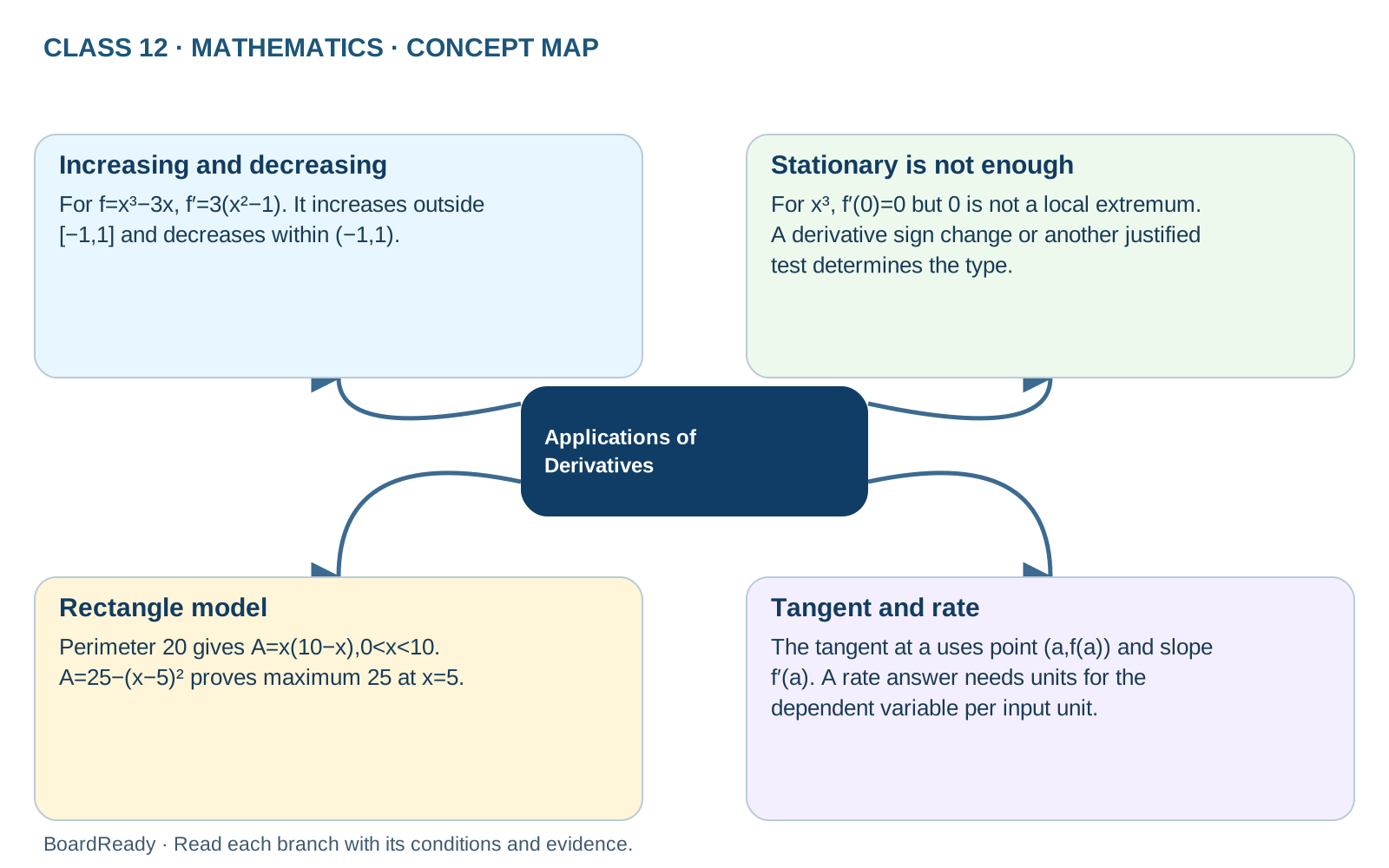
A derivative identifies local change; a global optimum also needs the feasible domain. Increasing and decreasing: For f=x³−3x, f′=3(x²−1). It increases outside [−1,1] and decreases within (−1,1). Stationary is not enough: For x³, f′(0)=0 but 0 is not a local extremum. A derivative sign change or another justified test determines the type. Rectangle model: Perimeter 20 gives A=x(10−x),0<x<10. A=25−(x−5)² proves maximum 25 at x=5. Tangent and rate: The tangent at a uses point (a,f(a)) and slope f′(a). A rate answer needs units for the dependent variable per input unit.Exam cue: Specify the domain and test candidate points and boundaries before declaring an absolute optimum.
- 1Applications of Derivatives -> Increasing and decreasing: For f=x³−3x, f′=3(x²−1). It increases outside [−1,1] and decreases within (−1,1).
- 2Applications of Derivatives -> Stationary is not enough: For x³, f′(0)=0 but 0 is not a local extremum. A derivative sign change or another justified test determines the type.
- 3Applications of Derivatives -> Rectangle model: Perimeter 20 gives A=x(10−x),0<x<10. A=25−(x−5)² proves maximum 25 at x=5.
- 4Applications of Derivatives -> Tangent and rate: The tangent at a uses point (a,f(a)) and slope f′(a). A rate answer needs units for the dependent variable per input unit.