Comparison map
Coordination Compounds: relationships and examples
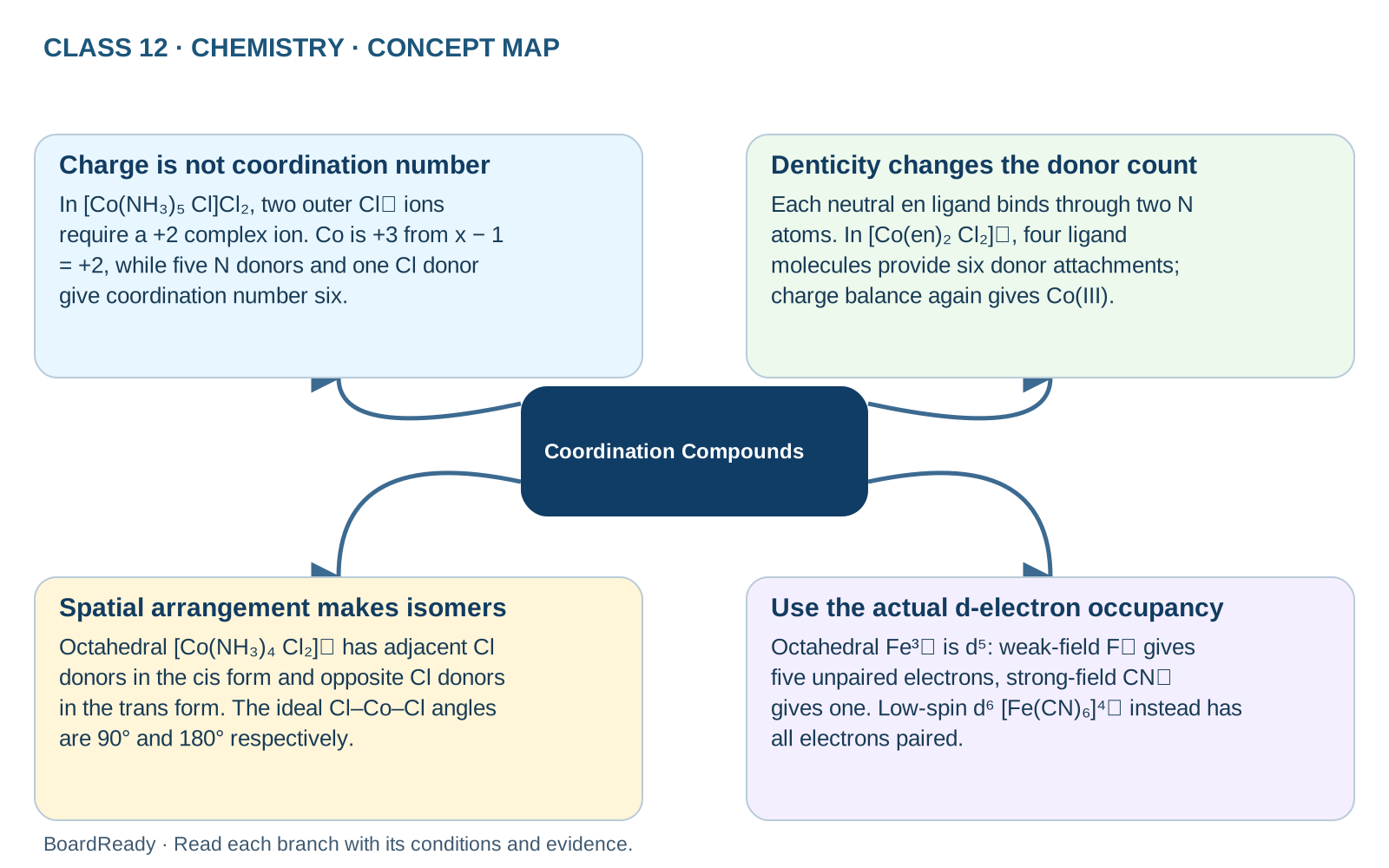
Read the coordination sphere, count donor attachments and use geometry and orbital occupancy to explain properties. Charge is not coordination number: In [Co(NH₃)₅ Cl]Cl₂, two outer Cl⁻ ions require a +2 complex ion. Co is +3 from x − 1 = +2, while five N donors and one Cl donor give coordination number six. Denticity changes the donor count: Each neutral en ligand binds through two N atoms. In [Co(en)₂ Cl₂]⁺, four ligand molecules provide six donor attachments; charge balance again gives Co(III). Spatial arrangement makes isomers: Octahedral [Co(NH₃)₄ Cl₂]⁺ has adjacent Cl donors in the cis form and opposite Cl donors in the trans form. The ideal Cl–Co–Cl angles are 90° and 180° respectively. Use the actual d-electron occupancy: Octahedral Fe³⁺ is d⁵: weak-field F⁻ gives five unpaired electrons, strong-field CN⁻ gives one. Low-spin d⁶ [Fe(CN)₆]⁴⁻ instead has all electrons paired.Exam cue: Separate complex charge, metal oxidation state, coordination number and shape. Name ligands alphabetically before the metal, ignoring multiplicative prefixes; predict magnetism from unpaired electrons rather than the word low spin alone.
- 1Coordination Compounds -> Charge is not coordination number: In [Co(NH₃)₅ Cl]Cl₂, two outer Cl⁻ ions require a +2 complex ion. Co is +3 from x − 1 = +2, while five N donors and one Cl donor give coordination number six.
- 2Coordination Compounds -> Denticity changes the donor count: Each neutral en ligand binds through two N atoms. In [Co(en)₂ Cl₂]⁺, four ligand molecules provide six donor attachments; charge balance again gives Co(III).
- 3Coordination Compounds -> Spatial arrangement makes isomers: Octahedral [Co(NH₃)₄ Cl₂]⁺ has adjacent Cl donors in the cis form and opposite Cl donors in the trans form. The ideal Cl–Co–Cl angles are 90° and 180° respectively.
- 4Coordination Compounds -> Use the actual d-electron occupancy: Octahedral Fe³⁺ is d⁵: weak-field F⁻ gives five unpaired electrons, strong-field CN⁻ gives one. Low-spin d⁶ [Fe(CN)₆]⁴⁻ instead has all electrons paired.