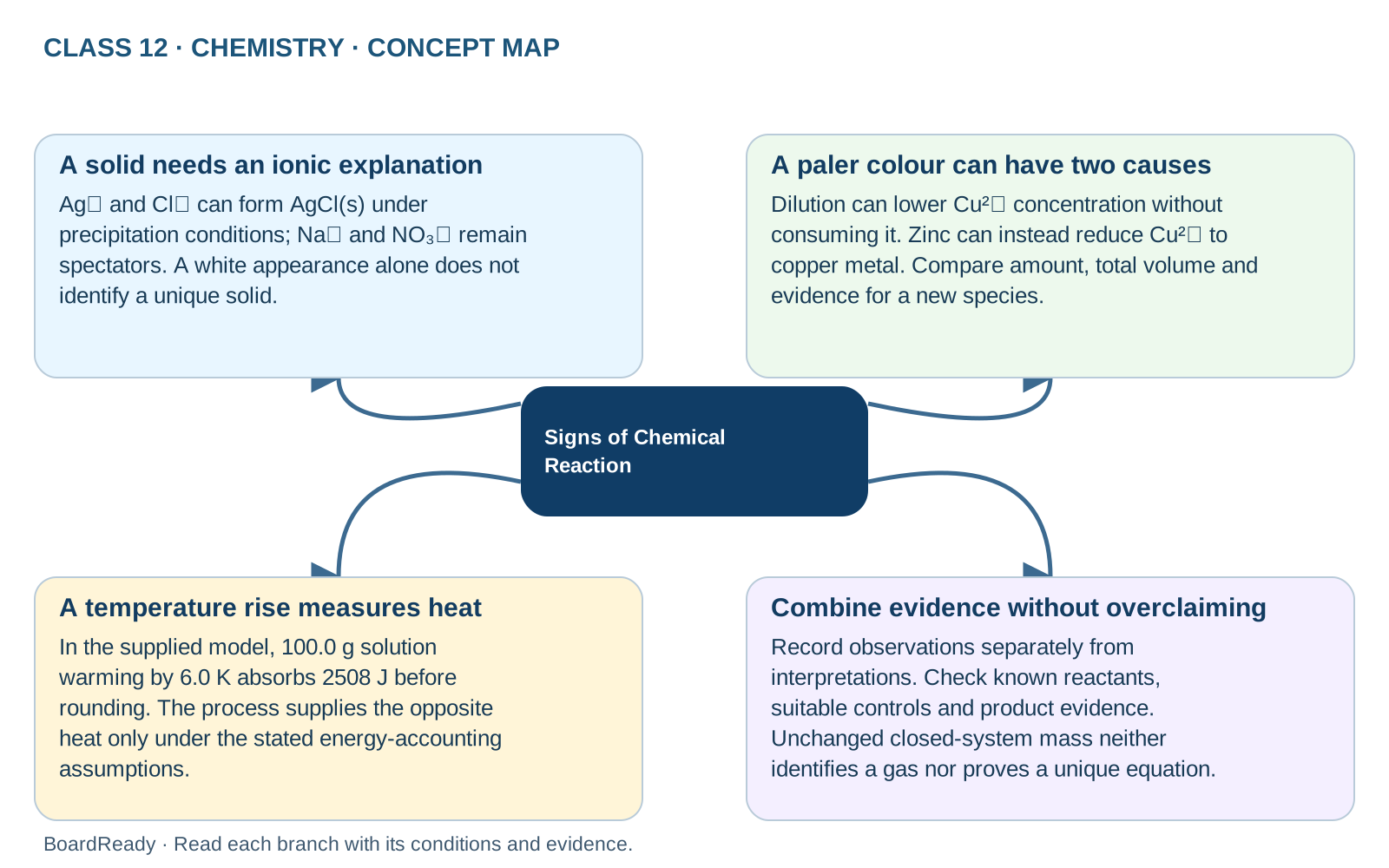
Comparison map
Signs of Chemical Reaction: relationships and examples
Foundation refresher: connect observations to species, balanced reactions, controls and the limits of a measurement. A solid needs an ionic explanation: Ag⁺ and Cl⁻ can form AgCl(s) under precipitation conditions; Na⁺ and NO₃⁻ remain spectators. A white appearance alone does not identify a unique solid. A paler colour can have two causes: Dilution can lower Cu²⁺ concentration without consuming it. Zinc can instead reduce Cu²⁺ to copper metal. Compare amount, total volume and evidence for a new species. A temperature rise measures heat: In the supplied model, 100.0 g solution warming by 6.0 K absorbs 2508 J before rounding. The process supplies the opposite heat only under the stated energy-accounting assumptions. Combine evidence without overclaiming: Record observations separately from interpretations. Check known reactants, suitable controls and product evidence. Unchanged closed-system mass neither identifies a gas nor proves a unique equation.Exam cue: State what was measured, propose a balanced species account, and explain what remains uncertain. Do not identify an unknown product from colour, bubbles, heat or a mass reading alone.
- 1Signs of Chemical Reaction -> A solid needs an ionic explanation: Ag⁺ and Cl⁻ can form AgCl(s) under precipitation conditions; Na⁺ and NO₃⁻ remain spectators. A white appearance alone does not identify a unique solid.
- 2Signs of Chemical Reaction -> A paler colour can have two causes: Dilution can lower Cu²⁺ concentration without consuming it. Zinc can instead reduce Cu²⁺ to copper metal. Compare amount, total volume and evidence for a new species.
- 3Signs of Chemical Reaction -> A temperature rise measures heat: In the supplied model, 100.0 g solution warming by 6.0 K absorbs 2508 J before rounding. The process supplies the opposite heat only under the stated energy-accounting assumptions.
- 4Signs of Chemical Reaction -> Combine evidence without overclaiming: Record observations separately from interpretations. Check known reactants, suitable controls and product evidence. Unchanged closed-system mass neither identifies a gas nor proves a unique equation.