Comparison map
Respiration Basics: relationships and examples
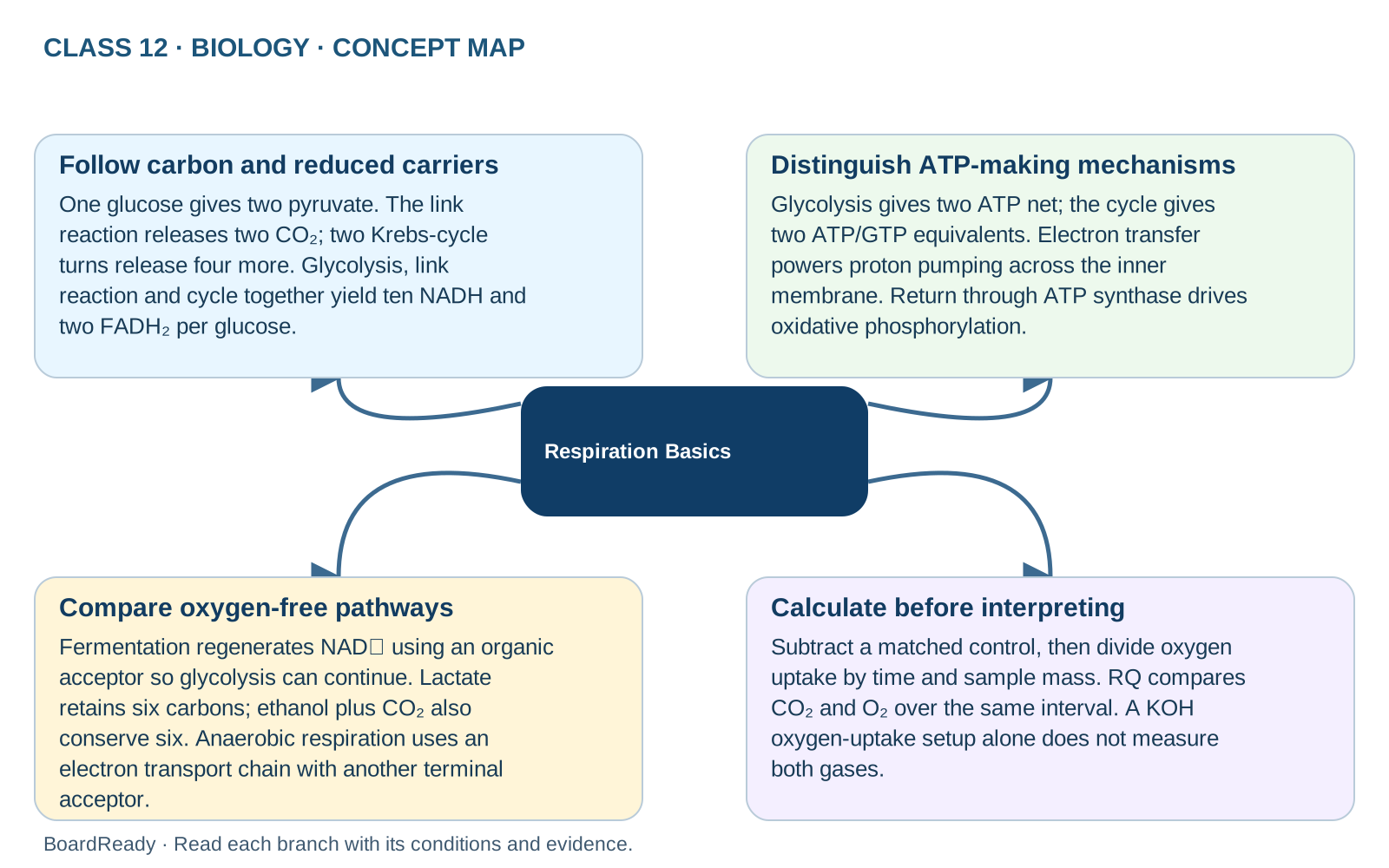
Connect carbon accounting, electron transfer, proton gradients and controlled measurements of cellular respiration. Follow carbon and reduced carriers: One glucose gives two pyruvate. The link reaction releases two CO₂; two Krebs-cycle turns release four more. Glycolysis, link reaction and cycle together yield ten NADH and two FADH₂ per glucose. Distinguish ATP-making mechanisms: Glycolysis gives two ATP net; the cycle gives two ATP/GTP equivalents. Electron transfer powers proton pumping across the inner membrane. Return through ATP synthase drives oxidative phosphorylation. Compare oxygen-free pathways: Fermentation regenerates NAD⁺ using an organic acceptor so glycolysis can continue. Lactate retains six carbons; ethanol plus CO₂ also conserve six. Anaerobic respiration uses an electron transport chain with another terminal acceptor. Calculate before interpreting: Subtract a matched control, then divide oxygen uptake by time and sample mass. RQ compares CO₂ and O₂ over the same interval. A KOH oxygen-uptake setup alone does not measure both gases.Exam cue: Separate carbon counts, carrier counts and ATP yields. Name the membrane and direction of proton movement. Give corrected rates with units, and do not infer a unique fuel from RQ alone.
- 1Respiration Basics -> Follow carbon and reduced carriers: One glucose gives two pyruvate. The link reaction releases two CO₂; two Krebs-cycle turns release four more. Glycolysis, link reaction and cycle together yield ten NADH and two FADH₂ per glucose.
- 2Respiration Basics -> Distinguish ATP-making mechanisms: Glycolysis gives two ATP net; the cycle gives two ATP/GTP equivalents. Electron transfer powers proton pumping across the inner membrane. Return through ATP synthase drives oxidative phosphorylation.
- 3Respiration Basics -> Compare oxygen-free pathways: Fermentation regenerates NAD⁺ using an organic acceptor so glycolysis can continue. Lactate retains six carbons; ethanol plus CO₂ also conserve six. Anaerobic respiration uses an electron transport chain with another terminal acceptor.
- 4Respiration Basics -> Calculate before interpreting: Subtract a matched control, then divide oxygen uptake by time and sample mass. RQ compares CO₂ and O₂ over the same interval. A KOH oxygen-uptake setup alone does not measure both gases.