Comparison map
Biodiversity, Conservation, and Environmental Issues: relationships and examples
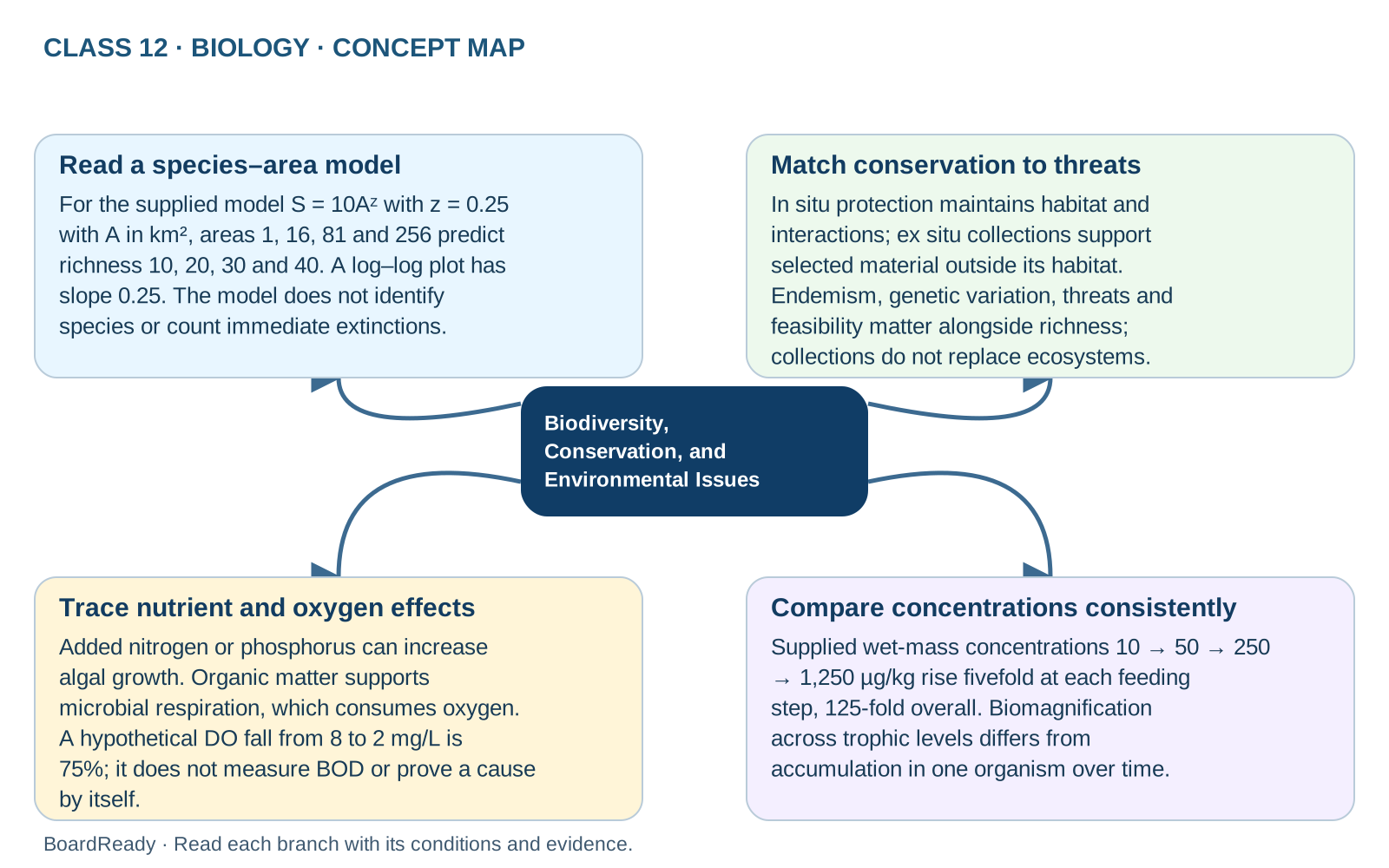
Use explicit richness models, distinguish conservation strategies, and trace environmental mechanisms rather than treating every pollutant or biodiversity measure alike. Read a species–area model: For the supplied model S = 10Aᶻ with z = 0.25 with A in km², areas 1, 16, 81 and 256 predict richness 10, 20, 30 and 40. A log–log plot has slope 0.25. The model does not identify species or count immediate extinctions. Match conservation to threats: In situ protection maintains habitat and interactions; ex situ collections support selected material outside its habitat. Endemism, genetic variation, threats and feasibility matter alongside richness; collections do not replace ecosystems. Trace nutrient and oxygen effects: Added nitrogen or phosphorus can increase algal growth. Organic matter supports microbial respiration, which consumes oxygen. A hypothetical DO fall from 8 to 2 mg/L is 75%; it does not measure BOD or prove a cause by itself. Compare concentrations consistently: Supplied wet-mass concentrations 10 → 50 → 250 → 1,250 µg/kg rise fivefold at each feeding step, 125-fold overall. Biomagnification across trophic levels differs from accumulation in one organism over time.Exam cue: State the comparison, units and assumptions. Species richness is one biodiversity measure; DO, BOD and contaminant concentration are different quantities. Link conservation or pollution control to the specific mechanism and evidence.
- 1Biodiversity, Conservation, and Environmental Issues -> Read a species–area model: For the supplied model S = 10Aᶻ with z = 0.25 with A in km², areas 1, 16, 81 and 256 predict richness 10, 20, 30 and 40. A log–log plot has slope 0.25. The model does not identify species or count immediate extinctions.
- 2Biodiversity, Conservation, and Environmental Issues -> Match conservation to threats: In situ protection maintains habitat and interactions; ex situ collections support selected material outside its habitat. Endemism, genetic variation, threats and feasibility matter alongside richness; collections do not replace ecosystems.
- 3Biodiversity, Conservation, and Environmental Issues -> Trace nutrient and oxygen effects: Added nitrogen or phosphorus can increase algal growth. Organic matter supports microbial respiration, which consumes oxygen. A hypothetical DO fall from 8 to 2 mg/L is 75%; it does not measure BOD or prove a cause by itself.
- 4Biodiversity, Conservation, and Environmental Issues -> Compare concentrations consistently: Supplied wet-mass concentrations 10 → 50 → 250 → 1,250 µg/kg rise fivefold at each feeding step, 125-fold overall. Biomagnification across trophic levels differs from accumulation in one organism over time.