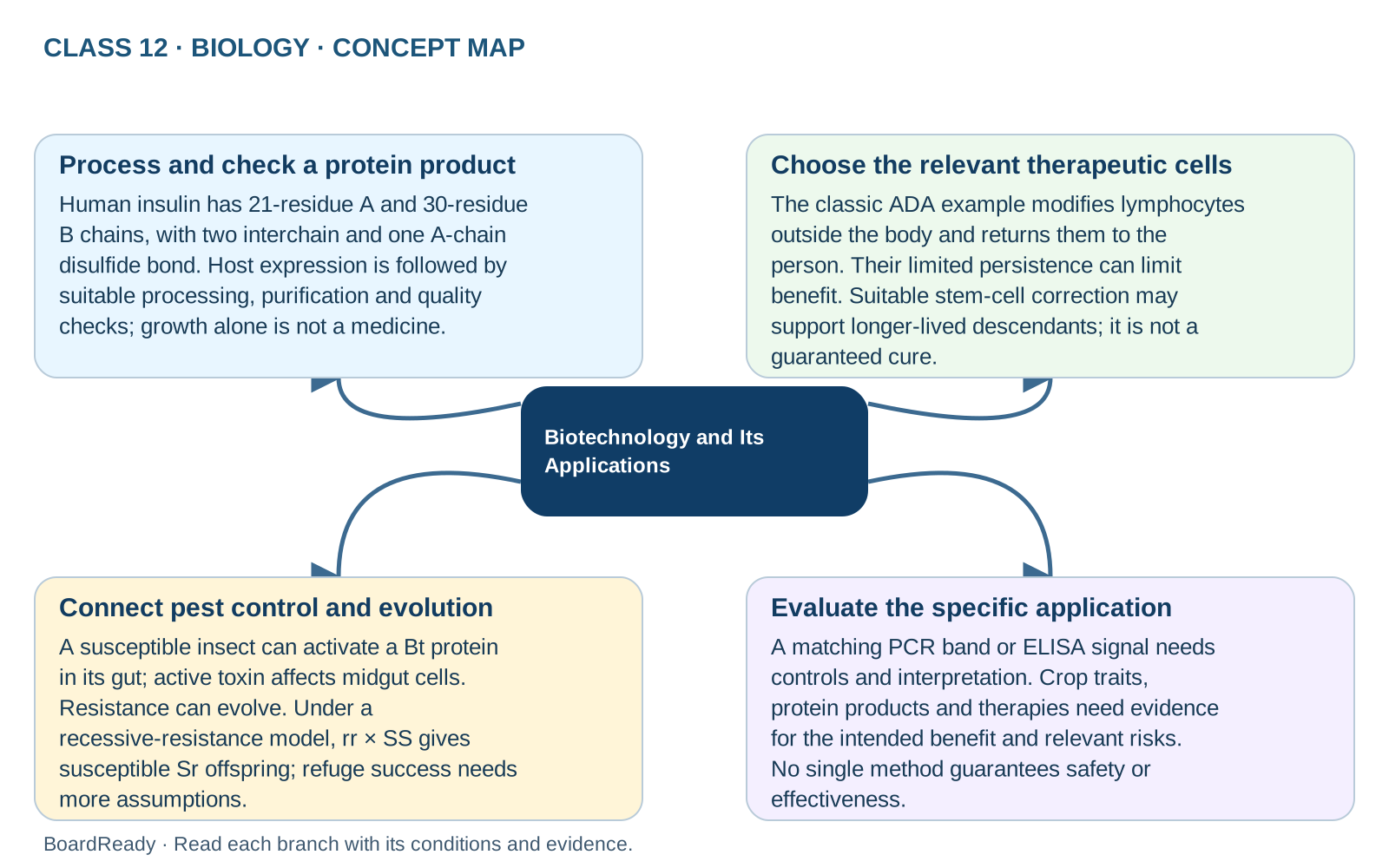
Comparison map
Biotechnology and Its Applications: relationships and examples
Link each application to the molecule or cell that acts, the intended outcome and the evidence needed to assess it. Mechanism and useful performance are separate claims. Process and check a protein product: Human insulin has 21-residue A and 30-residue B chains, with two interchain and one A-chain disulfide bond. Host expression is followed by suitable processing, purification and quality checks; growth alone is not a medicine. Choose the relevant therapeutic cells: The classic ADA example modifies lymphocytes outside the body and returns them to the person. Their limited persistence can limit benefit. Suitable stem-cell correction may support longer-lived descendants; it is not a guaranteed cure. Connect pest control and evolution: A susceptible insect can activate a Bt protein in its gut; active toxin affects midgut cells. Resistance can evolve. Under a recessive-resistance model, rr × SS gives susceptible Sr offspring; refuge success needs more assumptions. Evaluate the specific application: A matching PCR band or ELISA signal needs controls and interpretation. Crop traits, protein products and therapies need evidence for the intended benefit and relevant risks. No single method guarantees safety or effectiveness.Exam cue: Explain how the application works, then identify what the result does and does not establish. Distinguish production from product quality, cell modification from durable benefit, and a conditional refuge model from a universal field outcome.
- 1Biotechnology and Its Applications -> Process and check a protein product: Human insulin has 21-residue A and 30-residue B chains, with two interchain and one A-chain disulfide bond. Host expression is followed by suitable processing, purification and quality checks; growth alone is not a medicine.
- 2Biotechnology and Its Applications -> Choose the relevant therapeutic cells: The classic ADA example modifies lymphocytes outside the body and returns them to the person. Their limited persistence can limit benefit. Suitable stem-cell correction may support longer-lived descendants; it is not a guaranteed cure.
- 3Biotechnology and Its Applications -> Connect pest control and evolution: A susceptible insect can activate a Bt protein in its gut; active toxin affects midgut cells. Resistance can evolve. Under a recessive-resistance model, rr × SS gives susceptible Sr offspring; refuge success needs more assumptions.
- 4Biotechnology and Its Applications -> Evaluate the specific application: A matching PCR band or ELISA signal needs controls and interpretation. Crop traits, protein products and therapies need evidence for the intended benefit and relevant risks. No single method guarantees safety or effectiveness.