Comparison map
Rotational Motion: relationships and examples
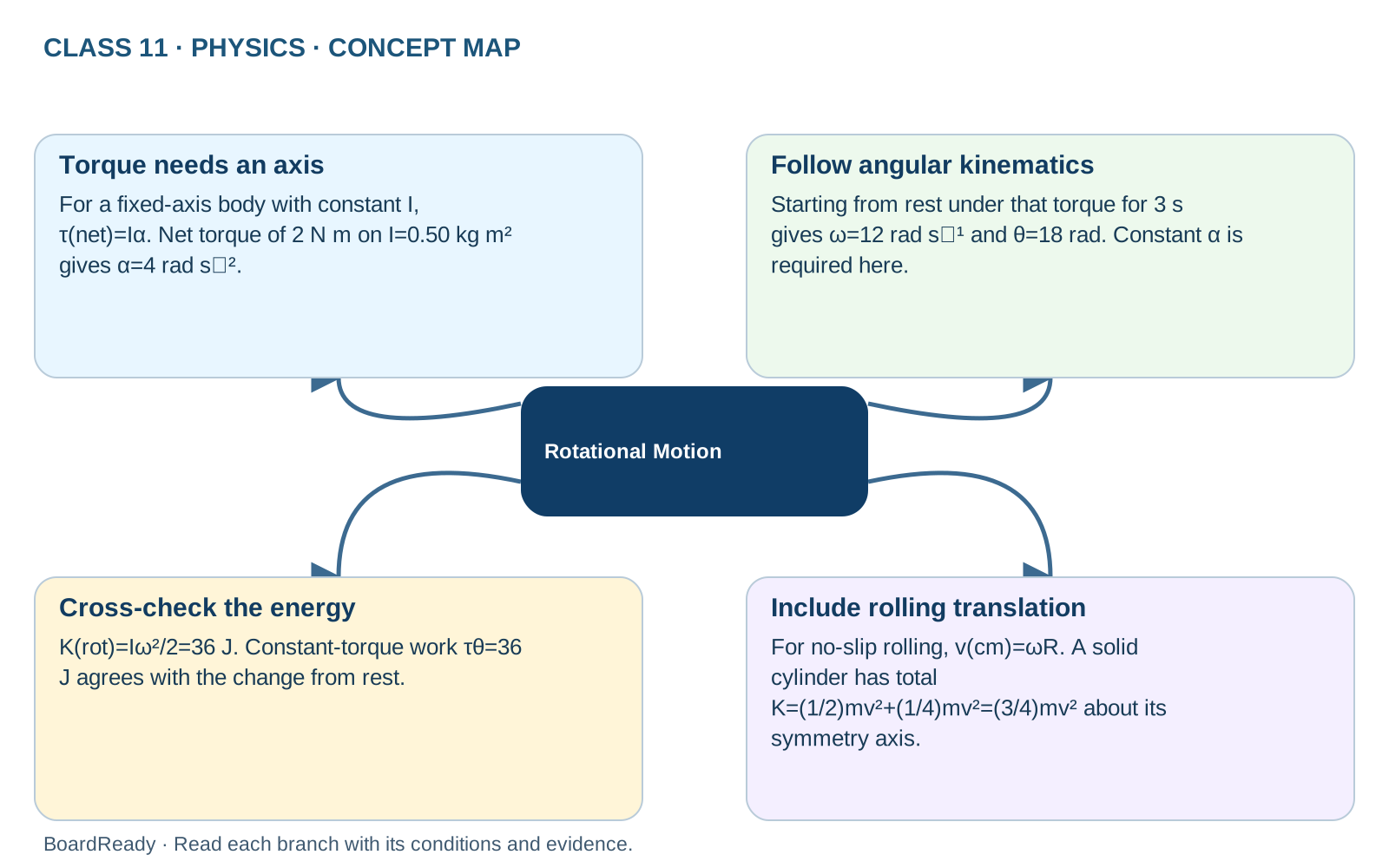
An axis, a mass distribution and torque connect angular acceleration and energy. Torque needs an axis: For a fixed-axis body with constant I, τ(net)=Iα. Net torque of 2 N m on I=0.50 kg m² gives α=4 rad s⁻². Follow angular kinematics: Starting from rest under that torque for 3 s gives ω=12 rad s⁻¹ and θ=18 rad. Constant α is required here. Cross-check the energy: K(rot)=Iω²/2=36 J. Constant-torque work τθ=36 J agrees with the change from rest. Include rolling translation: For no-slip rolling, v(cm)=ωR. A solid cylinder has total K=(1/2)mv²+(1/4)mv²=(3/4)mv² about its symmetry axis.Exam cue: Specify the axis and rolling constraint; torque and energy share dimensions but are different quantities.
- 1Rotational Motion -> Torque needs an axis: For a fixed-axis body with constant I, τ(net)=Iα. Net torque of 2 N m on I=0.50 kg m² gives α=4 rad s⁻².
- 2Rotational Motion -> Follow angular kinematics: Starting from rest under that torque for 3 s gives ω=12 rad s⁻¹ and θ=18 rad. Constant α is required here.
- 3Rotational Motion -> Cross-check the energy: K(rot)=Iω²/2=36 J. Constant-torque work τθ=36 J agrees with the change from rest.
- 4Rotational Motion -> Include rolling translation: For no-slip rolling, v(cm)=ωR. A solid cylinder has total K=(1/2)mv²+(1/4)mv²=(3/4)mv² about its symmetry axis.