Comparison map
Kinematics Review: relationships and examples
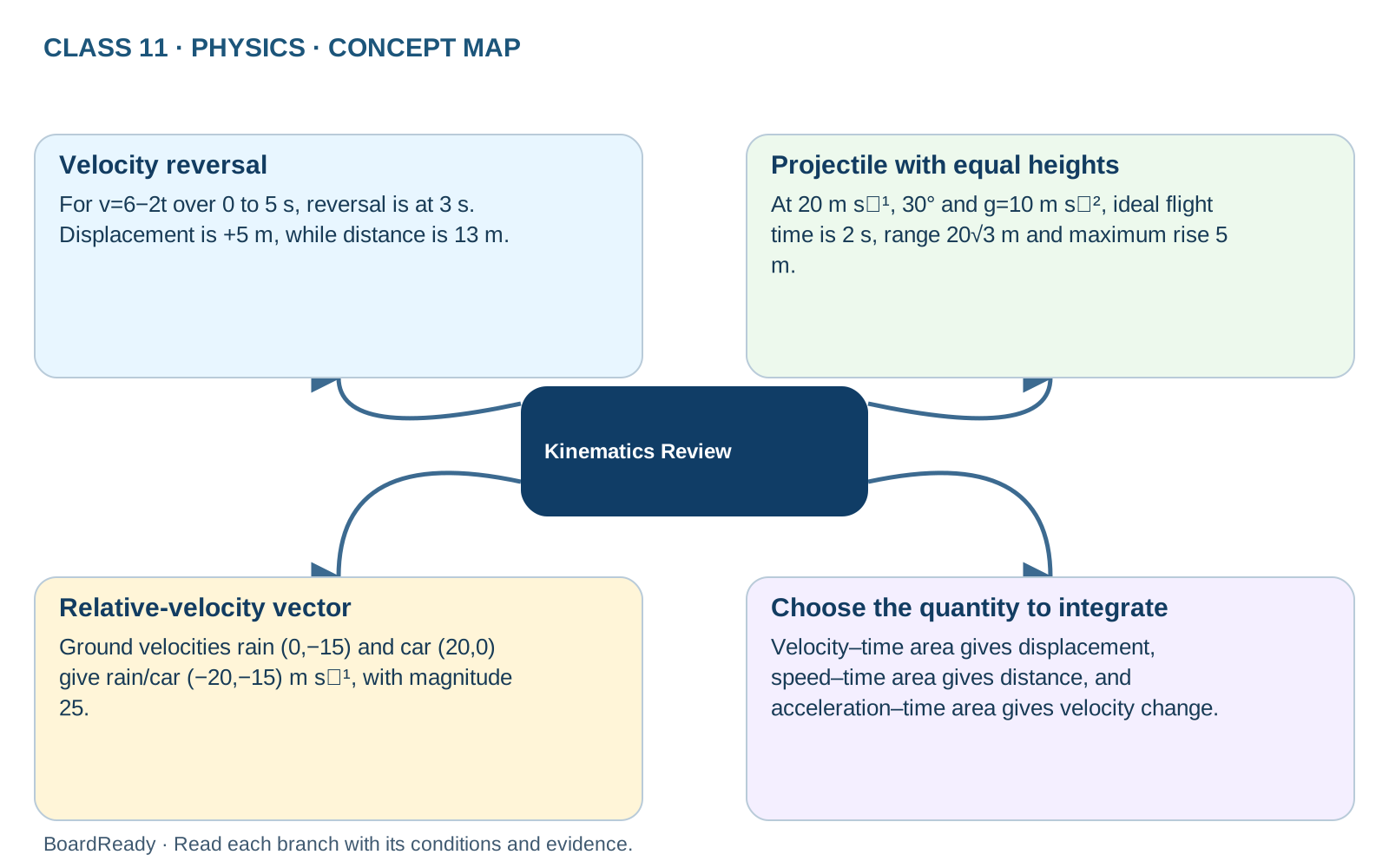
Frames, graph interpretation and common-time component equations connect motion problems. Velocity reversal: For v=6−2t over 0 to 5 s, reversal is at 3 s. Displacement is +5 m, while distance is 13 m. Projectile with equal heights: At 20 m s⁻¹, 30° and g=10 m s⁻², ideal flight time is 2 s, range 20√3 m and maximum rise 5 m. Relative-velocity vector: Ground velocities rain (0,−15) and car (20,0) give rain/car (−20,−15) m s⁻¹, with magnitude 25. Choose the quantity to integrate: Velocity–time area gives displacement, speed–time area gives distance, and acceleration–time area gives velocity change.Exam cue: State axes and the reference frame; mark reversal times and launch/landing heights before applying equations.
- 1Kinematics Review -> Velocity reversal: For v=6−2t over 0 to 5 s, reversal is at 3 s. Displacement is +5 m, while distance is 13 m.
- 2Kinematics Review -> Projectile with equal heights: At 20 m s⁻¹, 30° and g=10 m s⁻², ideal flight time is 2 s, range 20√3 m and maximum rise 5 m.
- 3Kinematics Review -> Relative-velocity vector: Ground velocities rain (0,−15) and car (20,0) give rain/car (−20,−15) m s⁻¹, with magnitude 25.
- 4Kinematics Review -> Choose the quantity to integrate: Velocity–time area gives displacement, speed–time area gives distance, and acceleration–time area gives velocity change.