Comparison map
Probability: relationships and examples
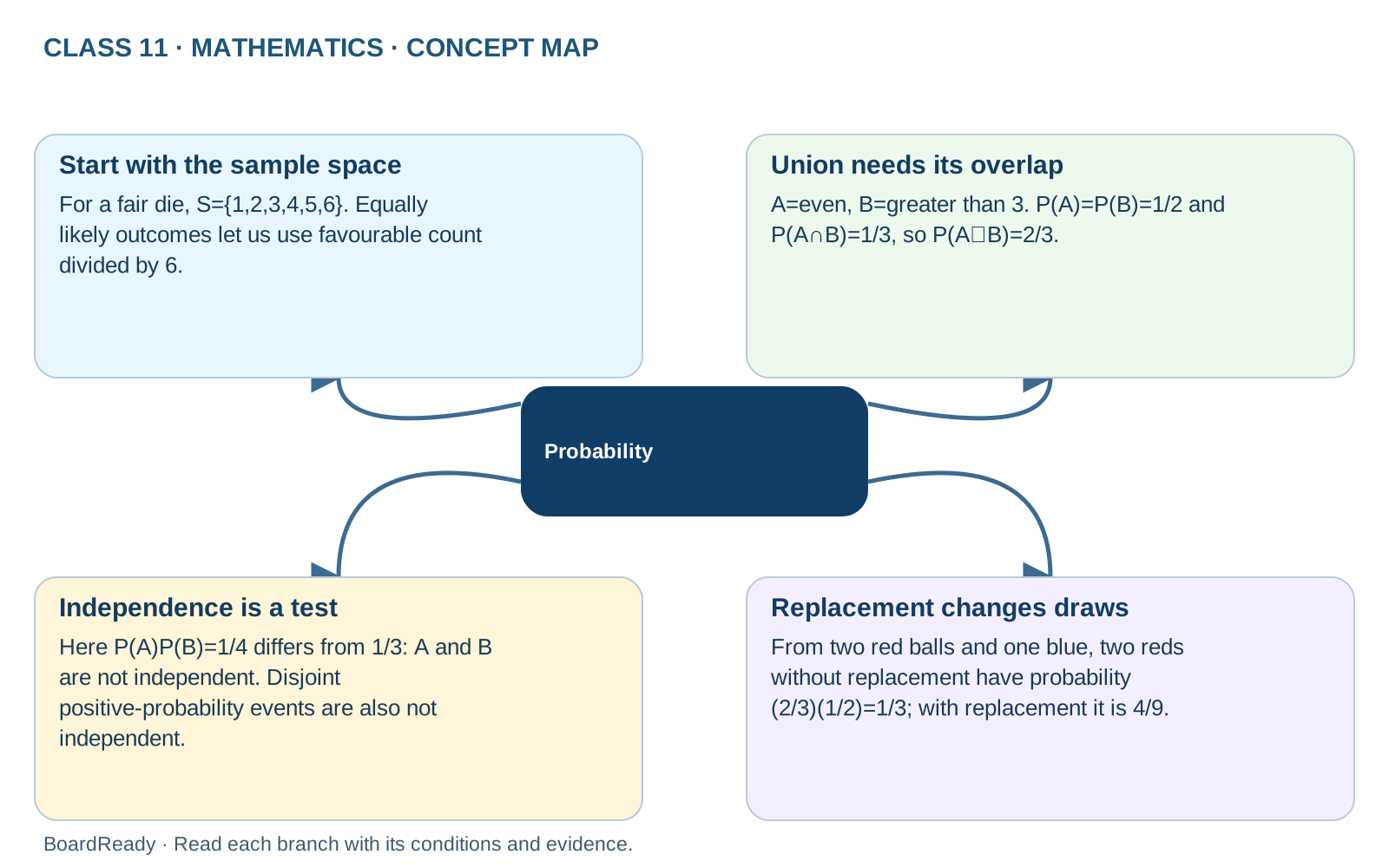
Probabilities combine through overlaps, complements and a declared experiment. Start with the sample space: For a fair die, S={1,2,3,4,5,6}. Equally likely outcomes let us use favourable count divided by 6. Union needs its overlap: A=even, B=greater than 3. P(A)=P(B)=1/2 and P(A∩B)=1/3, so P(A∪B)=2/3. Independence is a test: Here P(A)P(B)=1/4 differs from 1/3: A and B are not independent. Disjoint positive-probability events are also not independent. Replacement changes draws: From two red balls and one blue, two reds without replacement have probability (2/3)(1/2)=1/3; with replacement it is 4/9.Exam cue: State replacement and equiprobability assumptions; never add event probabilities without checking overlap.
- 1Probability -> Start with the sample space: For a fair die, S={1,2,3,4,5,6}. Equally likely outcomes let us use favourable count divided by 6.
- 2Probability -> Union needs its overlap: A=even, B=greater than 3. P(A)=P(B)=1/2 and P(A∩B)=1/3, so P(A∪B)=2/3.
- 3Probability -> Independence is a test: Here P(A)P(B)=1/4 differs from 1/3: A and B are not independent. Disjoint positive-probability events are also not independent.
- 4Probability -> Replacement changes draws: From two red balls and one blue, two reds without replacement have probability (2/3)(1/2)=1/3; with replacement it is 4/9.