Comparison map
Converse, Contrapositive and Contradiction: relationships and examples
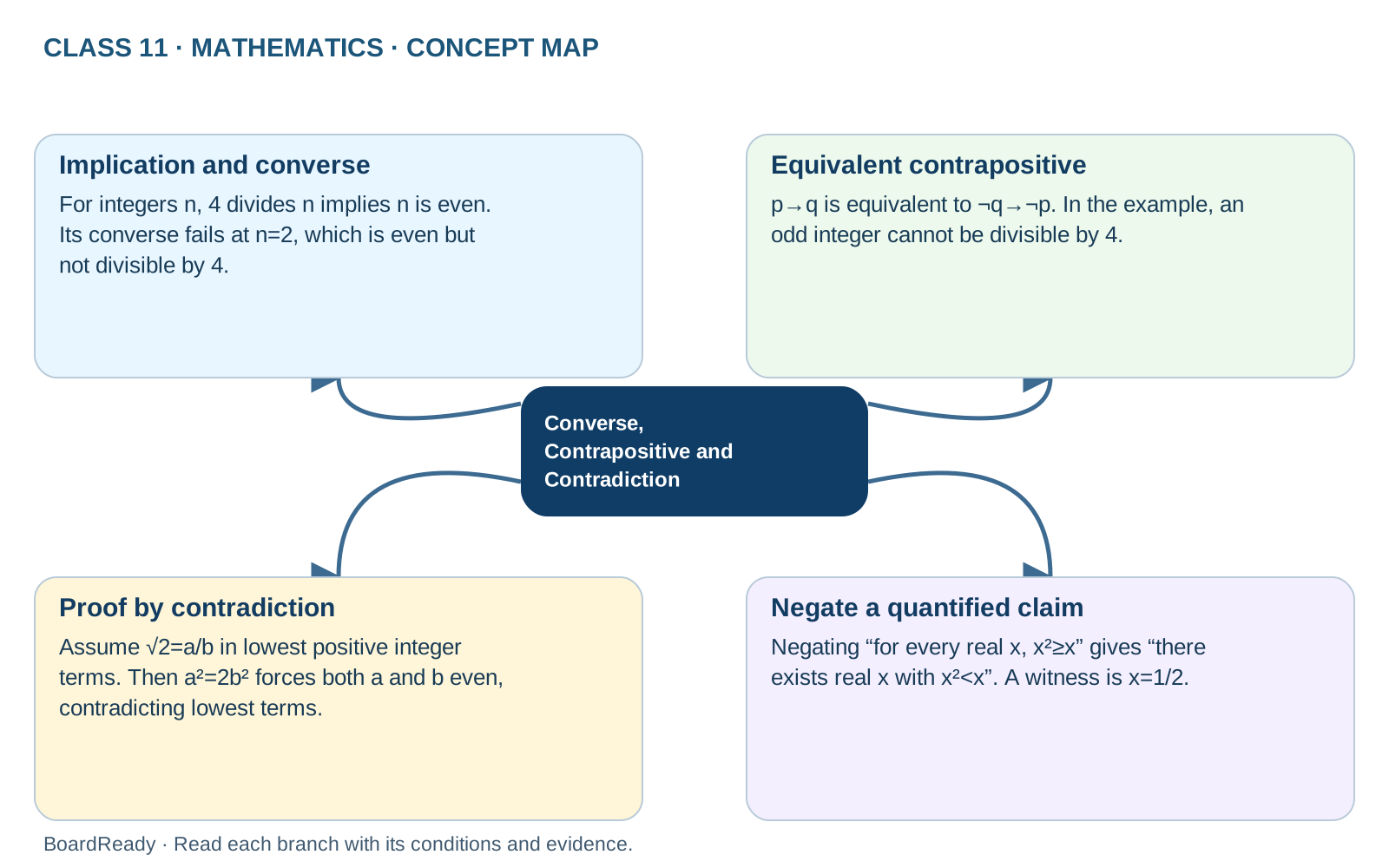
Reversing an implication, negating it and proving by contradiction have different roles. Implication and converse: For integers n, 4 divides n implies n is even. Its converse fails at n=2, which is even but not divisible by 4. Equivalent contrapositive: p→q is equivalent to ¬q→¬p. In the example, an odd integer cannot be divisible by 4. Proof by contradiction: Assume √2=a/b in lowest positive integer terms. Then a²=2b² forces both a and b even, contradicting lowest terms. Negate a quantified claim: Negating “for every real x, x²≥x” gives “there exists real x with x²<x”. A witness is x=1/2.Exam cue: A single counterexample refutes a universal claim; an equivalent contrapositive preserves its truth value.
- 1Converse, Contrapositive and Contradiction -> Implication and converse: For integers n, 4 divides n implies n is even. Its converse fails at n=2, which is even but not divisible by 4.
- 2Converse, Contrapositive and Contradiction -> Equivalent contrapositive: p→q is equivalent to ¬q→¬p. In the example, an odd integer cannot be divisible by 4.
- 3Converse, Contrapositive and Contradiction -> Proof by contradiction: Assume √2=a/b in lowest positive integer terms. Then a²=2b² forces both a and b even, contradicting lowest terms.
- 4Converse, Contrapositive and Contradiction -> Negate a quantified claim: Negating “for every real x, x²≥x” gives “there exists real x with x²<x”. A witness is x=1/2.