Comparison map
Circles: relationships and examples
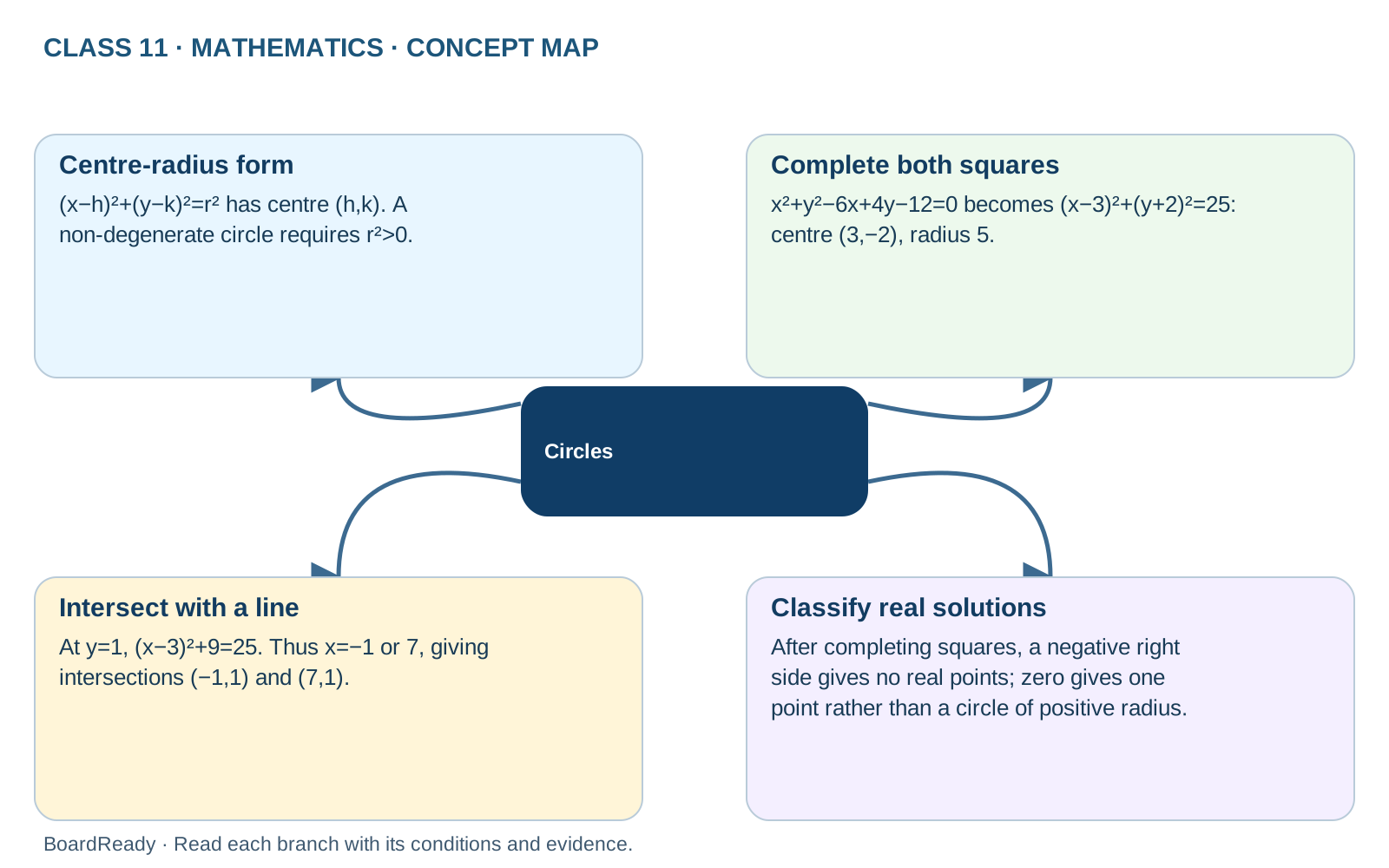
Completing squares exposes a circle’s centre and the real-point condition. Centre-radius form: (x−h)²+(y−k)²=r² has centre (h,k). A non-degenerate circle requires r²>0. Complete both squares: x²+y²−6x+4y−12=0 becomes (x−3)²+(y+2)²=25: centre (3,−2), radius 5. Intersect with a line: At y=1, (x−3)²+9=25. Thus x=−1 or 7, giving intersections (−1,1) and (7,1). Classify real solutions: After completing squares, a negative right side gives no real points; zero gives one point rather than a circle of positive radius.Exam cue: Substitute intersections into both original equations and read the signs of centre coordinates carefully.
- 1Circles -> Centre-radius form: (x−h)²+(y−k)²=r² has centre (h,k). A non-degenerate circle requires r²>0.
- 2Circles -> Complete both squares: x²+y²−6x+4y−12=0 becomes (x−3)²+(y+2)²=25: centre (3,−2), radius 5.
- 3Circles -> Intersect with a line: At y=1, (x−3)²+9=25. Thus x=−1 or 7, giving intersections (−1,1) and (7,1).
- 4Circles -> Classify real solutions: After completing squares, a negative right side gives no real points; zero gives one point rather than a circle of positive radius.