Comparison map
Sequence and Series: relationships and examples
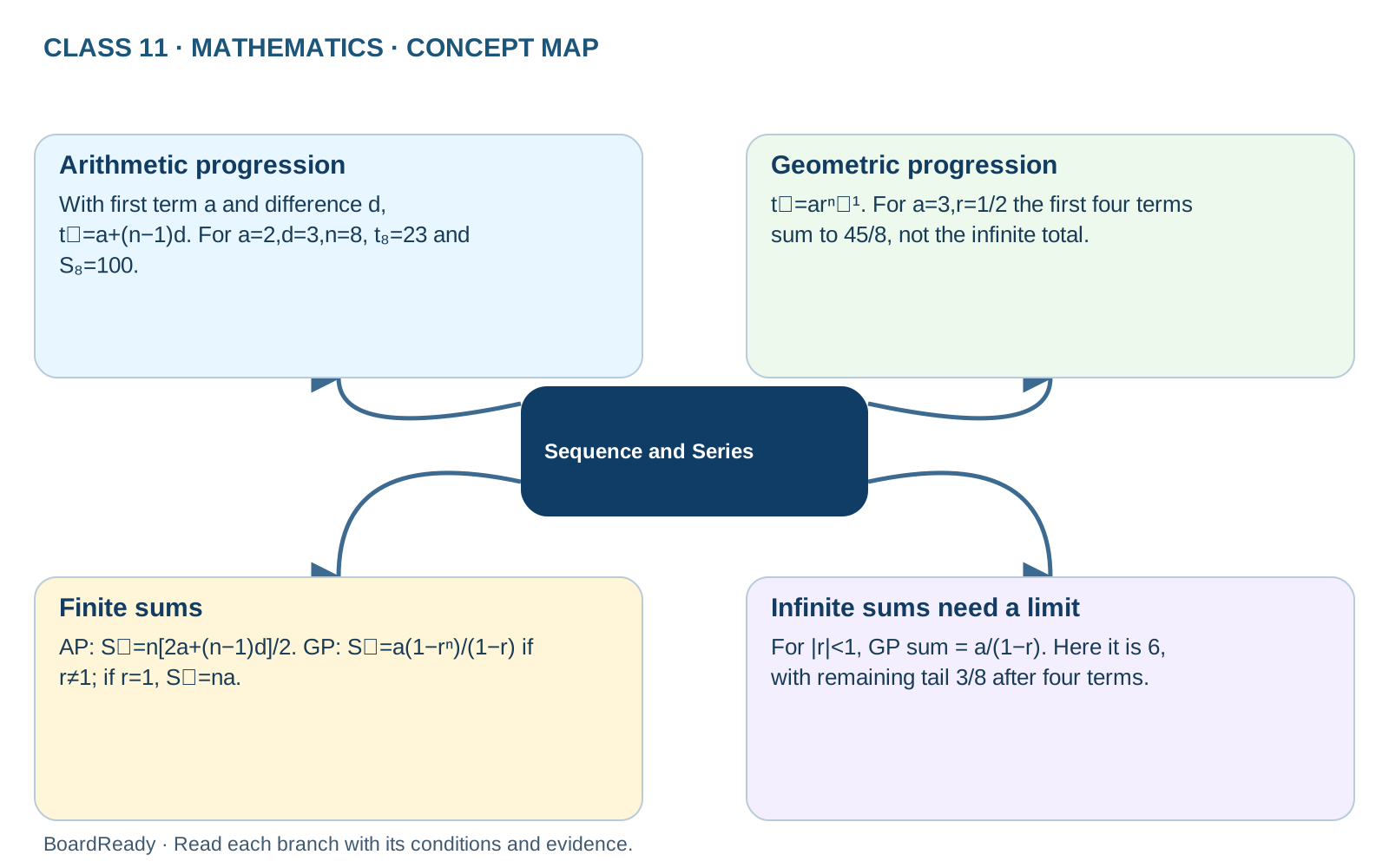
A sequence lists terms; a series adds them, with separate finite and limiting rules. Arithmetic progression: With first term a and difference d, tₙ=a+(n−1)d. For a=2,d=3,n=8, t₈=23 and S₈=100. Geometric progression: tₙ=arⁿ⁻¹. For a=3,r=1/2 the first four terms sum to 45/8, not the infinite total. Finite sums: AP: Sₙ=n[2a+(n−1)d]/2. GP: Sₙ=a(1−rⁿ)/(1−r) if r≠1; if r=1, Sₙ=na. Infinite sums need a limit: For |r|<1, GP sum = a/(1−r). Here it is 6, with remaining tail 3/8 after four terms.Exam cue: State a positive integer term count, and check convergence before using an infinite sum.
- 1Sequence and Series -> Arithmetic progression: With first term a and difference d, tₙ=a+(n−1)d. For a=2,d=3,n=8, t₈=23 and S₈=100.
- 2Sequence and Series -> Geometric progression: tₙ=arⁿ⁻¹. For a=3,r=1/2 the first four terms sum to 45/8, not the infinite total.
- 3Sequence and Series -> Finite sums: AP: Sₙ=n[2a+(n−1)d]/2. GP: Sₙ=a(1−rⁿ)/(1−r) if r≠1; if r=1, Sₙ=na.
- 4Sequence and Series -> Infinite sums need a limit: For |r|<1, GP sum = a/(1−r). Here it is 6, with remaining tail 3/8 after four terms.