Comparison map
Permutations and Combinations: relationships and examples
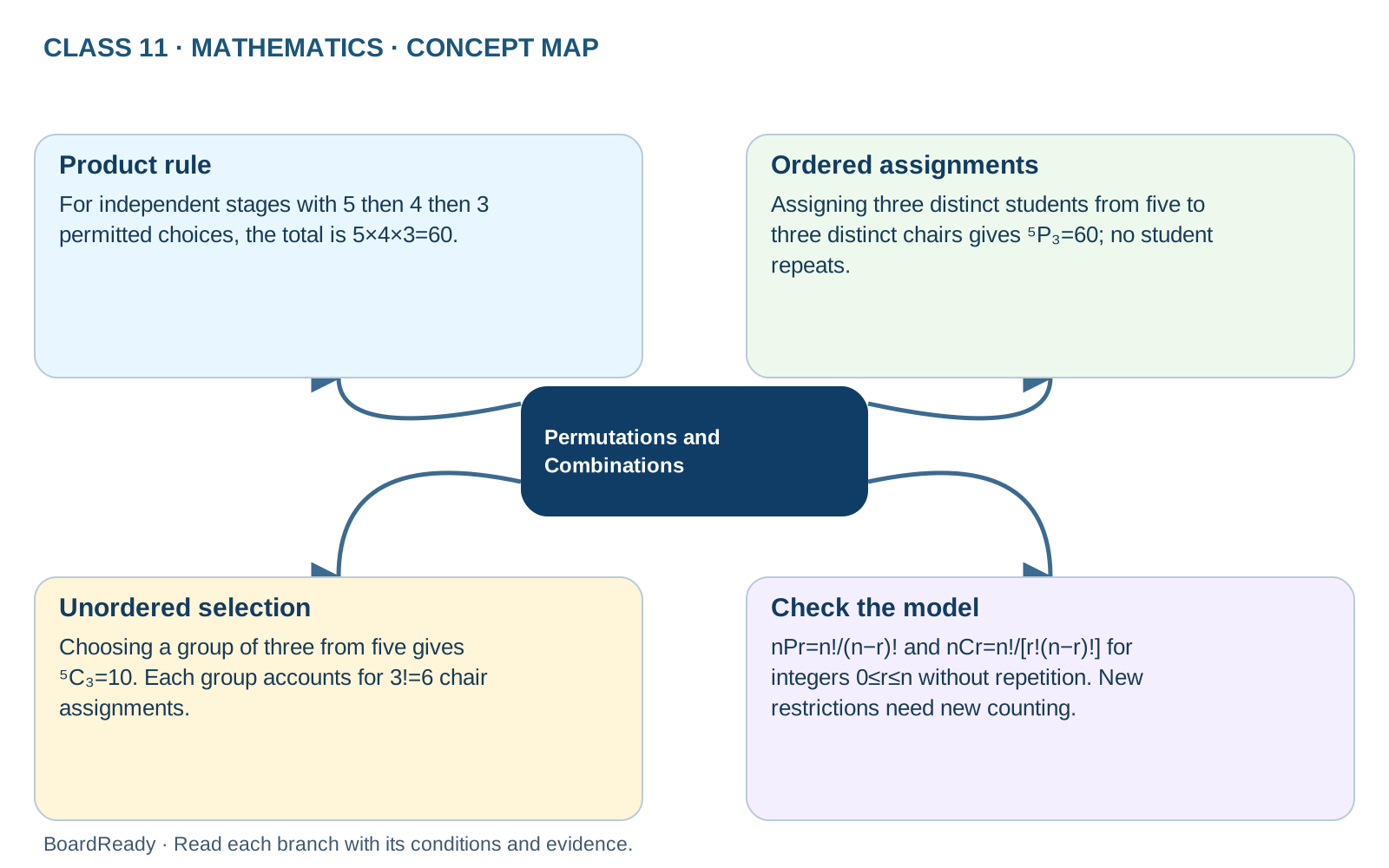
Counting changes when order, repetition or restrictions change. Product rule: For independent stages with 5 then 4 then 3 permitted choices, the total is 5×4×3=60. Ordered assignments: Assigning three distinct students from five to three distinct chairs gives ⁵P₃=60; no student repeats. Unordered selection: Choosing a group of three from five gives ⁵C₃=10. Each group accounts for 3!=6 chair assignments. Check the model: nPr=n!/(n−r)! and nCr=n!/[r!(n−r)!] for integers 0≤r≤n without repetition. New restrictions need new counting.Exam cue: Describe what one outcome is before choosing a permutation or a combination.
- 1Permutations and Combinations -> Product rule: For independent stages with 5 then 4 then 3 permitted choices, the total is 5×4×3=60.
- 2Permutations and Combinations -> Ordered assignments: Assigning three distinct students from five to three distinct chairs gives ⁵P₃=60; no student repeats.
- 3Permutations and Combinations -> Unordered selection: Choosing a group of three from five gives ⁵C₃=10. Each group accounts for 3!=6 chair assignments.
- 4Permutations and Combinations -> Check the model: nPr=n!/(n−r)! and nCr=n!/[r!(n−r)!] for integers 0≤r≤n without repetition. New restrictions need new counting.