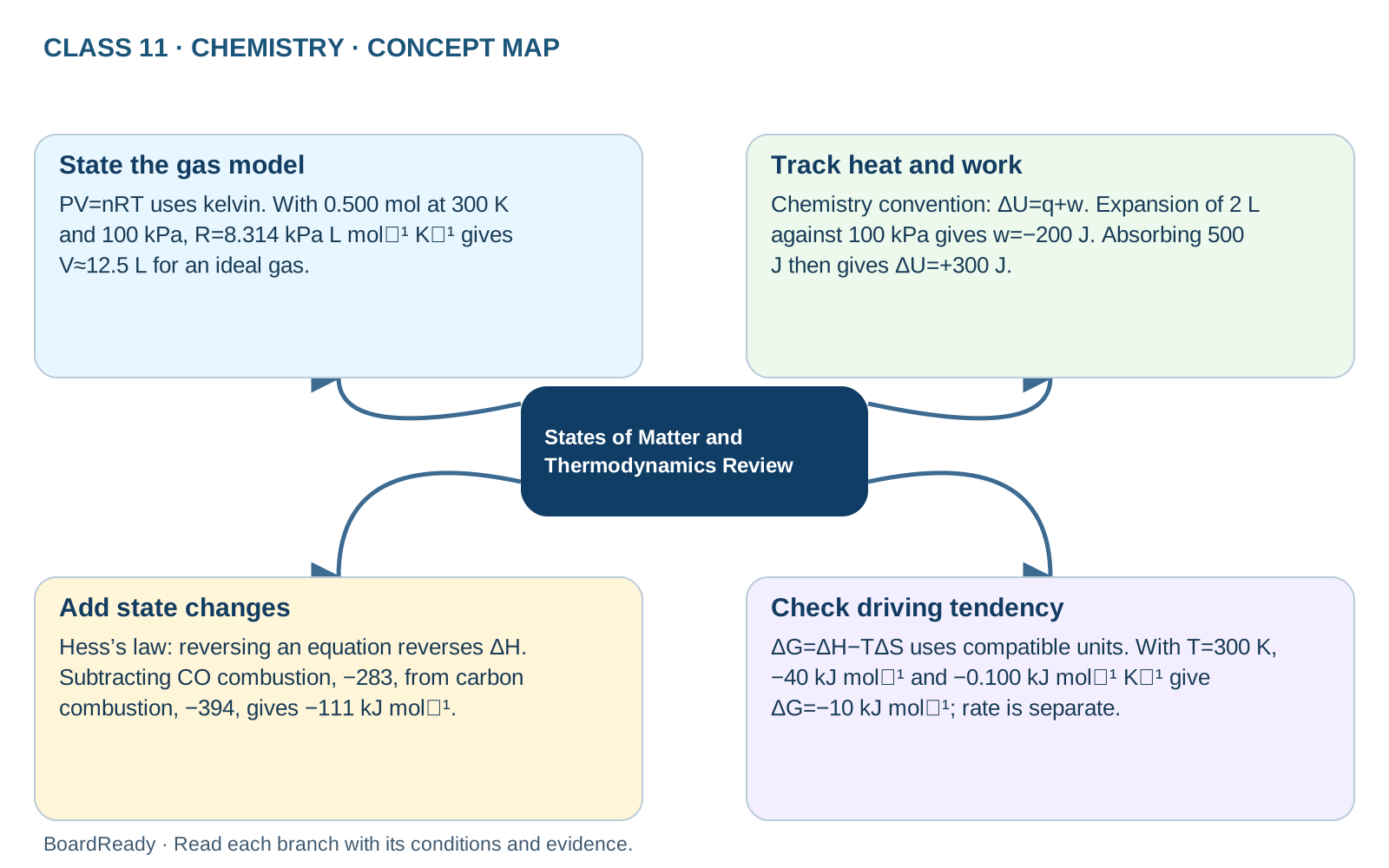
Comparison map
States of Matter and Thermodynamics Review: relationships and examples
Gas behaviour and energy accounting require consistent units, declared signs and explicit model conditions. State the gas model: PV=nRT uses kelvin. With 0.500 mol at 300 K and 100 kPa, R=8.314 kPa L mol⁻¹ K⁻¹ gives V≈12.5 L for an ideal gas. Track heat and work: Chemistry convention: ΔU=q+w. Expansion of 2 L against 100 kPa gives w=−200 J. Absorbing 500 J then gives ΔU=+300 J. Add state changes: Hess’s law: reversing an equation reverses ΔH. Subtracting CO combustion, −283, from carbon combustion, −394, gives −111 kJ mol⁻¹. Check driving tendency: ΔG=ΔH−TΔS uses compatible units. With T=300 K, −40 kJ mol⁻¹ and −0.100 kJ mol⁻¹ K⁻¹ give ΔG=−10 kJ mol⁻¹; rate is separate.Exam cue: Define the system and signs; do not confuse spontaneity with speed or a state function with a path transfer.
- 1States of Matter and Thermodynamics Review -> State the gas model: PV=nRT uses kelvin. With 0.500 mol at 300 K and 100 kPa, R=8.314 kPa L mol⁻¹ K⁻¹ gives V≈12.5 L for an ideal gas.
- 2States of Matter and Thermodynamics Review -> Track heat and work: Chemistry convention: ΔU=q+w. Expansion of 2 L against 100 kPa gives w=−200 J. Absorbing 500 J then gives ΔU=+300 J.
- 3States of Matter and Thermodynamics Review -> Add state changes: Hess’s law: reversing an equation reverses ΔH. Subtracting CO combustion, −283, from carbon combustion, −394, gives −111 kJ mol⁻¹.
- 4States of Matter and Thermodynamics Review -> Check driving tendency: ΔG=ΔH−TΔS uses compatible units. With T=300 K, −40 kJ mol⁻¹ and −0.100 kJ mol⁻¹ K⁻¹ give ΔG=−10 kJ mol⁻¹; rate is separate.