Comparison map
Stoichiometry: relationships and examples
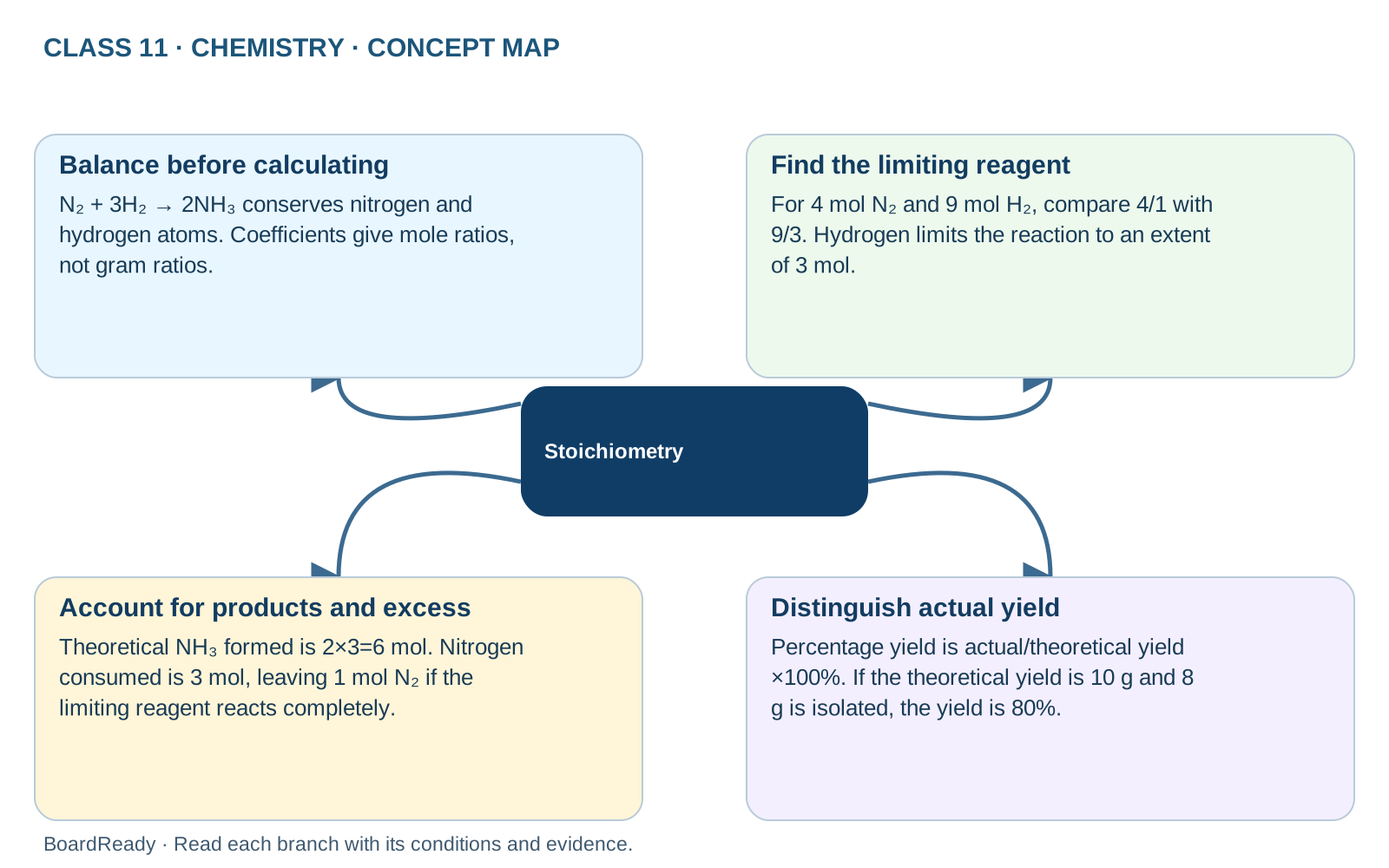
A balanced equation links reactant supply to theoretical product yield through mole ratios. Balance before calculating: N₂ + 3H₂ → 2NH₃ conserves nitrogen and hydrogen atoms. Coefficients give mole ratios, not gram ratios. Find the limiting reagent: For 4 mol N₂ and 9 mol H₂, compare 4/1 with 9/3. Hydrogen limits the reaction to an extent of 3 mol. Account for products and excess: Theoretical NH₃ formed is 2×3=6 mol. Nitrogen consumed is 3 mol, leaving 1 mol N₂ if the limiting reagent reacts completely. Distinguish actual yield: Percentage yield is actual/theoretical yield ×100%. If the theoretical yield is 10 g and 8 g is isolated, the yield is 80%.Exam cue: Convert masses to moles first and distinguish limiting supply, conversion and recovered product.
- 1Stoichiometry -> Balance before calculating: N₂ + 3H₂ → 2NH₃ conserves nitrogen and hydrogen atoms. Coefficients give mole ratios, not gram ratios.
- 2Stoichiometry -> Find the limiting reagent: For 4 mol N₂ and 9 mol H₂, compare 4/1 with 9/3. Hydrogen limits the reaction to an extent of 3 mol.
- 3Stoichiometry -> Account for products and excess: Theoretical NH₃ formed is 2×3=6 mol. Nitrogen consumed is 3 mol, leaving 1 mol N₂ if the limiting reagent reacts completely.
- 4Stoichiometry -> Distinguish actual yield: Percentage yield is actual/theoretical yield ×100%. If the theoretical yield is 10 g and 8 g is isolated, the yield is 80%.