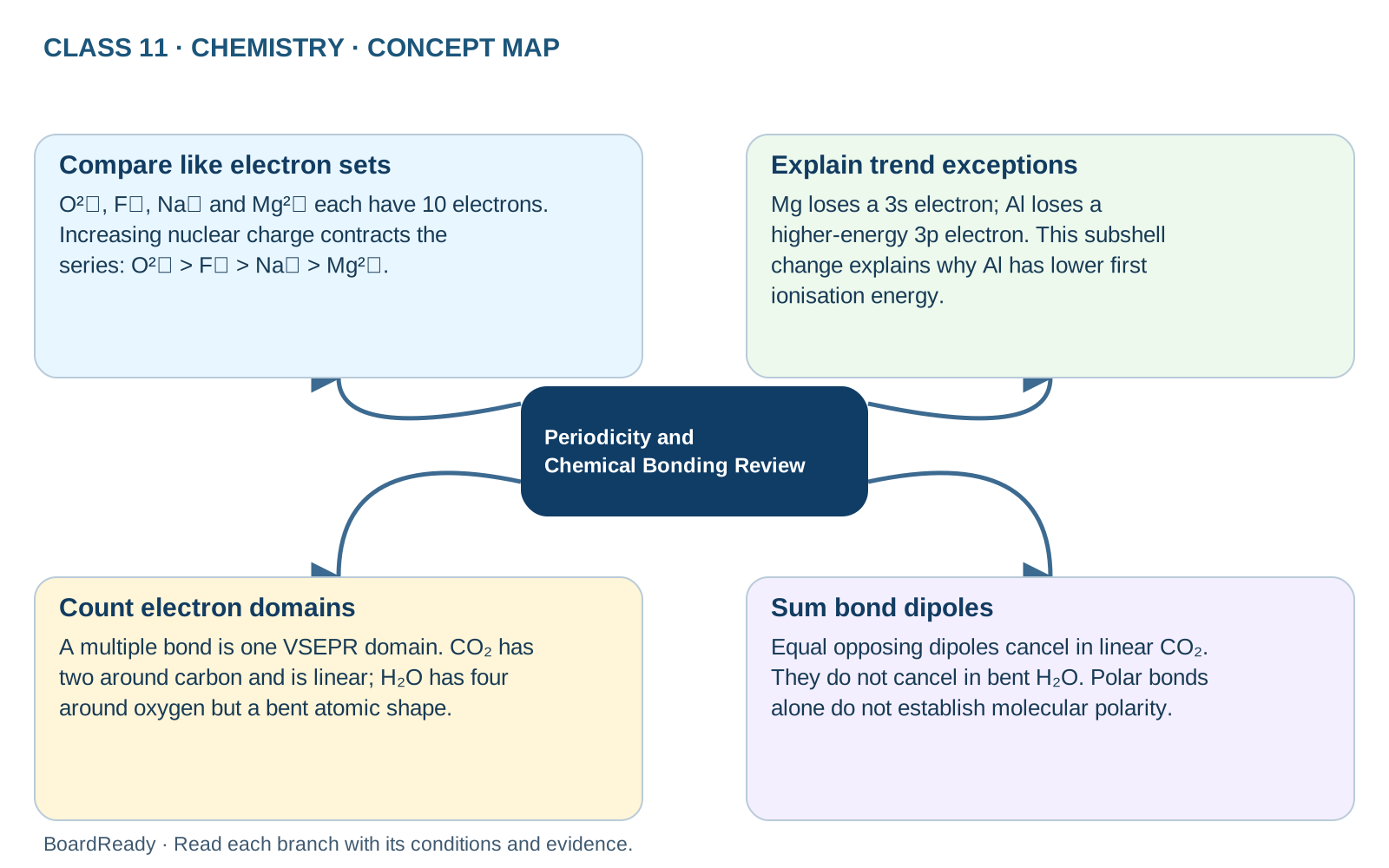
Comparison map
Periodicity and Chemical Bonding Review: relationships and examples
Use electron arrangement to connect periodic comparisons, bonding, molecular geometry and measurable properties. Compare like electron sets: O²⁻, F⁻, Na⁺ and Mg²⁺ each have 10 electrons. Increasing nuclear charge contracts the series: O²⁻ > F⁻ > Na⁺ > Mg²⁺. Explain trend exceptions: Mg loses a 3s electron; Al loses a higher-energy 3p electron. This subshell change explains why Al has lower first ionisation energy. Count electron domains: A multiple bond is one VSEPR domain. CO₂ has two around carbon and is linear; H₂O has four around oxygen but a bent atomic shape. Sum bond dipoles: Equal opposing dipoles cancel in linear CO₂. They do not cancel in bent H₂O. Polar bonds alone do not establish molecular polarity.Exam cue: Count valence electrons, distinguish domains from atom positions and justify each comparison electronically.
- 1Periodicity and Chemical Bonding Review -> Compare like electron sets: O²⁻, F⁻, Na⁺ and Mg²⁺ each have 10 electrons. Increasing nuclear charge contracts the series: O²⁻ > F⁻ > Na⁺ > Mg²⁺.
- 2Periodicity and Chemical Bonding Review -> Explain trend exceptions: Mg loses a 3s electron; Al loses a higher-energy 3p electron. This subshell change explains why Al has lower first ionisation energy.
- 3Periodicity and Chemical Bonding Review -> Count electron domains: A multiple bond is one VSEPR domain. CO₂ has two around carbon and is linear; H₂O has four around oxygen but a bent atomic shape.
- 4Periodicity and Chemical Bonding Review -> Sum bond dipoles: Equal opposing dipoles cancel in linear CO₂. They do not cancel in bent H₂O. Polar bonds alone do not establish molecular polarity.