Comparison map
Hydrocarbons: relationships and examples
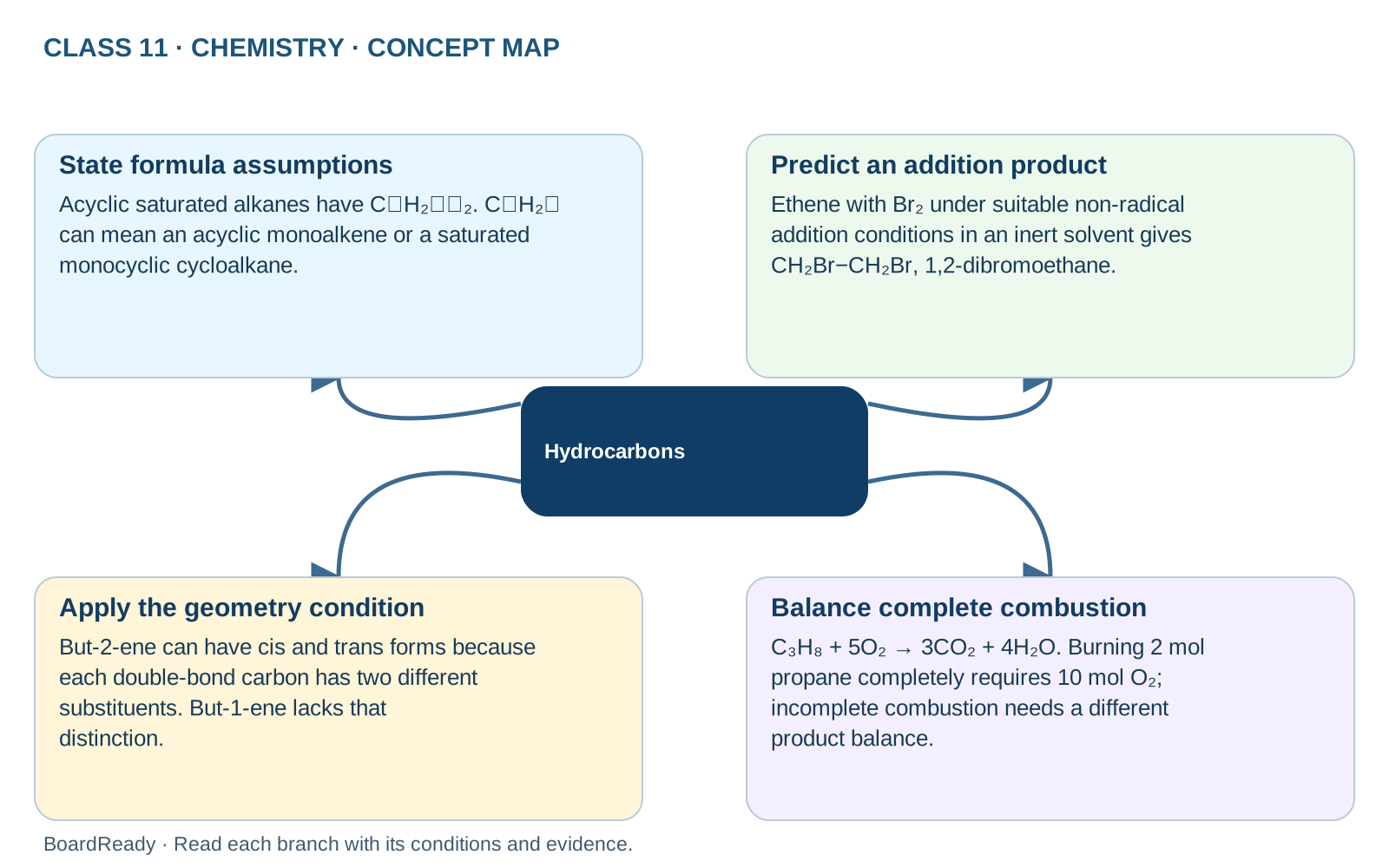
Carbon connectivity, bond type and reaction conditions distinguish hydrocarbon families and their products. State formula assumptions: Acyclic saturated alkanes have CₙH₂ₙ₊₂. CₙH₂ₙ can mean an acyclic monoalkene or a saturated monocyclic cycloalkane. Predict an addition product: Ethene with Br₂ under suitable non-radical addition conditions in an inert solvent gives CH₂ Br−CH₂ Br, 1,2-dibromoethane. Apply the geometry condition: But-2-ene can have cis and trans forms because each double-bond carbon has two different substituents. But-1-ene lacks that distinction. Balance complete combustion: C₃H₈ + 5O₂ → 3CO₂ + 4H₂O. Burning 2 mol propane completely requires 10 mol O₂; incomplete combustion needs a different product balance.Exam cue: Distinguish addition, substitution and combustion; a molecular formula alone does not establish saturation or connectivity.
- 1Hydrocarbons -> State formula assumptions: Acyclic saturated alkanes have CₙH₂ₙ₊₂. CₙH₂ₙ can mean an acyclic monoalkene or a saturated monocyclic cycloalkane.
- 2Hydrocarbons -> Predict an addition product: Ethene with Br₂ under suitable non-radical addition conditions in an inert solvent gives CH₂ Br−CH₂ Br, 1,2-dibromoethane.
- 3Hydrocarbons -> Apply the geometry condition: But-2-ene can have cis and trans forms because each double-bond carbon has two different substituents. But-1-ene lacks that distinction.
- 4Hydrocarbons -> Balance complete combustion: C₃H₈ + 5O₂ → 3CO₂ + 4H₂O. Burning 2 mol propane completely requires 10 mol O₂; incomplete combustion needs a different product balance.