Comparison map
Organic Chemistry Review: relationships and examples
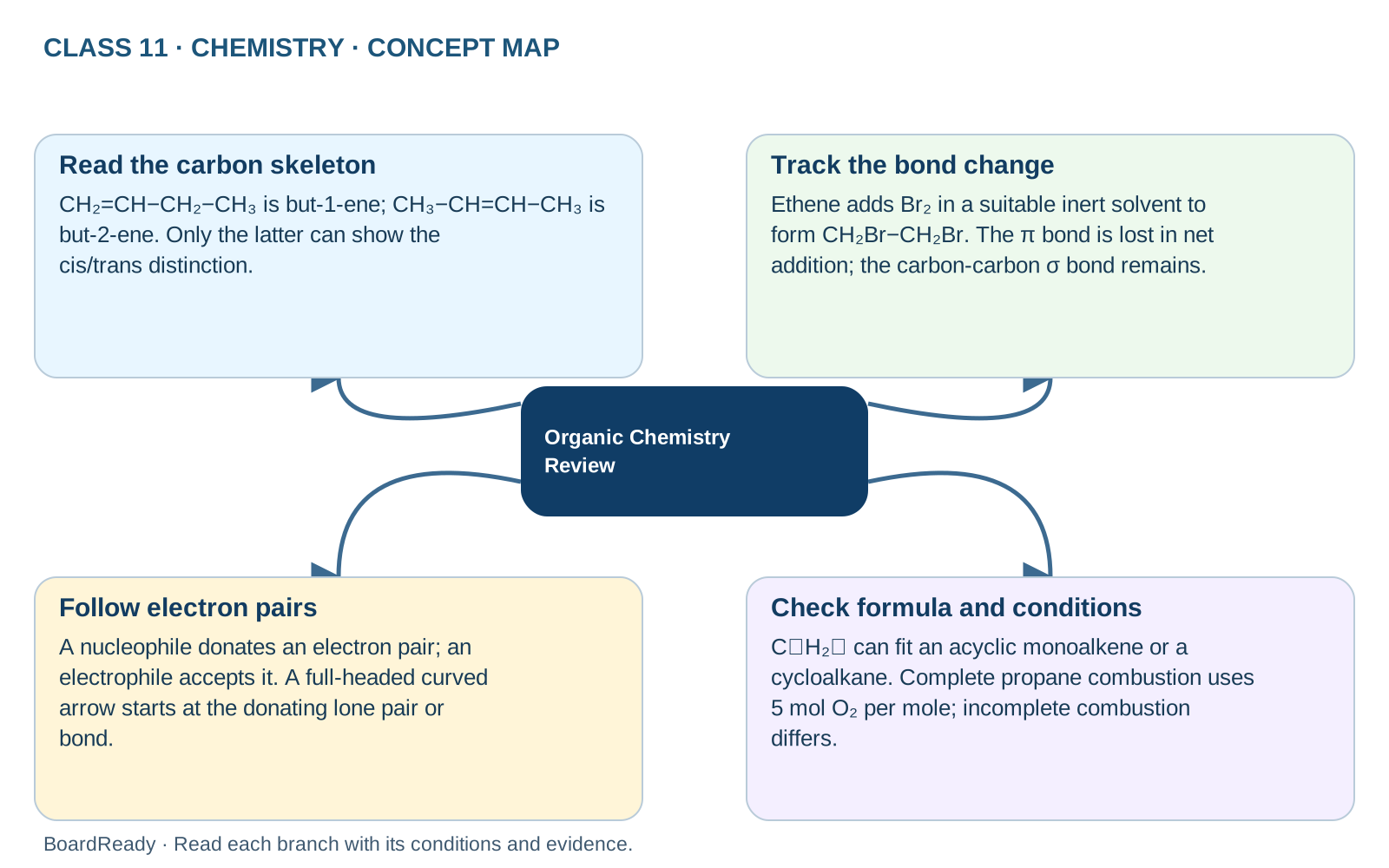
Read connectivity before naming or predicting reactions. Use electron movement, conditions and atom balance to justify a product. Read the carbon skeleton: CH₂=CH−CH₂−CH₃ is but-1-ene; CH₃−CH=CH−CH₃ is but-2-ene. Only the latter can show the cis/trans distinction. Track the bond change: Ethene adds Br₂ in a suitable inert solvent to form CH₂ Br−CH₂ Br. The π bond is lost in net addition; the carbon-carbon σ bond remains. Follow electron pairs: A nucleophile donates an electron pair; an electrophile accepts it. A full-headed curved arrow starts at the donating lone pair or bond. Check formula and conditions: CₙH₂ₙ can fit an acyclic monoalkene or a cycloalkane. Complete propane combustion uses 5 mol O₂ per mole; incomplete combustion differs.Exam cue: A molecular formula does not give connectivity; verify valence, charge, reaction conditions and the balanced equation.
- 1Organic Chemistry Review -> Read the carbon skeleton: CH₂=CH−CH₂−CH₃ is but-1-ene; CH₃−CH=CH−CH₃ is but-2-ene. Only the latter can show the cis/trans distinction.
- 2Organic Chemistry Review -> Track the bond change: Ethene adds Br₂ in a suitable inert solvent to form CH₂ Br−CH₂ Br. The π bond is lost in net addition; the carbon-carbon σ bond remains.
- 3Organic Chemistry Review -> Follow electron pairs: A nucleophile donates an electron pair; an electrophile accepts it. A full-headed curved arrow starts at the donating lone pair or bond.
- 4Organic Chemistry Review -> Check formula and conditions: CₙH₂ₙ can fit an acyclic monoalkene or a cycloalkane. Complete propane combustion uses 5 mol O₂ per mole; incomplete combustion differs.