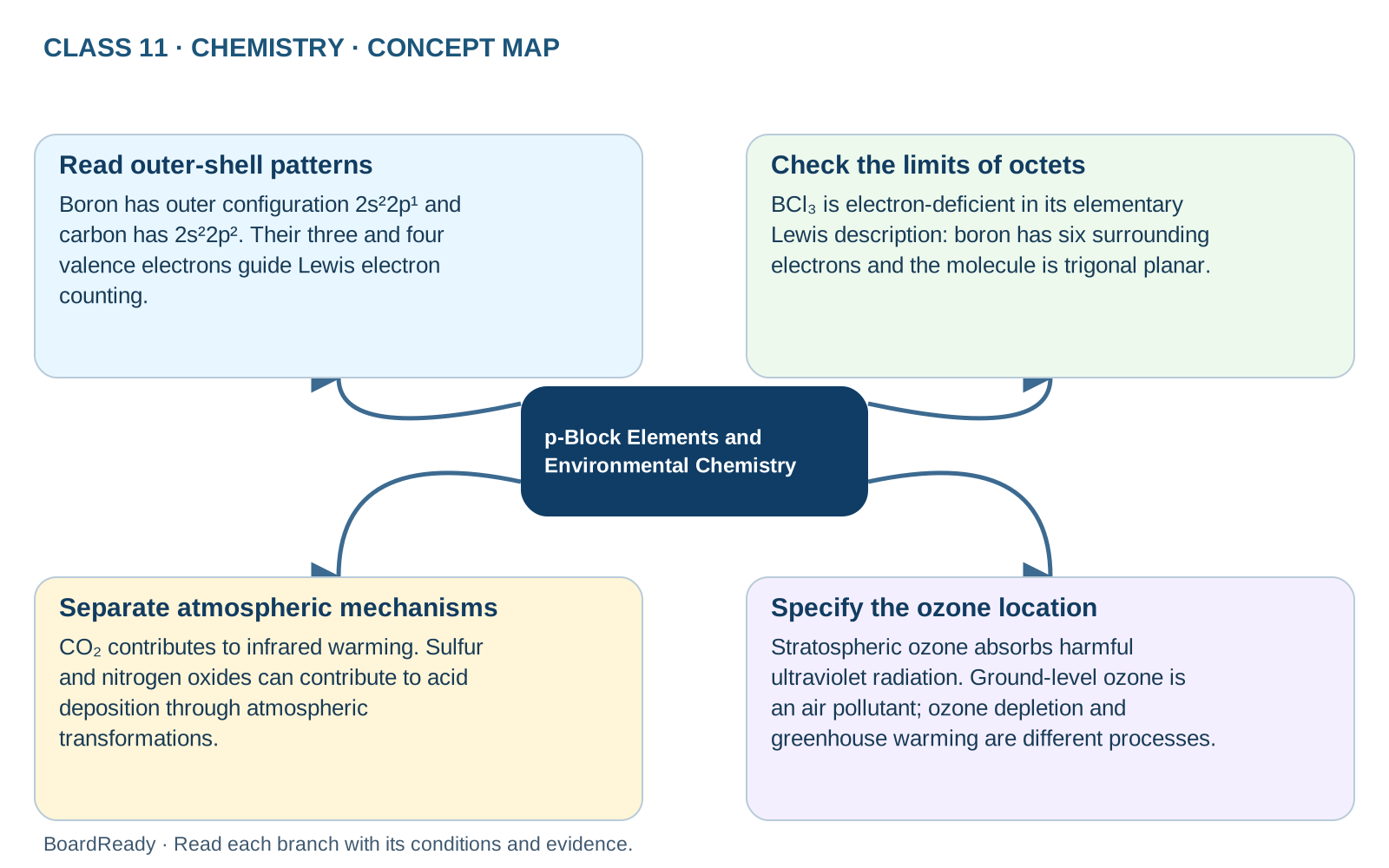
Comparison map
p-Block Elements and Environmental Chemistry: relationships and examples
Representative compounds and atmospheric chemistry require structure, oxidation state and location-specific explanations. Read outer-shell patterns: Boron has outer configuration 2s²2p¹ and carbon has 2s²2p². Their three and four valence electrons guide Lewis electron counting. Check the limits of octets: BCl₃ is electron-deficient in its elementary Lewis description: boron has six surrounding electrons and the molecule is trigonal planar. Separate atmospheric mechanisms: CO₂ contributes to infrared warming. Sulfur and nitrogen oxides can contribute to acid deposition through atmospheric transformations. Specify the ozone location: Stratospheric ozone absorbs harmful ultraviolet radiation. Ground-level ozone is an air pollutant; ozone depletion and greenhouse warming are different processes.Exam cue: Link a named species to a process and location. Do not use pollution, warming and ozone depletion as interchangeable labels.
- 1p-Block Elements and Environmental Chemistry -> Read outer-shell patterns: Boron has outer configuration 2s²2p¹ and carbon has 2s²2p². Their three and four valence electrons guide Lewis electron counting.
- 2p-Block Elements and Environmental Chemistry -> Check the limits of octets: BCl₃ is electron-deficient in its elementary Lewis description: boron has six surrounding electrons and the molecule is trigonal planar.
- 3p-Block Elements and Environmental Chemistry -> Separate atmospheric mechanisms: CO₂ contributes to infrared warming. Sulfur and nitrogen oxides can contribute to acid deposition through atmospheric transformations.
- 4p-Block Elements and Environmental Chemistry -> Specify the ozone location: Stratospheric ozone absorbs harmful ultraviolet radiation. Ground-level ozone is an air pollutant; ozone depletion and greenhouse warming are different processes.