Comparison map
Inorganic Chemistry Review: relationships and examples
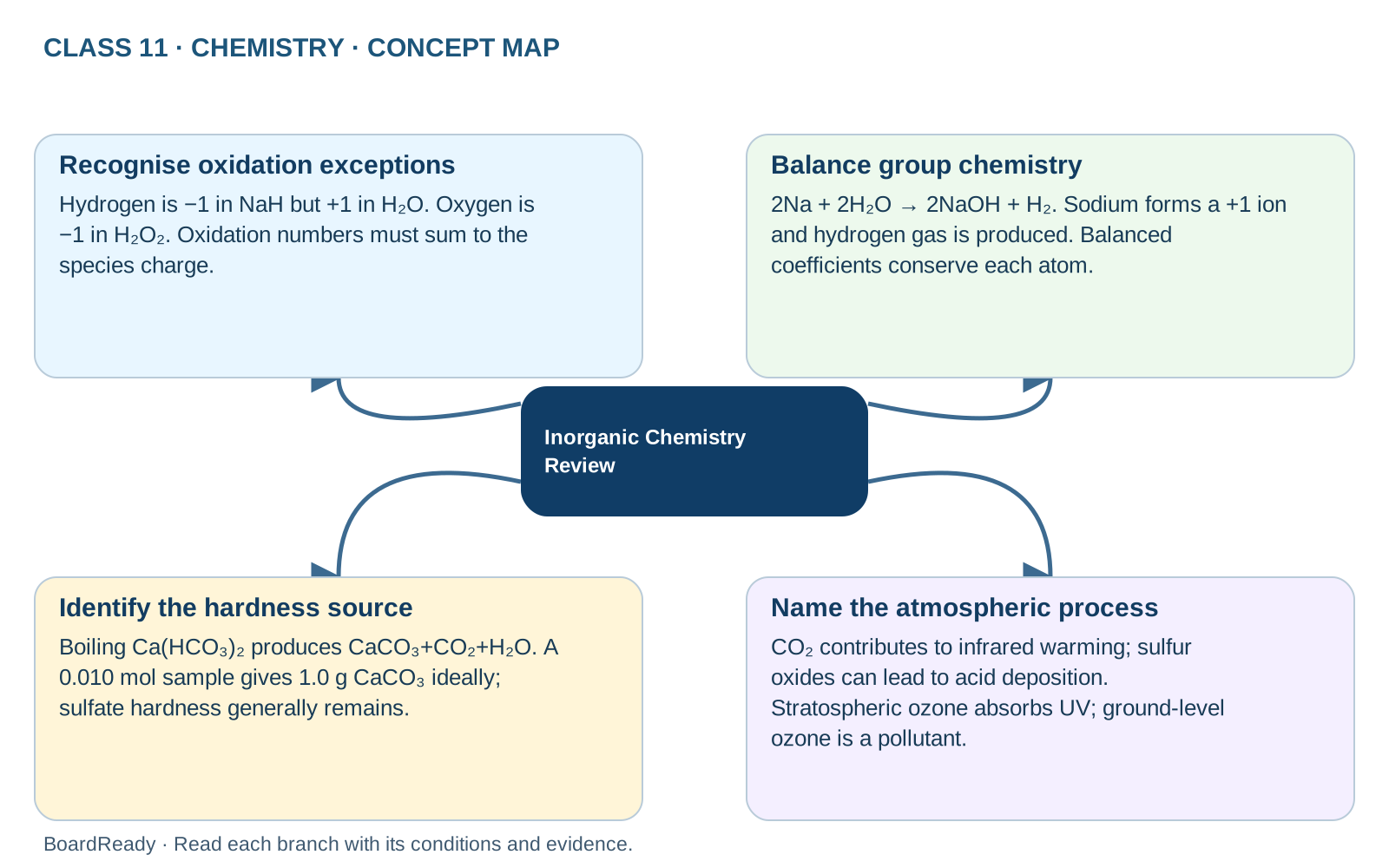
Connect representative compounds to electron bookkeeping, water chemistry and distinct atmospheric processes. Recognise oxidation exceptions: Hydrogen is −1 in NaH but +1 in H₂O. Oxygen is −1 in H₂O₂. Oxidation numbers must sum to the species charge. Balance group chemistry: 2Na + 2H₂O → 2NaOH + H₂. Sodium forms a +1 ion and hydrogen gas is produced. Balanced coefficients conserve each atom. Identify the hardness source: Boiling Ca(HCO₃)₂ produces CaCO₃+CO₂+H₂O. A 0.010 mol sample gives 1.0 g CaCO₃ ideally; sulfate hardness generally remains. Name the atmospheric process: CO₂ contributes to infrared warming; sulfur oxides can lead to acid deposition. Stratospheric ozone absorbs UV; ground-level ozone is a pollutant.Exam cue: Avoid universal group claims; identify the actual compound, oxidation state, conditions and environmental mechanism.
- 1Inorganic Chemistry Review -> Recognise oxidation exceptions: Hydrogen is −1 in NaH but +1 in H₂O. Oxygen is −1 in H₂O₂. Oxidation numbers must sum to the species charge.
- 2Inorganic Chemistry Review -> Balance group chemistry: 2Na + 2H₂O → 2NaOH + H₂. Sodium forms a +1 ion and hydrogen gas is produced. Balanced coefficients conserve each atom.
- 3Inorganic Chemistry Review -> Identify the hardness source: Boiling Ca(HCO₃)₂ produces CaCO₃+CO₂+H₂O. A 0.010 mol sample gives 1.0 g CaCO₃ ideally; sulfate hardness generally remains.
- 4Inorganic Chemistry Review -> Name the atmospheric process: CO₂ contributes to infrared warming; sulfur oxides can lead to acid deposition. Stratospheric ozone absorbs UV; ground-level ozone is a pollutant.