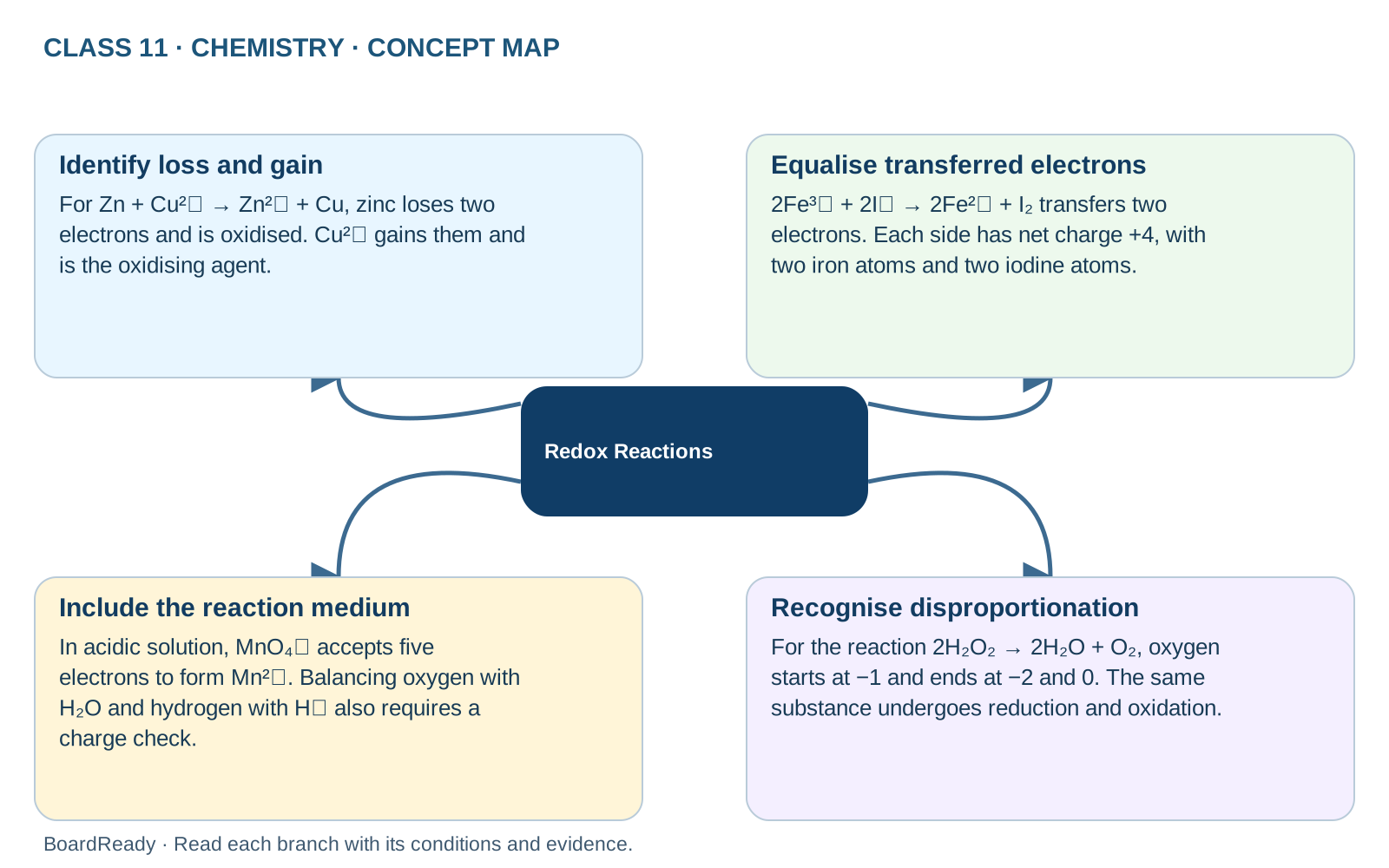
Comparison map
Redox Reactions: relationships and examples
Oxidation numbers and half-equations track the electron transfer while conserving atoms and net charge. Identify loss and gain: For Zn + Cu²⁺ → Zn²⁺ + Cu, zinc loses two electrons and is oxidised. Cu²⁺ gains them and is the oxidising agent. Equalise transferred electrons: 2Fe³⁺ + 2I⁻ → 2Fe²⁺ + I₂ transfers two electrons. Each side has net charge +4, with two iron atoms and two iodine atoms. Include the reaction medium: In acidic solution, MnO₄⁻ accepts five electrons to form Mn²⁺. Balancing oxygen with H₂O and hydrogen with H⁺ also requires a charge check. Recognise disproportionation: For the reaction 2H₂O₂ → 2H₂O + O₂, oxygen starts at −1 and ends at −2 and 0. The same substance undergoes reduction and oxidation.Exam cue: The oxidising agent is reduced. Balance atoms and charge, then use the electron ratio in quantitative work.
- 1Redox Reactions -> Identify loss and gain: For Zn + Cu²⁺ → Zn²⁺ + Cu, zinc loses two electrons and is oxidised. Cu²⁺ gains them and is the oxidising agent.
- 2Redox Reactions -> Equalise transferred electrons: 2Fe³⁺ + 2I⁻ → 2Fe²⁺ + I₂ transfers two electrons. Each side has net charge +4, with two iron atoms and two iodine atoms.
- 3Redox Reactions -> Include the reaction medium: In acidic solution, MnO₄⁻ accepts five electrons to form Mn²⁺. Balancing oxygen with H₂O and hydrogen with H⁺ also requires a charge check.
- 4Redox Reactions -> Recognise disproportionation: For the reaction 2H₂O₂ → 2H₂O + O₂, oxygen starts at −1 and ends at −2 and 0. The same substance undergoes reduction and oxidation.