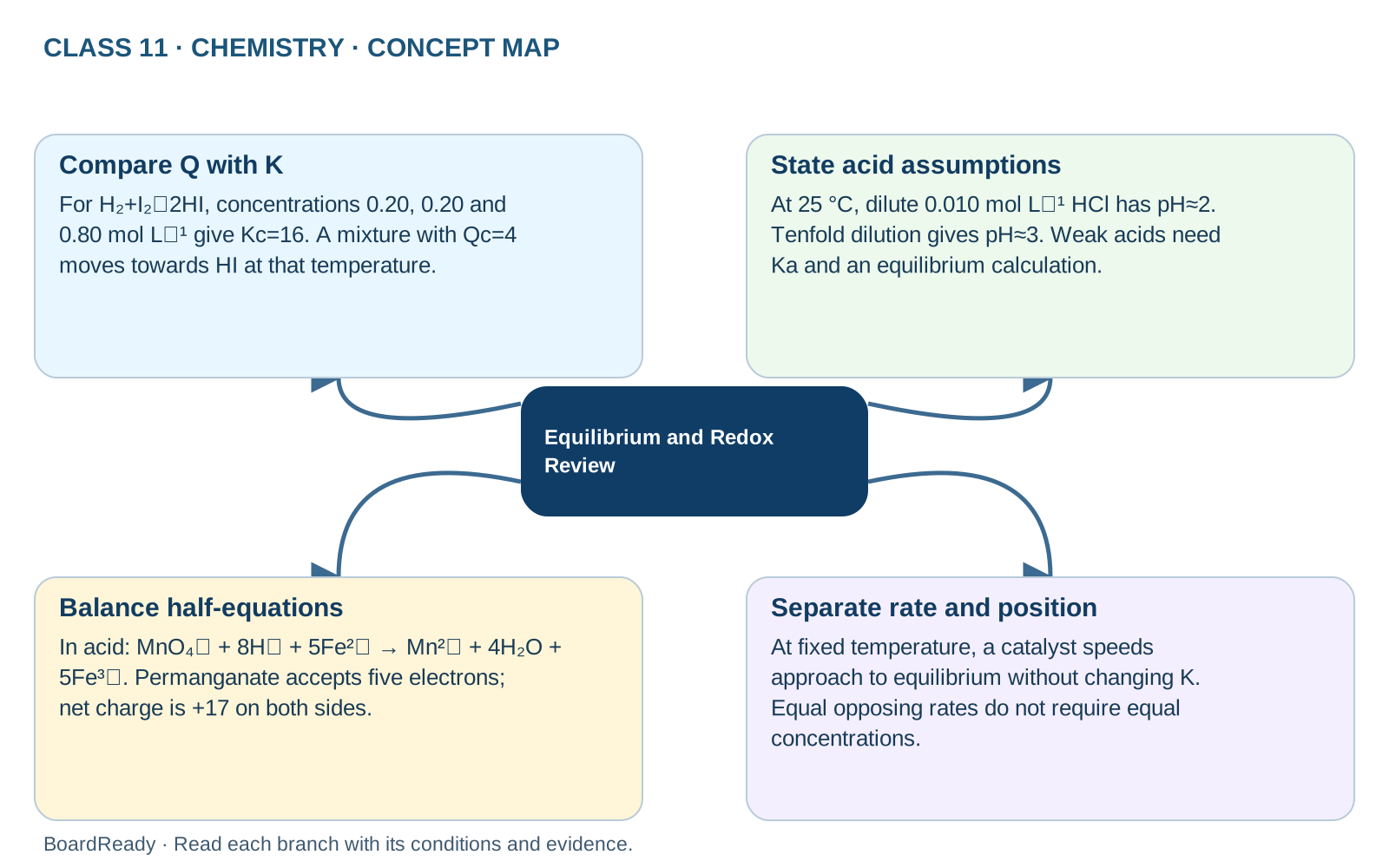
Comparison map
Equilibrium and Redox Review: relationships and examples
Equilibrium compares a current mixture with a temperature-dependent balance; redox conserves electrons, atoms and charge. Compare Q with K: For H₂+I₂⇌2HI, concentrations 0.20, 0.20 and 0.80 mol L⁻¹ give Kc=16. A mixture with Qc=4 moves towards HI at that temperature. State acid assumptions: At 25 °C, dilute 0.010 mol L⁻¹ HCl has pH≈2. Tenfold dilution gives pH≈3. Weak acids need Ka and an equilibrium calculation. Balance half-equations: In acid: MnO₄⁻ + 8H⁺ + 5Fe²⁺ → Mn²⁺ + 4H₂O + 5Fe³⁺. Permanganate accepts five electrons; net charge is +17 on both sides. Separate rate and position: At fixed temperature, a catalyst speeds approach to equilibrium without changing K. Equal opposing rates do not require equal concentrations.Exam cue: Balance first, state temperature, test approximations and check net charge as well as atoms.
- 1Equilibrium and Redox Review -> Compare Q with K: For H₂+I₂⇌2HI, concentrations 0.20, 0.20 and 0.80 mol L⁻¹ give Kc=16. A mixture with Qc=4 moves towards HI at that temperature.
- 2Equilibrium and Redox Review -> State acid assumptions: At 25 °C, dilute 0.010 mol L⁻¹ HCl has pH≈2. Tenfold dilution gives pH≈3. Weak acids need Ka and an equilibrium calculation.
- 3Equilibrium and Redox Review -> Balance half-equations: In acid: MnO₄⁻ + 8H⁺ + 5Fe²⁺ → Mn²⁺ + 4H₂O + 5Fe³⁺. Permanganate accepts five electrons; net charge is +17 on both sides.
- 4Equilibrium and Redox Review -> Separate rate and position: At fixed temperature, a catalyst speeds approach to equilibrium without changing K. Equal opposing rates do not require equal concentrations.