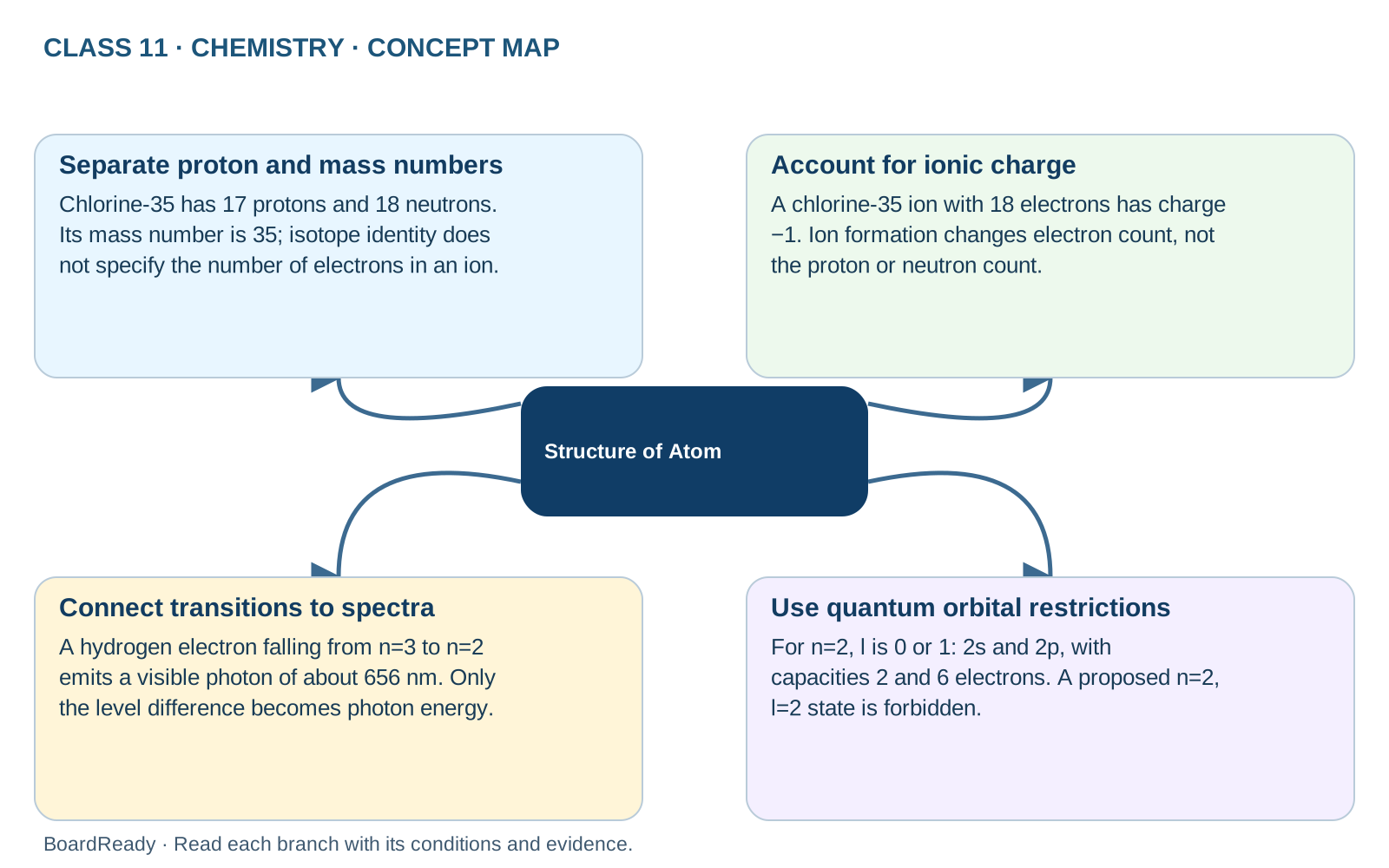
Comparison map
Structure of Atom: relationships and examples
Nuclear identity, electron arrangement and quantised energy describe different aspects of an atom. Separate proton and mass numbers: Chlorine-35 has 17 protons and 18 neutrons. Its mass number is 35; isotope identity does not specify the number of electrons in an ion. Account for ionic charge: A chlorine-35 ion with 18 electrons has charge −1. Ion formation changes electron count, not the proton or neutron count. Connect transitions to spectra: A hydrogen electron falling from n=3 to n=2 emits a visible photon of about 656 nm. Only the level difference becomes photon energy. Use quantum orbital restrictions: For n=2, l is 0 or 1: 2s and 2p, with capacities 2 and 6 electrons. A proposed n=2, l=2 state is forbidden.Exam cue: State whether a number describes the nucleus, the electron population, an orbital capacity or an energy difference.
- 1Structure of Atom -> Separate proton and mass numbers: Chlorine-35 has 17 protons and 18 neutrons. Its mass number is 35; isotope identity does not specify the number of electrons in an ion.
- 2Structure of Atom -> Account for ionic charge: A chlorine-35 ion with 18 electrons has charge −1. Ion formation changes electron count, not the proton or neutron count.
- 3Structure of Atom -> Connect transitions to spectra: A hydrogen electron falling from n=3 to n=2 emits a visible photon of about 656 nm. Only the level difference becomes photon energy.
- 4Structure of Atom -> Use quantum orbital restrictions: For n=2, l is 0 or 1: 2s and 2p, with capacities 2 and 6 electrons. A proposed n=2, l=2 state is forbidden.