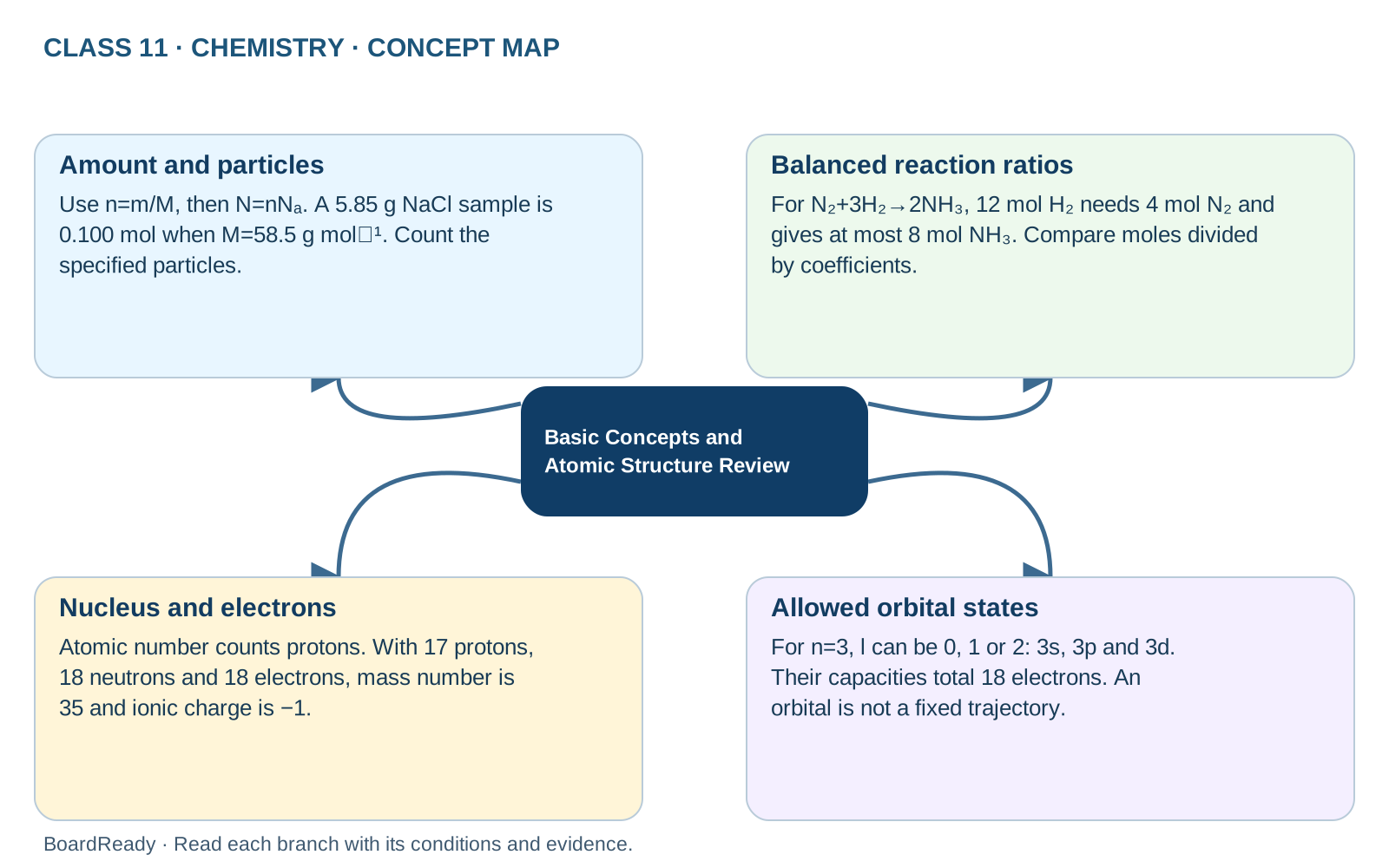
Comparison map
Basic Concepts and Atomic Structure Review: relationships and examples
Connect balanced amounts with the quantum description of atoms. Check units, electron count and the limits of each model. Amount and particles: Use n=m/M, then N=nNₐ. A 5.85 g NaCl sample is 0.100 mol when M=58.5 g mol⁻¹. Count the specified particles. Balanced reaction ratios: For N₂+3H₂→2NH₃, 12 mol H₂ needs 4 mol N₂ and gives at most 8 mol NH₃. Compare moles divided by coefficients. Nucleus and electrons: Atomic number counts protons. With 17 protons, 18 neutrons and 18 electrons, mass number is 35 and ionic charge is −1. Allowed orbital states: For n=3, l can be 0, 1 or 2: 3s, 3p and 3d. Their capacities total 18 electrons. An orbital is not a fixed trajectory.Exam cue: Keep mass, amount, particle count and charge distinct; state the assumptions behind an atomic model.
- 1Basic Concepts and Atomic Structure Review -> Amount and particles: Use n=m/M, then N=nNₐ. A 5.85 g NaCl sample is 0.100 mol when M=58.5 g mol⁻¹. Count the specified particles.
- 2Basic Concepts and Atomic Structure Review -> Balanced reaction ratios: For N₂+3H₂→2NH₃, 12 mol H₂ needs 4 mol N₂ and gives at most 8 mol NH₃. Compare moles divided by coefficients.
- 3Basic Concepts and Atomic Structure Review -> Nucleus and electrons: Atomic number counts protons. With 17 protons, 18 neutrons and 18 electrons, mass number is 35 and ionic charge is −1.
- 4Basic Concepts and Atomic Structure Review -> Allowed orbital states: For n=3, l can be 0, 1 or 2: 3s, 3p and 3d. Their capacities total 18 electrons. An orbital is not a fixed trajectory.